
TEG Dehydration Maintenance: A Comprehensive Guide for Gas Processing Efficiency
- Jul 5
- 11 min read
With triethylene glycol prices reaching as high as $1.56 per kilogram in early 2026, treating your glycol as a consumable rather than a fixed asset is a costly operational oversight. Many operators accept frequent chemical replacements and unexpected foaming as unavoidable burdens, but these issues are usually symptoms of a neglected system. Professional TEG dehydration maintenance is not just about basic upkeep; it's about maximizing the chemical integrity of your medium to protect your entire mechanical infrastructure.
It's a common struggle to meet dew point specifications while facing the constant threat of pump failure or regulatory scrutiny under the latest EPA NESHAP Subpart HH proposals. You need a strategy that ensures operational uptime and avoids the high cost of glycol waste. This article teaches you how to optimize your dehydration unit performance, reduce chemical costs, and restore triethylene glycol purity without production shutdowns. We'll explore technical protocols for vacuum distillation reclamation, pump repair, and system commissioning to keep your facility running at peak efficiency.
Table of Contents
The Fundamentals of TEG Dehydration Maintenance
Effective TEG dehydration maintenance is a technical discipline that integrates mechanical restoration with chemical purity management. It isn't a reactive checklist performed only when equipment fails. Instead, it's a proactive strategy designed to protect the integrity of the dehydration loop. When an operator neglects the holistic health of the system, the ability of the triethylene glycol to absorb moisture diminishes. This failure directly impacts the facility's capacity to achieve required dew point depression, leading to contaminated gas and accelerated equipment wear.
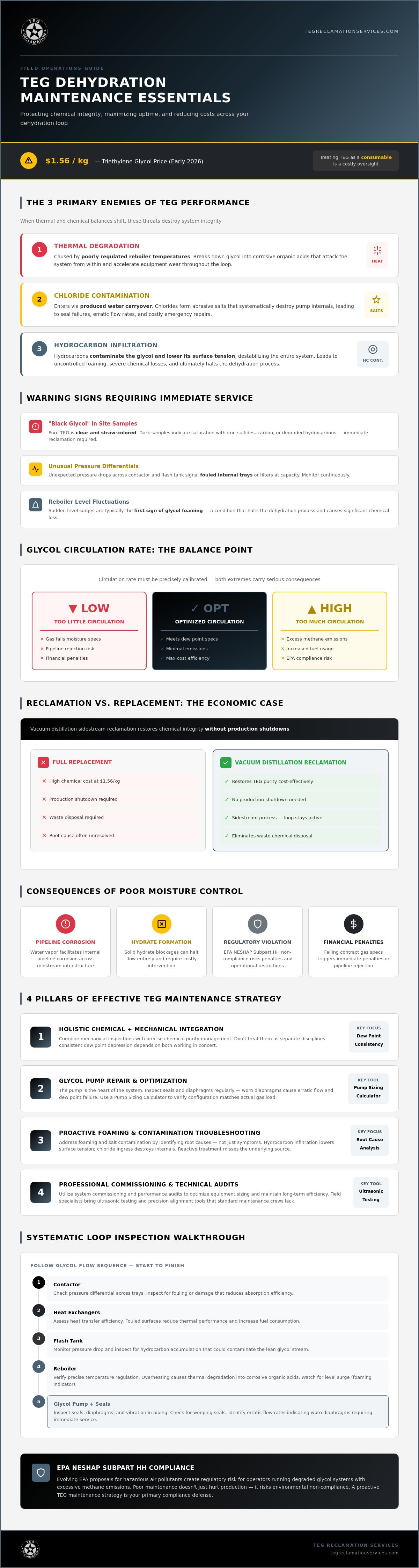
The Glycol dehydration process depends on precise thermal and chemical balances. If these balances shift, the unit faces three primary enemies that compromise performance. Thermal degradation occurs when reboiler temperatures are poorly regulated, breaking down the glycol into corrosive organic acids. Chlorides enter the system through produced water carryover, forming abrasive salts that destroy pump internals. Hydrocarbons act as the third threat, contaminating the glycol and lowering its surface tension until the system becomes unstable. Poor maintenance doesn't just hurt production; it risks environmental non-compliance under evolving EPA standards for hazardous air pollutants.
Why Maintenance Frequency Matters for Gas Quality
Moisture in the gas stream is an immediate threat to midstream infrastructure. Water vapor facilitates internal pipeline corrosion and triggers the formation of hydrates, which are solid blockages that can halt flow entirely. Regular maintenance ensures that glycol circulation rates remain optimized for absorption efficiency. If circulation is too low, the gas won't meet moisture specifications. If it's too high, the facility suffers from increased methane emissions and unnecessary fuel consumption. Missing contract gas specifications often results in immediate financial penalties or the rejection of gas by downstream pipelines.
Signs Your Dehydration Unit Needs Immediate Service
Mechanical and visual cues often provide early warnings of system distress. Pure triethylene glycol is a clear, straw-colored liquid. If your site samples show "black glycol," the medium is saturated with iron sulfides, carbon, or degraded hydrocarbons that require immediate reclamation. You should also track pressure differentials across the contactor and flash tank. Unusual pressure drops typically indicate that internal trays are fouled or that filters have reached their capacity. Finally, keep a close watch for sudden level fluctuations in the reboiler. These surges are often the first sign of glycol foaming, which effectively stops the dehydration process and causes significant chemical loss.
Mechanical Integrity: Maintaining Critical DEHY Components
A rigorous inspection routine for the dehydration loop prevents minor mechanical wear from escalating into a total facility shutdown. While chemical purity is vital, the physical infrastructure must be capable of supporting the high-pressure and high-temperature demands of the process. Effective TEG dehydration maintenance requires a focus on the moving parts that circulate the medium and the heat-transfer surfaces that facilitate regeneration. Neglecting these components leads to internal leaks, reduced heat efficiency, and an increased emissions profile.
Operators should establish a systematic walkthrough that begins at the contactor and follows the glycol flow through the heat exchangers, flash tank, and reboiler. Identifying vibration in piping or weeping seals early can save thousands in emergency repair costs. For complex mechanical troubleshooting, utilizing specialized field services ensures that the root cause is addressed rather than just the symptoms. These experts bring tools for ultrasonic testing and precision alignment that standard maintenance crews often lack.
Kimray Pump Repair and Optimization
The glycol circulation pump is the heart of the dehydration unit. Regular inspection of seals and diaphragms is mandatory, as these high-wear items are the most frequent points of failure. Worn diaphragms cause erratic flow rates, which directly prevents the system from meeting dew point specifications. To ensure the pump is operating within its design parameters, operators should utilize a Glycol Pump Sizing Calculator. This tool helps determine if the current pump configuration matches the actual gas flow and moisture load of the facility. If performance lags, professional Kimray pump repair and service provides a cost-effective alternative to full replacement, restoring factory-spec tolerances on-site.
Reboiler and Burner Management
The reboiler is the most high-stakes component in the loop. Fire tubes must be inspected periodically for carbon buildup and "hot spots," which are localized areas of intense heat that cause rapid thermal degradation of the glycol. As noted by the EPA on Glycol Dehydrators, optimizing these systems is also critical for reducing methane and VOC emissions. Integrating an automated Burner Management System (BMS) ensures that the reboiler operates within a safe temperature range, preventing the glycol from reaching its decomposition point. Additionally, implementing DEHY equipment upgrades, such as advanced BTEX elimination systems, significantly improves both environmental compliance and site safety by capturing hazardous vapors before they reach the atmosphere.
Replacing triethylene glycol (TEG) remains one of the most significant recurring expenses for midstream operators. With market prices in the United States recorded between $1.44 and $1.56 per kilogram in early 2026, the financial impact of a full system recharge is substantial. Traditional replacement strategies also incur high costs for hazardous waste disposal and complex logistical coordination. Sustainable TEG dehydration maintenance shifts this paradigm by prioritizing Vacuum Distillation Glycol Reclamation over the costly "drain and refill" cycle.
Sidestream vacuum distillation is the industry's most effective method for purity restoration. It allows operators to restore contaminated TEG to over 98% purity, matching the performance of virgin chemical stock. This approach addresses the root cause of efficiency loss by stripping out the accumulated contaminants that standard mechanical filters leave behind. The results are immediate. According to TEG Dehydration Fundamentals, maintaining high glycol concentration is a primary factor in minimizing emissions and maximizing water removal capacity.
The Process of Vacuum Distillation
The science of vacuum distillation involves separating glycol from its contaminants by utilizing differences in boiling points. This method effectively removes heat-stable salts, heavy hydrocarbons, and organic acids that would otherwise accelerate equipment degradation. By operating under a vacuum, the system significantly lowers the boiling point of the glycol, which prevents the secondary thermal degradation that often occurs during atmospheric regeneration. Because the reclamation equipment functions as a sidestream loop, it enables continuous gas production while the purification process is underway.
Environmental and Economic Benefits of Reclamation
Choosing reclamation over replacement provides immediate relief to both operational budgets and environmental compliance teams. It drastically reduces the volume of hazardous waste that must be managed on-site, which simplifies reporting and lowers disposal fees. Economically, the savings from avoiding large-scale glycol purchases often exceed the cost of the reclamation service itself. Beyond the immediate chemical savings, purified glycol is less corrosive to internal metallurgy. This cleaner medium extends the service life of mechanical seals and pump components, reducing the frequency of Kimray pump repair and service requirements across the facility.
Troubleshooting Operational Challenges: Foaming and Contamination
Operational disruptions in gas processing often manifest as acute foaming or unexplained chemical loss. While many operators rely on anti-foam agents to manage these symptoms, professional TEG dehydration maintenance requires a deeper diagnostic approach to identify the underlying contaminants. Foaming is rarely a standalone issue; it's typically the result of accumulated surfactants, suspended solids, or dissolved salts that alter the glycol's surface tension. When these contaminants reach critical levels, the system's ability to separate gas from the liquid medium fails, leading to massive glycol carryover into the downstream pipeline.
Addressing these challenges necessitates a comprehensive Chemical Flushing protocol. This process removes stubborn deposits of iron sulfide and carbon that adhere to contactor trays and heat exchanger surfaces. Without regular flushing, these deposits create stagnant zones that harbor corrosive agents. A precise diagnostic framework is also essential for identifying thermal degradation. This involves measuring the glycol’s pH and neutralization number to quantify the concentration of organic acids. As glycol breaks down, it produces sludge and polymers that coat heat-transfer surfaces, reducing the thermal efficiency of the reboiler. Routine maintenance must include these chemical analyses to prevent a total system collapse.
Managing Glycol Foaming and Hydrocarbon Carryover
Anti-foam agents provide temporary relief but don't eliminate the root cause of contamination. Overusing these chemicals can actually worsen the problem by adding more organic load to the system. If foaming persists, check the mechanical operation of the flash tank. Adjusting the residence time or liquid levels can facilitate better hydrocarbon separation, but the primary defense remains the inlet separator. A well-maintained inlet separator prevents the entry of liquid hydrocarbons and produced water, which are the leading precursors to glycol instability and foaming events.
Acid Neutralization and Chloride Removal
The formation of organic acids is a byproduct of glycol oxidation and thermal stress. These acids lower the pH of the medium, making it aggressively corrosive toward the reboiler and internal piping. While standard filtration captures large solids, it cannot remove dissolved chlorides that enter via produced water carryover. Chloride levels above 100 ppm can significantly accelerate stress corrosion cracking in stainless steel components. Removing these dissolved salts requires specialized vacuum distillation techniques that separate the pure glycol from the ionic contaminants. To restore your system's stability, schedule a professional Chemical Flushing and reclamation service to eliminate these corrosive threats and restore chemical balance.
Optimizing System Performance: Commissioning and Technical Support
Precision during the initial startup or revamp of a midstream facility dictates the long-term reliability of the entire process loop. Professional DEHY system commissioning is the definitive step where design parameters meet operational reality. Without an expert transition from construction to production, even the most advanced equipment can suffer from immediate efficiency losses. Integrating TEG dehydration maintenance into the commissioning phase ensures that the system is calibrated to handle specific gas compositions and flow rates from day one, preventing the premature degradation of the glycol medium.
Technical field inspections and regular performance audits provide the data necessary to make informed operational decisions. These audits identify subtle shifts in temperature differentials or pressure drops that signal the onset of fouling or mechanical wear. By utilizing specialized technical support, midstream operators reduce the diagnostic burden on internal maintenance teams who may lack the specific tools for high-level chemical analysis or vacuum distillation troubleshooting. In a volatile energy market, this proactive approach serves as a strategic advantage, ensuring that production remains continuous and that the facility avoids the catastrophic costs of unplanned downtime.
DEHY System Commissioning Best Practices
Successful commissioning begins with rigorous pressure testing and system cleaning to remove construction debris, mill scale, or preservative oils. Once the mechanical integrity is verified, the system is charged with high-purity triethylene glycol. It's critical to collect baseline data during this phase, including circulation rates, reboiler fuel gas consumption, and initial glycol purity levels. This data acts as a benchmark for all future performance evaluations. Proper initial sizing is also verified here; using a Glycol Pump Sizing Calculator ensures the circulation rate matches the moisture load, which prevents the over-circulation issues that lead to excessive methane emissions.
Leveraging Technical Field Services
On-site specialists bring a level of technical integrity that standard maintenance protocols often miss. These experts perform complex troubleshooting on burner management systems and high-pressure contactors, identifying root causes that aren't visible to the naked eye. Regular Chemical Flushing and cleaning services are essential components of this support, as they remove the internal deposits that lead to localized corrosion and heat-transfer failure. These proactive measures ensure that the mechanical infrastructure remains in factory-spec condition throughout its lifecycle. Optimize your dehydration efficiency today with TEG Reclamation Services to secure your facility's operational uptime.
Securing Long-Term Operational Continuity in Gas Processing
Achieving peak gas processing efficiency requires a shift from reactive repairs to a disciplined strategy for TEG dehydration maintenance. By prioritizing the chemical integrity of your glycol and maintaining mechanical tolerances in pumps and reboilers, you eliminate the root causes of foaming and dew point failures. The integration of advanced vacuum distillation and professional commissioning protocols ensures that your facility remains compliant with evolving environmental standards while protecting your bottom line. These technical practices transform the dehydration unit from a frequent bottleneck into a reliable asset.
Leveraging over 45 years of experience in oil and gas process equipment allows for the restoration of system health without the need for production interruptions. Proprietary sidestream vacuum distillation technology restores contaminated glycol to over 98% purity, providing a sustainable alternative to costly chemical replacement. These specialized on-site services provide the technical integrity required to maintain continuous production in a demanding industrial environment. High-purity glycol reduces internal corrosion and stabilizes the entire dehydration loop.
Restore your glycol purity and DEHY efficiency with TEG Reclamation Services to ensure your facility operates at maximum capacity. Protecting your infrastructure today secures your operational success for years to come.
Frequently Asked Questions
How often should TEG dehydration maintenance be performed?
Monthly inspections are the standard for basic system parameters, while a comprehensive TEG dehydration maintenance audit should occur at least once per year. High throughput facilities or those processing gas with high liquid carryover may require more frequent technical field inspections. Consistent monitoring of glycol pH and concentration levels allows operators to identify early signs of thermal degradation before they result in a total system shutdown.
What causes triethylene glycol to turn black, and can it be fixed?
Triethylene glycol turns black due to the accumulation of iron sulfide, carbon particles, or heavy hydrocarbon contamination. This discoloration is a clear indicator that the medium's chemical integrity is compromised. Professional vacuum distillation reclamation can restore this black glycol to over 98% purity, effectively removing the sub-micron contaminants that standard mechanical filters cannot capture during the normal circulation loop.
Can glycol be reclaimed while the dehydration unit is still in operation?
Yes, sidestream reclamation allows the dehydration unit to remain in full operation while the glycol is purified. The reclamation equipment connects to the system loop and processes a portion of the glycol stream continuously. This approach eliminates the need for production shutdowns, ensuring that the facility maintains its gas flow and contract specifications throughout the entire purification process.
What is the difference between mechanical filtration and vacuum distillation?
Mechanical filtration only removes suspended solids and large particulates from the glycol stream. In contrast, vacuum distillation operates at the molecular level to separate the pure glycol from dissolved contaminants such as salts, organic acids, and heavy hydrocarbons. While filters are necessary for daily upkeep, distillation is the only method that restores the chemical purity required for long-term operational efficiency.
Is it more cost-effective to reclaim glycol or buy new chemicals?
Reclaiming existing glycol is significantly more cost-effective than purchasing new chemicals, especially with early 2026 prices reaching as high as $1.56 per kilogram. Reclamation eliminates the high costs associated with hazardous waste disposal and the logistics of transporting large volumes of new chemical stock. Operators typically see a full return on investment by avoiding the combined expense of replacement and waste management fees.
What are the most common causes of glycol pump failure in DEHY units?
Most glycol pump failures result from abrasive solids in the glycol stream or improper pump sizing. Particulates like iron sulfide act as sandpaper on internal seals and diaphragms, causing rapid wear and loss of prime. Utilizing a glycol pump sizing calculator ensures that the hardware matches the actual flow requirements, preventing the mechanical stress associated with over-circulation or high-speed operation during the dehydration process.
How do chlorides affect the efficiency of a dehydration system?
Chlorides enter the system through produced water carryover and cause severe internal corrosion and salt accumulation. When chloride levels exceed 100 ppm, they significantly increase the risk of stress corrosion cracking in stainless steel components. These dissolved salts also coat heat-transfer surfaces in the reboiler, reducing thermal efficiency and leading to localized hot spots that accelerate glycol degradation and increase fuel consumption.
Can on-site reclamation help meet environmental emission standards?
On-site reclamation is a critical tool for meeting the EPA's April 2026 proposed NESHAP standards for hazardous air pollutants. Maintaining high glycol purity ensures that the dehydration process remains efficient, which reduces the methane and VOC emissions typically caused by over-circulation or poor absorption. Cleaner glycol allows the regenerator still vent to operate within tighter environmental compliance limits without requiring frequent system blowdowns.


Comments