
Glycol Reconditioning Service: Restoring TEG Purity for Oil & Gas Operations
Updated: Jul 8
What if you could restore your triethylene glycol to virgin-level purity without ever turning off your dehydration unit? Most operators accept production shutdowns and expensive chemical replacements as an unavoidable cost of maintaining gas quality. You understand that contaminated TEG leads to reduced dehydration efficiency and eventual equipment damage from salt or chloride buildup. Utilizing a professional glycol reconditioning service allows you to break this cycle of reactive maintenance. This specialized process targets the contaminants that compromise your system; it ensures your operations remain online while your fluids return to optimal performance.
It's possible to achieve 98% or higher glycol purity while maintaining full production capacity. This article explores how industrial reconditioning eliminates the need for costly fluid disposal and protects your DEHY system from the long-term effects of accumulation. You'll learn how this tactical maintenance strategy restores efficiency, extends equipment lifespan, and provides a clear path to operational continuity. We focus on the proven results of high-tech restoration, helping you maintain peak dehydration standards without the burden of traditional chemical overhead or the risks of wet gas entering your lines.
Table of Contents
What is Glycol Reconditioning for Gas Dehydration?
Glycol reconditioning is the comprehensive mechanical and chemical restoration of triethylene glycol to its original technical specifications. Unlike simple filtration, which only removes suspended solids, a professional glycol reconditioning service addresses the molecular integrity of the fluid. It removes dissolved contaminants that standard particulate filtration cannot touch. Glycol dehydration relies on the hygroscopic nature of high-purity TEG to pull water vapor from natural gas streams. When the glycol becomes saturated with chlorides, salts, and heavy hydrocarbons, its ability to achieve necessary dew point depression drops significantly. This failure leads to "wet gas" that fails to meet pipeline specifications and increases the risk of downstream corrosion.
The process of reconditioning focuses on the removal of primary contaminants that accumulate during normal operations. Chlorides and salts often enter the system through production fluids, while heavy hydrocarbons can condense in the contactor. Thermal degradation byproducts, such as organic acids, are dangerous because they lower the pH of the glycol and accelerate the corrosion of steel vessels and piping. Reconditioning effectively strips these impurities, returning the chemical to a state where it can perform its primary function without damaging the infrastructure.
Triethylene Glycol (TEG) vs. Other Glycols
TEG is the preferred desiccant in the oil and gas industry because of its high boiling point and low vapor pressure. These properties allow for effective water absorption at high temperatures with minimal chemical loss. However, TEG is highly susceptible to thermal degradation if the reboiler temperature isn't managed precisely. This degradation produces carbonaceous solids, often resulting in "black glycol" that fouls contactors and heat exchangers. To maintain peak dehydration efficiency and prevent equipment fouling, TEG purity must remain above 98% throughout the entire circulation loop.
The Economic Impact of Contaminated Glycol
Ignoring the health of your glycol chemistry creates a cascade of mechanical and financial failures. Contaminated fluids often lead to persistent foaming in the contactor, which causes glycol carryover and the loss of expensive chemicals into the gas stream. Salts and chlorides act as abrasives, causing premature wear on internal pump components and seals. This often necessitates frequent pump repair or total system flushing. Beyond the direct cost of new chemicals, facilities face significant expenses from hazardous waste disposal and the risk of delivering off-spec gas to midstream pipelines. Utilizing a glycol reconditioning service mitigates these risks by maintaining fluid integrity without requiring a total system shutdown for chemical replacement.
The Science of Sidestream Vacuum Distillation
Most industrial maintenance routines require a total system shutdown, resulting in lost revenue and operational delays. A professional glycol reconditioning service avoids this by utilizing a sidestream approach. By drawing a small percentage of the glycol inventory into a specialized loop, the process purifies the fluid while the main dehydration unit remains fully active. This ensures that gas processing continues without interruption while the chemical inventory undergoes comprehensive restoration. It's a pragmatic solution for facilities that cannot afford even a few hours of downtime.
The core of this restoration is vacuum distillation. By reducing the atmospheric pressure within the reclamation unit, the boiling point of triethylene glycol is lowered significantly. This allows for the precise separation of pure TEG from dissolved contaminants that possess higher boiling points, such as salts and chlorides. These impurities are often impossible for traditional mechanical filters to capture. Removing these dissolved solids is critical to preventing scale buildup and adhering to environmental regulations for glycol dehydrators, as cleaner systems operate with higher efficiency and lower emissions.
Beyond particulate and salt removal, the reconditioning process addresses the chemical stability of the fluid. Over time, thermal stress creates organic acids that lower the glycol's pH, making the fluid corrosive to system metallurgy. The reconditioning cycle neutralizes these acids and restores the proper pH balance, protecting your contactors and reboilers from localized pitting. If your system shows signs of accelerated wear, it's often more effective to consult with a specialist regarding chemical restoration than to simply replace the fluid.
Achieving 98%+ Purity On-Site
Technical benchmarks for reclaimed glycol meet or exceed 98% purity, effectively matching the performance of virgin chemicals. The distillation process is engineered to handle high-boiling point contaminants that degrade dehydration performance. By returning the TEG to this high level of purity, operators ensure consistent dew point depression. This prevents water from condensing in the pipeline and ensures compliance with strict midstream delivery requirements.
The Role of Technical Field Services
Restoring glycol on-site requires highly specialized equipment and a deep understanding of distillation physics. It's not a basic filtration task. Technical field services provide real-time monitoring of fluid chemistry and process temperatures throughout the reclamation cycle. This expertise is particularly valuable during DEHY system commissioning, where starting with a clean, optimized chemical inventory prevents future mechanical failures and maximizes equipment lifespan.
Reconditioning vs. Replacement: A Cost-Benefit Analysis
Many operators view chemical replacement as a standard maintenance cost. However, a deeper analysis of Total Cost of Ownership (TCO) reveals significant hidden expenses associated with the "flush and refill" method. When you opt for a professional glycol reconditioning service, you're investing in the longevity of your existing chemical assets rather than just purchasing a commodity. This approach eliminates the logistical burden of transporting thousands of gallons of virgin TEG to remote locations. It also removes the immediate need for hazardous waste disposal, which often carries high regulatory and financial overhead.
Maintaining fluid health is not just about cost; it's about operational integrity. According to the U.S. Environmental Protection Agency on glycol dehydration, optimizing circulation and regeneration is vital for minimizing emissions and ensuring system efficiency. Reconditioning supports these goals by removing the contaminants that force operators to increase circulation rates. This reduces energy consumption and limits the physical wear on reboilers and Kimray pumps. Purified glycol flows more efficiently, preventing the abrasive damage caused by salt crystallization and carbonized solids.
The most substantial financial variable remains the "shutdown cost." A full system replacement requires the facility to cease gas processing, leading to a total loss of revenue for the duration of the maintenance window. In contrast, sidestream reconditioning occurs while the plant remains online. For high-volume midstream facilities, the revenue preserved by avoiding a 24-hour shutdown often exceeds the entire cost of the reconditioning service itself. It's a pragmatic choice for managers who prioritize uptime as their primary metric of success.
Eliminating Production Shutdowns
Sidestream reclamation is engineered to integrate seamlessly with your existing DEHY unit footprint. Because the process draws from the active inventory, there's no need to drain the contactor or depressurize the system. This mitigates the mechanical risks associated with thermal cycling and complex restart procedures. It's a safer, more predictable way to manage fluid chemistry without the volatility of a full system restart. You maintain your production targets while we restore your chemical purity in the background.
Environmental and Regulatory Advantages
Extending the life of your glycol inventory is a core component of industrial waste minimization. By restoring TEG to 98% purity, you reduce the carbon footprint of your facility by decreasing the demand for new chemical manufacturing and transport. This proactive fluid management aligns with internal sustainability goals and regional environmental protocols. Additionally, maintaining high glycol purity ensures that your flash tanks and BTEX systems operate at peak efficiency, further reducing volatile organic compound emissions across the site.
For organizations looking to extend these sustainability efforts to their facility's water systems, Hydrokube offers an ecological CO2-based water softening solution that avoids the environmental impact of traditional salt-based systems.
Signs Your Facility Needs Glycol Reconditioning
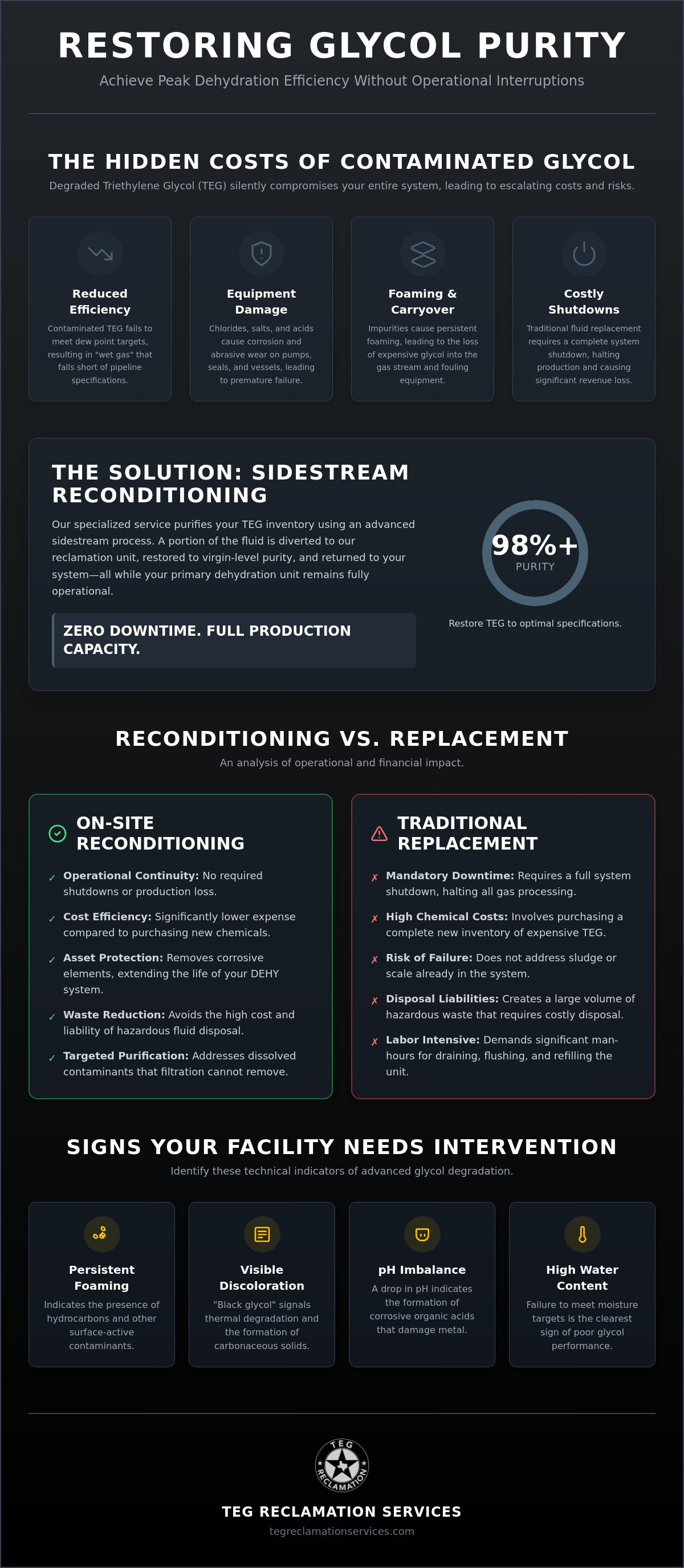
Identifying the precise moment to schedule a glycol reconditioning service is essential for preventing catastrophic system failure. Fluid degradation is rarely a sudden event; it is a cumulative process where contaminants slowly compromise the mechanical integrity of your dehydration unit. Operators must remain vigilant for specific indicators that the triethylene glycol (TEG) is no longer capable of performing its primary function. If these signs are ignored, the cost of repair often far exceeds the cost of proactive restoration.
Watch for the following operational red flags in your facility:
Persistent Foaming: If foaming in the contactor or flash tank continues despite the addition of anti-foam chemicals, it usually indicates a high concentration of suspended solids or liquid hydrocarbons.
Fluid Discoloration: TEG should maintain a clear, straw-colored appearance. A transition to "black glycol" is a definitive sign of thermal degradation and the presence of carbonized solids.
Salt Precipitation: Visible salt crystals in the reboiler or high chloride counts in lab reports suggest that the glycol is saturated and can no longer hold dissolved solids in suspension.
Dew Point Instability: An inability to meet gas moisture specifications, even with increased circulation rates, suggests the glycol has lost its hygroscopic efficiency.
Pump and Seal Failure: Frequent Kimray pump leaks or internal component wear are often caused by the abrasive nature of contaminated, "dirty" glycol.
If your facility exhibits these symptoms, you should contact TEG Reclamation Services for a professional fluid assessment and reconditioning plan.
Interpreting Glycol Analysis Reports
Professional lab analysis provides the technical roadmap for restoration. Key metrics like pH levels and iron concentration are critical; a low pH indicates the presence of organic acids that will eventually eat through steel vessels. High iron counts often follow a drop in pH, signaling active corrosion within the system. Immediate reclamation becomes mandatory when chloride concentrations reach levels that trigger salt precipitation in the reboiler, as this creates a thermal barrier on the firetube.
Troubleshooting DEHY Performance
Distinguishing between mechanical failure and chemical contamination is a vital skill for field operators. Poor burner management system efficiency can often be traced back to fouled firetubes caused by degraded glycol. Before assuming a pump is undersized, utilize a glycol pump sizing calculator to verify the system balance against current gas volumes. When the math confirms the pump is sized correctly yet the gas remains wet, the issue is almost certainly the purity of the TEG inventory itself.
TEG Reclamation Services: The Industrial Standard
TEG Reclamation Services has established an industrial standard through more than 45 years of specialized process equipment expertise. This longevity is built on a foundation of technical integrity and a no-nonsense approach to field troubleshooting. Our team operates as an elite specialist in the oil and gas sector, providing proprietary vacuum distillation units specifically engineered for high-stakes production environments. These units are not generic chemical processors; they are purpose-built tools designed to restore triethylene glycol while maintaining the highest safety standards. We don't just treat the fluid. We provide a comprehensive glycol reconditioning service that addresses the entire dehydration loop, from initial DEHY commissioning to sophisticated BTEX system upgrades.
Our technical support is rooted in a deep understanding of the mechanical and chemical variables that dictate system health. We approach every project as a guardian of equipment longevity, focusing on solving complex problems that others might overlook. This proactive stance ensures that your facility remains compliant with environmental standards while maximizing uptime. Whether you're dealing with a new installation or a legacy system that's suffered from years of contamination, our field specialists possess the unique tools and skills required to bring your operations back to peak efficiency. We lead with experience and technical proof, ensuring that every restoration project results in a measurable improvement in dehydration performance.
Our On-Site Reclamation Process
The on-site reclamation process is methodical and transparent. It begins with a strategic equipment setup that integrates into your existing infrastructure via a sidestream loop. This allows the glycol reconditioning service to proceed without disrupting gas production or requiring a system depressurization. Throughout the cycle, our technicians perform purity verification to ensure the fluid meets the 98% purity benchmark. Safety remains our primary directive. All operations strictly comply with national oil and gas regulations and site-specific safety protocols. Upon completion, we provide a comprehensive technical report documenting the restoration of the fluid's chemical and physical properties, providing a clear audit trail for your maintenance records.
Beyond Reclamation: Total DEHY Support
Equipment health requires more than just clean chemistry. When systems are heavily fouled with carbonized solids or salt cakes, we provide chemical flushing and mechanical cleaning to restore internal surfaces. This is often a necessary precursor to reclamation in neglected systems. Our expertise extends to critical mechanical components, including Kimray pump repair and sizing services. Utilizing our pump sizing tools ensures your circulation rates are optimized for your specific gas volume and moisture load. This holistic approach prevents the mechanical bottlenecks that often negate the benefits of pure glycol. Optimize your dehydration efficiency with TEG Reclamation Services to ensure your facility maintains operational continuity and peak performance.
Secure Your Operational Continuity
Maintaining dehydration efficiency requires a shift from reactive chemical replacement to strategic fluid management. Utilizing a professional glycol reconditioning service allows you to leverage over 45 years of industrial expertise while keeping your facility fully operational. Our proprietary vacuum distillation technology restores your triethylene glycol to 98% purity or higher. This process effectively eliminates the logistical and financial burdens of a total system shutdown, ensuring your production targets remain on schedule. By prioritizing the health of your chemical inventory, you protect your reboilers and Kimray pumps from the long-term effects of salt accumulation and thermal degradation.
We provide the technical proof and on-site support necessary to ensure your gas streams meet every delivery specification. Our commitment to technical integrity means we focus on results that extend the lifespan of your mechanical assets. You don't have to accept wet gas or frequent maintenance intervals as the cost of doing business. Request a Technical Consultation for Your Glycol System and discover how our specialized restoration process can optimize your dehydration unit. We look forward to helping your facility achieve peak performance and long-term mechanical health.
Just as maintaining your equipment's health is vital for production efficiency, prioritizing personal wellness is essential for the team behind the operations; for those seeking metabolic health support, you can buy compounded tirzepatide online from providers like My NuEra Rx to help achieve long-term weight management goals.
Frequently Asked Questions
How often should triethylene glycol be reconditioned?
Reconditioning frequency depends entirely on the contamination rate and specific operational conditions of your dehydration unit. Most facilities establish a reliable baseline through semi-annual or annual laboratory analysis. If your technical reports show rising chloride levels or a significant drop in pH, immediate service is necessary to prevent equipment damage. Proactive monitoring prevents the accumulation of thermal degradation byproducts that eventually foul heat exchangers and contactors.
Can you remove chlorides from glycol on-site?
Yes, our specialized process removes dissolved chlorides and salts directly at your facility. Traditional mechanical filters are incapable of capturing dissolved solids; however, vacuum distillation effectively separates pure TEG from these contaminants. This on-site capability prevents the need for expensive fluid replacement and hazardous waste transport. It ensures your system remains protected from the corrosive effects of salt precipitation in the reboiler.
What is the difference between glycol reclamation and simple filtration?
Simple filtration only removes suspended particulates and solid debris from the fluid stream. In contrast, a professional glycol reconditioning service utilizes vacuum distillation to restore the chemical's molecular purity. This process removes dissolved salts, organic acids, and heavy hydrocarbons that pass through standard filters. While filtration keeps the fluid clear, reconditioning restores the actual dehydration efficiency of the triethylene glycol.
Does the reconditioning process require a production shutdown?
No, our sidestream reconditioning process is engineered to operate while your dehydration unit remains fully online. We draw a small percentage of the glycol inventory into our reclamation unit, purify it, and return it to the system loop. This continuous process ensures that gas processing never stops. It is a pragmatic solution for high-volume facilities that prioritize operational uptime and consistent dew point depression.
What purity level can be achieved with vacuum distillation?
Our proprietary vacuum distillation process restores triethylene glycol to a technical purity level of 98% or higher. This benchmark matches the performance standards of virgin TEG. By achieving this level of restoration, we ensure that your system can reach the necessary dew point depression required for pipeline compliance. The process effectively strips away the dissolved impurities that compromise the hygroscopic properties of the glycol inventory.
Is reconditioned glycol as effective as virgin TEG?
Reconditioned glycol is chemically equivalent to virgin triethylene glycol once it reaches the 98% purity threshold. It provides the same water absorption capacity and thermal stability as new chemicals. Because the process removes organic acids and restores pH balance, the reclaimed fluid also protects your system metallurgy from corrosion. Operators find that reconditioned fluids integrate seamlessly into existing inventories without any loss in dehydration performance.
What causes glycol to turn black in dehydration units?
Glycol typically turns black due to thermal degradation or the presence of heavy hydrocarbons. When TEG is exposed to excessive temperatures in the reboiler, it breaks down into carbonaceous solids. These suspended particles darken the fluid and eventually form a thick sludge that fouls internal components. A professional glycol reconditioning service removes these solids and the underlying contaminants that cause them, restoring the fluid's clarity and performance.
How do I sample my glycol for a purity analysis?
Sampling should be performed while the system is circulating to ensure you capture a representative cross-section of the fluid. Use a clean, dry container and draw the sample from a point after the filters but before the contactor to assess lean glycol purity. Always follow established safety protocols for handling high-temperature industrial chemicals. Accurate lab analysis from these samples provides the data needed to determine the appropriate reconditioning schedule.
Comments