
Chemical Cleaning a Dehydration Tower: A Practical Decision Guide
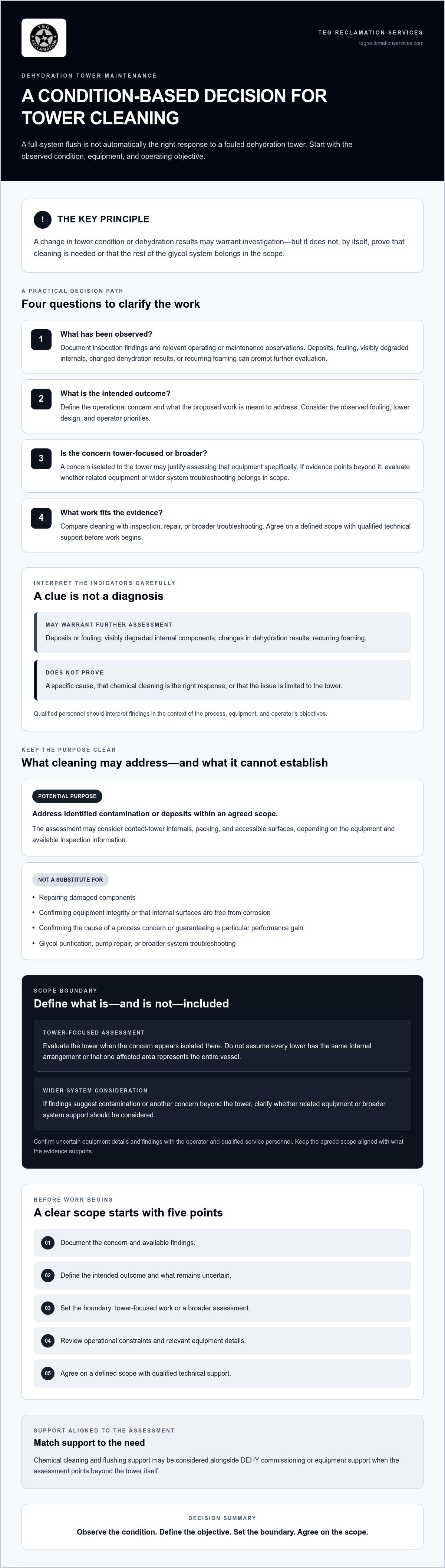
A full-system flush isn’t automatically the right response to a fouled dehydration tower. Chemical cleaning dehydration tower work should be evaluated against the equipment’s condition and operating priorities, not treated as a routine fix for every performance concern. Changes in tower condition or dehydration results may warrant investigation, but they don’t by themselves prove that cleaning is needed or that the rest of the glycol system belongs in the scope.
This guide explains which condition indicators may warrant further assessment, how to distinguish a tower-focused cleaning question from a wider glycol-system concern, and what to clarify before planning work. It also covers how to define the purpose and boundaries of an assessment, account for operational constraints, and prepare a clear scope with qualified technical support. The goal is a condition-based decision that aligns the proposed work with the equipment and intended outcome.
Table of Contents
Why Chemical Cleaning a Dehydration Tower Starts with Its Condition
Chemical cleaning is a maintenance service intended to address identified contamination or deposits. Start by documenting the condition and defining the operational objective, rather than assuming cleaning will correct every performance concern. The appropriate scope depends on the observed fouling, tower design, and what the operator needs the work to accomplish.
A tower-focused assessment is different from cleaning the full glycol circulation system. A concern isolated to the tower may justify evaluating that equipment specifically. If evidence suggests the issue extends beyond the tower, a broader scope may be needed. Defining the boundary early helps avoid including unrelated equipment or overlooking connected equipment that could be relevant.
What can indicate a dehydration tower cleaning concern?
Inspection findings such as deposits, fouling, or visibly degraded internal components can prompt further evaluation. Operating and maintenance observations, including a change in dehydration results or recurring foaming, may also warrant investigation. These are clues, not proof of a specific cause or confirmation that chemical cleaning is the right response.
Qualified personnel should interpret findings in the context of the process, equipment, and operator’s objectives. An assessment can help distinguish a possible deposit-removal need from a mechanical concern or another issue that cleaning alone may not address.
How does tower cleaning relate to natural gas dehydration?
The tower, often called a contactor, brings natural gas into contact with circulating glycol so the glycol can absorb water from the gas. The tower’s condition matters because it supports this dehydration process. For background on the system, see the Glycol dehydration process. A cleaning assessment can help determine whether deposits are relevant to the observed concern, but it cannot promise a particular performance gain.
“Chemical cleaning a dehydration tower is a condition-based maintenance service intended to address identified contamination or deposits within an agreed scope.” This definition keeps the purpose clear. Cleaning does not confirm equipment integrity, repair damaged components, or resolve every issue affecting dehydration. The assessment should establish what is known, what remains uncertain, and whether tower cleaning fits the operator’s priorities.
What Chemical Cleaning Can Address, and What It Cannot Confirm
A cleaning assessment distinguishes conditions that may be addressed by deposit removal from those that call for a different response. If deposits are present, chemical cleaning may be considered within an agreed scope. Cleaning cannot repair damaged components, establish that internal surfaces are free from corrosion, or confirm the cause of a process concern. Those questions require appropriate inspection or technical evaluation.
This distinction matters when defining the work. The outcome should be assessed against the agreed scope and actual equipment condition. Cleaning should not be treated as proof that the tower is mechanically sound or that dehydration performance will return to a particular level. Chemical cleaning dehydration tower work is one potential maintenance response, not a substitute for diagnosis.
Which tower components and observations belong in the assessment?
Use documented findings to identify what needs consideration. Depending on the equipment and available inspection information, the assessment may include contact-tower internals, packing, and accessible surfaces. Don’t assume every tower has the same internal arrangement or that a concern in one area applies throughout the vessel.
If equipment details or findings are uncertain, confirm them with the operator and qualified service personnel. The aim is to identify what the evidence supports, what remains unknown, and whether cleaning alone fits the need.
When might cleaning need to be considered alongside other work?
Mechanical condition findings may point to inspection, repair, or a separate maintenance scope. A cleaning assessment should distinguish these needs rather than imply that deposits are the only possible issue. Tower cleaning is also different from glycol purification, pump repair, or broader system troubleshooting. Each addresses a different concern and should be scoped accordingly.
If contamination concerns extend beyond the tower, glycol contamination removal guidance provides context for considering the wider system. Technical field support can also help operators clarify whether the planned scope should stay tower-focused or include related equipment concerns. Keep the objective specific, and define how the results will be assessed without treating cleaning as a guarantee of restored process performance.
Chemical Cleaning vs. Other Dehydration Tower Maintenance Options
Cleaning, inspection, repair, and system troubleshooting serve different purposes. The right choice depends on documented findings and the operator’s requirements, not a preferred maintenance method. Use the comparison below to frame the evaluation. It is not a diagnosis. Qualified personnel should confirm the scope using site information and equipment condition.
When is a tower-focused cleaning scope worth evaluating?
Documented deposits or fouling can justify requesting a technical evaluation of chemical cleaning dehydration tower work. The assessment should determine whether the observations point to the tower or whether the concern may involve the wider glycol system. Qualified personnel can use site information and operator requirements to define an appropriate boundary. A tower-specific scope should follow the evidence, not an assumption that all related equipment needs the same work.
When might inspection or repair be the priority instead?
Findings that suggest damaged or deteriorated components call for assessment beyond a cleaning decision. Symptoms alone don’t confirm their cause, and equipment can’t be diagnosed remotely from a brief description. Inspection or repair may need separate consideration. For related service context, see glycol chemical cleaning services. Operators defining a scope can also review TEG Reclamation Services’ support as one resource.
How to Scope Dehydration Tower Cleaning Before Work Begins
A useful scope connects the observed concern to an operational objective and accounts for site conditions. Focus planning on decisions and responsibilities, not a generic cleaning procedure. For chemical cleaning dehydration tower work, operators and qualified service personnel can align on the need, boundaries, constraints, and how findings will be reviewed.
A practical planning sequence is:
Document the concern. Record the operating issue and available condition findings without assuming a cause.
Define the objective. State what the proposed work is intended to address and what it is not expected to establish.
Review constraints. Identify operational priorities, site requirements, and coordination needs for the work.
Agree on scope. Confirm equipment boundaries, responsibilities, communication channels, and what information will be documented.
Assess results. Review findings against the agreed objective and determine whether additional evaluation is needed.
Responsible, qualified personnel must review site-specific safety and environmental requirements. The operator and service provider should also agree how site authorization and operational decisions will be handled. This keeps the scope aligned with facility requirements instead of relying on assumptions about the site.
What information should operators prepare for a scope discussion?
Useful starting information includes an equipment description, known condition findings, relevant maintenance history, and a concise account of the operating concern. Operators can also identify process constraints and site coordination requirements. Keep sensitive process information within appropriate channels. Ask the service provider what additional records or inspections are needed to assess the proposed work. This can help clarify whether the available information supports a tower-focused scope or whether further evaluation is appropriate.
How should objectives and follow-up be agreed?
Before scheduling, define the requested outcome and the evidence that will be used to assess it. Agree on how findings, limitations, and follow-up recommendations will be communicated. This helps prevent cleaning from being mistaken for a repair or a confirmed diagnosis.
Clarify who is responsible for site authorization, operational decisions, and any separate repairs. Record those responsibilities alongside the scope so each party understands its role. A clear discussion helps account for operational priorities and gives the operator a basis for reviewing the work without promising an outcome that has not been established.
For support defining an appropriate scope, discuss your dehydration tower cleaning requirements with TEG Reclamation Services.
How TEG Reclamation Services Supports Dehydration Tower Cleaning
TEG Reclamation Services provides chemical cleaning and chemical flushing support for oil-and-gas operators. For a chemical cleaning dehydration tower assessment, begin with the equipment concern and the operator’s objectives. The appropriate service scope depends on site information and qualified technical review. Don’t assume a particular tower outcome before that assessment.
If the concern extends beyond cleaning, DEHY system commissioning and equipment support may be relevant to the broader discussion. These services address different needs, so the scope should distinguish cleaning from commissioning, repair, or other follow-up work. Founder Rocky McDonald brings more than 45 years of oil-and-gas process-equipment experience to the company’s technical support.
What should operators expect from a service discussion?
Be ready to discuss equipment condition, documented observations, the operating objective, and site constraints. Relevant maintenance records can help frame the concern. It can also help to clarify whether the issue appears limited to the tower or may involve a wider DEHY system. Site-specific recommendations require relevant information and qualified technical review. If related equipment needs arise, BTEX system maintenance guidance may provide additional context.
How can operators take the next step?
Before contacting the service team, gather available condition findings and relevant maintenance history. Note whether the concern appears limited to the tower or may involve other parts of the DEHY system. You don’t need to disclose sensitive process details in a general inquiry. Share information through appropriate channels and ask what additional records are needed to evaluate the scope.
A focused discussion can clarify the requested service, relevant constraints, and whether commissioning or other equipment support needs separate consideration. It can also establish what findings and limitations should be communicated after the work, without assuming a specific result in advance.
Contact TEG Reclamation Services to discuss your site conditions and chemical cleaning or flushing requirements. A clear description of the concern is a practical first step toward determining whether the proposed scope fits the equipment and operational priorities.
Make the Next Maintenance Decision with Confidence
The right chemical cleaning dehydration tower scope starts with verified condition findings and a defined operational objective. Cleaning may address identified deposits, but it doesn’t confirm equipment integrity, establish root cause, or replace inspection and repair when those are needed. Comparing a tower-focused scope with broader DEHY support helps keep the work aligned with the concern.
TEG Reclamation Services provides chemical cleaning, chemical flushing, and DEHY equipment support to upstream, midstream, and gas-processing facilities across the United States. Founder Rocky McDonald brings more than 45 years of oil-and-gas process-equipment experience to the company’s field support.
Bring condition observations, maintenance records, and operational priorities to a scope discussion. Discuss your dehydration tower cleaning requirements with TEG Reclamation Services to explore an appropriate next step. A clear, condition-based plan can help your team make a considered maintenance decision.
Frequently Asked Questions
What is chemical cleaning of a dehydration tower?
Chemical cleaning of a dehydration tower is a maintenance service intended to address identified contamination or deposits on tower equipment. It isn’t a universal repair or a guaranteed way to restore process performance. The appropriate scope depends on documented equipment condition, tower design, and the operator’s objectives. Qualified technical personnel should review available findings and site requirements to determine whether cleaning is appropriate and define the work boundaries.
When should a dehydration tower be chemically cleaned?
Consider evaluating cleaning when inspection findings or maintenance history indicate deposits or fouling. Those observations can prompt investigation, but symptoms alone don’t establish their cause or prove cleaning is necessary. Before deciding on a scope, review equipment condition, the wider system context, and operating constraints with qualified personnel. Their assessment can help determine whether the concern is tower-specific, calls for another maintenance response, or needs further investigation first.
Can chemical cleaning fix every dehydration tower performance problem?
No. Cleaning may address certain deposits, but it doesn’t automatically resolve mechanical damage, incorrect operation, or issues elsewhere in the dehydration system. Inspection gathers information about condition; repair addresses identified mechanical problems; troubleshooting evaluates possible causes across equipment or process operation. These are distinct needs. Without unit-specific evidence, the cause can’t be diagnosed remotely. Review documented findings before selecting work, and don’t treat cleaning as a guaranteed performance fix.
What information should I provide before requesting tower cleaning?
Prepare the equipment identification, available inspection findings, relevant maintenance history, a description of the observed concern, and known site or operating constraints. This information helps frame the initial scope discussion, but a service provider may need additional records or inspection details before assessing the work. Protect sensitive process information by sharing it only through appropriate, secure channels. Ask what further information is needed and how site coordination should be handled.
Does chemical cleaning require a production shutdown?
Operating impact depends on the equipment, site conditions, proposed scope, and operator requirements. Don’t assume tower cleaning can be completed online or without a shutdown. The responsible operator and qualified service team should review operational constraints, site requirements, and the proposed work before scheduling. They can clarify what coordination is necessary for the specific facility. No general answer can establish the operating plan for an individual unit.
Does TEG Reclamation Services sell cleaning chemicals?
TEG Reclamation Services provides chemical cleaning and chemical flushing services, but glycol chemical sales are not among its listed offerings. Operators should discuss the requested service scope and site requirements with the company rather than assume a particular chemical or method will be used. Site-specific recommendations require relevant equipment information and qualified technical review. The service discussion should focus on the maintenance need and agreed scope, not an assumed chemical purchase.
What should happen after a dehydration tower is cleaned?
Follow-up depends on the agreed scope and the findings reported from the work. Operators should review those observations, determine whether additional inspection or repair needs consideration, and follow site-approved operating and safety requirements. Cleaning alone doesn’t confirm equipment integrity or guarantee a particular process result. Responsible site personnel should make decisions about returning equipment to operation using unit-specific information, not a generic restart instruction.


Comments