
Dehydration System Maintenance Contractor: Field Support for Gas Operations
When dehydration-unit issues keep recurring, a dehydration system maintenance contractor can help assess equipment condition and identify practical field support while keeping operational continuity in view. A focused assessment helps connect the observed problem to the equipment or process that may need attention, rather than treating every concern as the same repair.
Dehydration performance depends on equipment working as intended, and unresolved issues can affect gas handling and facility operations. Specialist support can extend beyond a single repair to include commissioning, troubleshooting, inspections, chemical flushing, equipment upgrades, and Kimray pump service. The right scope depends on the unit’s condition and the operating concern.
This article explains what dehydration system maintenance can cover, when field support may be useful, and how TEG Reclamation Services supports gas operations. It also covers on-site glycol reclamation as part of a broader support approach. The service restores contaminated triethylene glycol (TEG) to over 98% purity without requiring a production shutdown. That outcome applies to glycol reclamation, not every maintenance task.
Table of Contents
What Does a Dehydration System Maintenance Contractor Do?
A dehydration system maintenance contractor provides specialist field support to maintain, troubleshoot, and improve gas dehydration equipment. This support helps operators investigate equipment or glycol-system concerns that may affect dehydration performance and facility operations.
Glycol dehydration removes water vapor from natural gas. For a foundational overview of the Glycol dehydration process, see the linked reference. In operation, both equipment condition and glycol condition matter. A concern in either area may affect how consistently the unit performs. Specialist assessment can help clarify the issue and identify a suitable scope of field support.
Which equipment and systems may need specialist support?
Support may involve DEHY equipment, glycol circulation, pumps, and associated process equipment. The scope depends on the facility’s operating needs and system condition, rather than following the same task list for every unit.
TEG Reclamation Services supports dehydration systems through field troubleshooting, inspections, DEHY system commissioning, chemical flushing, equipment upgrades, and Kimray pump repair and service. These capabilities address different needs, from investigating a recurring concern to servicing equipment or supporting system changes. The work is shaped around the operating issue and system condition, not a generic component-by-component procedure.
How maintenance support differs from routine operations
Routine observation and specialist field maintenance serve different purposes. Facility staff may notice a change in unit operation or an issue that keeps recurring. Recording what changed, when it occurred, and which equipment was involved gives a specialist a more useful starting point. Those observations help describe the concern, but they are not a substitute for a specialist inspection or technical troubleshooting.
Field support brings focused attention to the equipment or process concern. A specialist can inspect relevant systems, assess the issue, and identify service options suited to the facility’s needs. Depending on the situation, support may involve troubleshooting, cleaning, pump service, commissioning, or an equipment upgrade. The objective is to address the identified need while considering the wider dehydration system and operating context.
Specialist assistance can be useful when routine observations point to a persistent or technically complex concern. Share the operating issue, the system or equipment affected, and any relevant history of the recurring problem. That context helps align the service scope with the facility’s condition and requirements.
Which Dehydration System Problems Can Prompt Maintenance Support?
A single change in performance does not establish what is wrong with a dehydration unit. Recurring concerns can signal that the system’s condition deserves a closer assessment. Keep a clear record of what changed, when it happened, whether it returned, and what equipment was involved. These details help focus the review without assuming a cause.
Indicators that may warrant specialist attention include:
Persistent concerns about dehydration performance or dew point relative to the facility’s operating objectives.
Repeated equipment issues affecting DEHY operation or glycol circulation.
Concerns about glycol condition, including suspected contamination.
Pump performance or service concerns that recur or remain unresolved.
These are prompts for investigation, not diagnoses. Glycol condition, circulation equipment, and overall process performance are related parts of the system, so a concern in one area may warrant looking at the wider operating context. A dehydration system maintenance contractor can provide a focused field assessment to help distinguish an observed concern from the maintenance work it may require.
When recurring performance concerns deserve a closer look
Repeated difficulty meeting dehydration objectives is a reason to review system condition, especially when the concern persists or returns after routine attention. Dew point performance matters in relation to the facility’s operating objectives, which vary by operation. Avoid treating one observation as proof of a particular fault. A specialist assessment can help evaluate the issue in context.
Recording when a concern occurs, whether it returns, and what changed around the same time can make the assessment more focused. This turns recurring observations into better-informed maintenance planning without presuming the cause before the system is evaluated.
Dehydration equipment can also have environmental considerations. The EPA provides background on emissions from glycol dehydrators, which can inform a broader understanding of the equipment’s operating context. This reference does not determine the cause of a performance concern or the maintenance a particular unit needs.
When glycol or equipment condition becomes part of the issue
Contaminated glycol may affect system efficiency and can be one factor to consider during an assessment. Circulation equipment condition matters too. A pump concern may justify specialist field attention, particularly if it recurs or coincides with performance issues. Neither observation alone confirms the underlying cause.
For more focused reading, see the related guidance on glycol contamination removal and Kimray pump repair. TEG Reclamation Services provides field troubleshooting, glycol reclamation, and Kimray pump repair and service. Sharing the recurring concern, relevant observations, and equipment involved helps shape a service discussion around the facility’s operating need.
How Planned Maintenance and Reactive Repairs Support Dehydration Reliability
Planned maintenance and reactive field troubleshooting support reliability in different ways. Planned work gives operators an opportunity to address equipment condition and recurring concerns in coordination with facility priorities. Reactive support focuses on an identified issue that needs assessment. Neither approach can predict or prevent every problem, so facilities may use both as operating needs change.
What planned maintenance can help operators manage
Planned attention creates an opportunity to review equipment condition and consider recurring operational concerns before they become more disruptive. Depending on the system’s condition and facility priorities, the scope may include inspections, chemical cleaning, or equipment support. Planning also helps teams coordinate service work with operating needs. It does not guarantee uninterrupted operation, and no single inspection interval applies to every facility.
When reactive field troubleshooting may be appropriate
Reactive support is useful when an equipment or process concern has been identified and requires focused evaluation. Rather than assuming a cause, a dehydration system maintenance contractor can assess the concern in context and help determine an appropriate maintenance response. That response may involve troubleshooting, pump service, cleaning, or other equipment support suited to the facility’s need.
Both approaches can fit within a broader maintenance plan. Planned work addresses known priorities, while reactive troubleshooting responds to issues that arise between scheduled activities. For background on maintenance planning, see standard industrial asset management and maintenance planning reference guidelines.
Downtime considerations can also shape the service discussion. TEG Reclamation Services’ on-site glycol reclamation restores contaminated TEG to over 98% purity without requiring a production shutdown. This applies specifically to glycol reclamation, not to every maintenance or repair service. Discuss dehydration system field support in relation to the operating concern and facility priorities.
What Dehydration System Maintenance Services Can Address
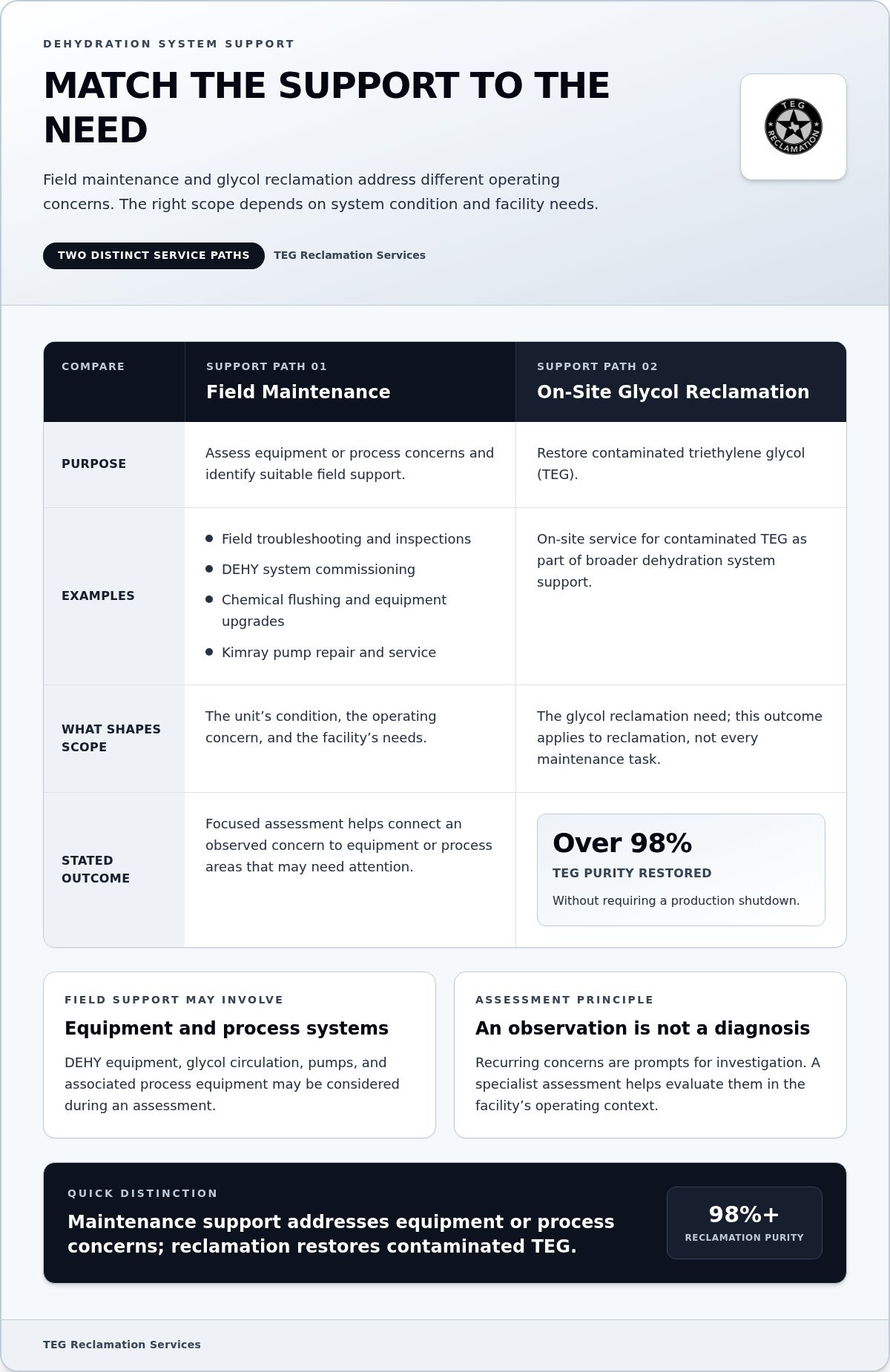
Dehydration maintenance can involve several types of field support, depending on equipment condition and the facility’s operating need. A dehydration system maintenance contractor can help assess a process concern, service equipment, clean affected systems, or support improvements. The purpose is to match the work to the issue, not apply the same scope to every unit.
Field troubleshooting, commissioning, and equipment support
Field troubleshooting and inspections help evaluate identified equipment or process concerns. DEHY system commissioning supports equipment readiness, while Kimray pump repair and service addresses pump-related needs. Burner management system support can also form part of broader process-equipment service. Each capability has a distinct role, and the appropriate scope depends on the facility’s situation.
For more detail on pump-related support, see the Kimray pump repair field guide. These services help operators focus attention on the equipment involved and determine relevant next steps without assuming the cause or outcome in advance.
Chemical cleaning, upgrades, and glycol reclamation
Chemical flushing and cleaning address process-equipment cleaning needs. DEHY equipment upgrades provide a separate option for improving or updating system components. The work selected should reflect equipment condition and the operating objective. For related background, see the glycol chemical cleaning guide.
Glycol reclamation addresses the condition of contaminated triethylene glycol. TEG Reclamation Services restores TEG to over 98% purity through its on-site service. This describes the reclamation outcome without disclosing the proprietary process. The service does not require a production shutdown. This claim applies to reclamation specifically, not to every maintenance or equipment service.
Together, field troubleshooting, equipment support, cleaning, upgrades, and reclamation give operators distinct options to consider as system needs arise. The scope can be tailored to the facility’s condition and operational priorities.
Explore TEG field services to see how these capabilities relate to dehydration system support.
How TEG Reclamation Services Supports Dehydration System Maintenance
Effective field support starts with the facility’s operating concern, not a preset task list. TEG Reclamation Services supports oil and gas operators across the United States with dehydration-system and process-equipment services shaped by the unit’s condition and operating priorities. The goal is to define relevant work clearly while keeping operational continuity in view.
From operating concern to a defined service scope
Start by describing the concern, the equipment involved, and how it relates to the facility’s operating objectives. Include useful observations such as whether the issue is recurring and what changed. This context helps guide a discussion about appropriate field support, which may involve troubleshooting, inspection, commissioning, pump service, cleaning, equipment upgrades, or glycol reclamation.
Scope definition focuses on the need and intended outcome. It does not require disclosing proprietary methods or assuming a cause before the system has been assessed. A clear understanding of the concern helps keep the work relevant to the facility, whether the priority is addressing a recurring equipment issue or supporting a broader system improvement.
Coordinating field support around operational priorities
Field support is considered in relation to facility priorities and operating continuity. The type of work matters: an equipment upgrade, a troubleshooting need, and glycol reclamation are distinct services, each with its own purpose. TEG’s on-site glycol reclamation restores contaminated TEG to over 98% purity without requiring a production shutdown. That outcome applies specifically to glycol reclamation, not to every field service.
TEG’s process-equipment experience also informs its field support. The company was founded in 2008, and founder Rocky McDonald has over 45 years of oil and gas process-equipment experience. This background supports an equipment-focused approach to discussing dehydration-system needs.
For an initial service-scope discussion, identify the operating concern, the system or equipment affected, and the facility’s priorities. That gives the conversation a clear starting point without presuming a solution or disrupting operations unnecessarily.
Discuss dehydration system maintenance support with TEG Reclamation Services to discuss the needs of your facility.
Keep Dehydration Support Focused on Facility Needs
Reliable dehydration support depends on matching field work to the concern at hand. Recurring performance issues can prompt a closer assessment, while planned maintenance and reactive troubleshooting each serve a distinct role. A dehydration system maintenance contractor can help operators consider equipment support, cleaning, upgrades, commissioning, or glycol reclamation in the context of system condition and operational priorities.
TEG Reclamation Services brings process-equipment experience to that work. Founder Rocky McDonald has over 45 years of oil and gas process-equipment experience. For contaminated triethylene glycol, the company’s reclamation service restores it to over 98% purity without requiring a production shutdown. That outcome applies specifically to glycol reclamation, not to every maintenance service.
Start with a clear description of the facility concern, the equipment involved, and the operating priorities. A focused discussion helps define relevant next steps without assuming the cause or scope in advance. Discuss dehydration system maintenance support with TEG Reclamation Services to plan field support around your facility’s needs.
Frequently Asked Questions
When should a gas dehydration unit receive specialist maintenance?
Consider specialist maintenance when a performance concern keeps recurring, an equipment issue remains unresolved, or glycol or circulation-system condition raises questions. These indicators prompt assessment but do not prove a specific cause. A focused review can help determine whether troubleshooting, inspection, cleaning, pump service, or another type of support fits the concern and the facility’s operating priorities.
Can glycol reclamation be performed without shutting down production?
Yes. TEG Reclamation Services’ on-site glycol reclamation restores contaminated triethylene glycol to over 98% purity without requiring a production shutdown. This applies specifically to glycol reclamation. It does not mean every dehydration maintenance, repair, cleaning, commissioning, or upgrade task can be completed while production continues.
What services can a dehydration system maintenance contractor provide?
Services may include field troubleshooting, inspections, DEHY system commissioning, Kimray pump repair and service, chemical flushing, and DEHY equipment upgrades. TEG Reclamation Services also provides on-site glycol reclamation and burner management system support. These are distinct capabilities, and the appropriate scope depends on the facility’s concern, equipment condition, and operational priorities.
How does glycol condition affect a dehydration system?
Glycol condition can influence dehydration system efficiency. Contamination may be a factor to consider when reviewing a performance concern, but it does not by itself identify the cause or determine the right response. Assessment should consider glycol condition alongside circulation equipment and overall system performance. TEG Reclamation Services provides on-site glycol reclamation, restoring contaminated TEG to over 98% purity without requiring a production shutdown.
Does dehydration system maintenance always require a production shutdown?
No. Operating requirements vary with the work and facility conditions. TEG Reclamation Services’ glycol reclamation service does not require a production shutdown, but that claim applies only to reclamation. It should not be extended to other services, such as equipment repairs, cleaning, commissioning, or upgrades.
What is the difference between dehydration system maintenance and commissioning?
Maintenance addresses equipment condition or an identified operating concern through services such as troubleshooting, inspections, pump service, cleaning, or upgrades. Commissioning is a distinct service focused on supporting a DEHY system as it is brought into operation. Both relate to system performance but serve different needs. TEG Reclamation Services provides DEHY system commissioning as well as field maintenance and process-equipment support.
Can one contractor support both glycol and dehydration equipment concerns?
Yes. TEG Reclamation Services supports glycol-related needs and dehydration equipment through on-site glycol reclamation, field troubleshooting, inspections, DEHY commissioning, equipment upgrades, chemical flushing, and Kimray pump service. Bringing these capabilities into one service discussion can help relate a glycol concern to the wider system context. The scope is shaped around the facility’s operating need and the equipment involved.


Comments