
BTEX Emission Control Upgrades: A Strategic Guide to Compliance and Efficiency (2026)
Could your current dehydration setup survive a rigorous EPA audit under the latest Subpart OOOOb requirements? As of September 1, 2026, the distinction between a compliant facility and one facing enforcement hinges on the technical integrity of your BTEX emission control upgrades. You likely recognize that managing benzene, toluene, ethylbenzene, and xylene is no longer just about mitigating local odor complaints or managing complex reporting. It's a critical operational necessity that directly impacts the lifespan of your equipment and prevents premature failure caused by poor emission management.
Implementing these targeted upgrades allows you to modernize your facility to meet NESHAP standards while simultaneously enhancing dehydration efficiency. By prioritizing system optimization, operators can significantly reduce VOC emissions and lower long-term operating costs. This guide examines the technical pathways to achieving full regulatory compliance, the synergy between glycol purity and emission performance, and the strategies for upgrading equipment without triggering production shutdowns. You'll discover how to maintain technical integrity while meeting the stringent requirements of modern air quality mandates.
Table of Contents
The Evolving Regulatory Landscape for BTEX Emissions in 2026
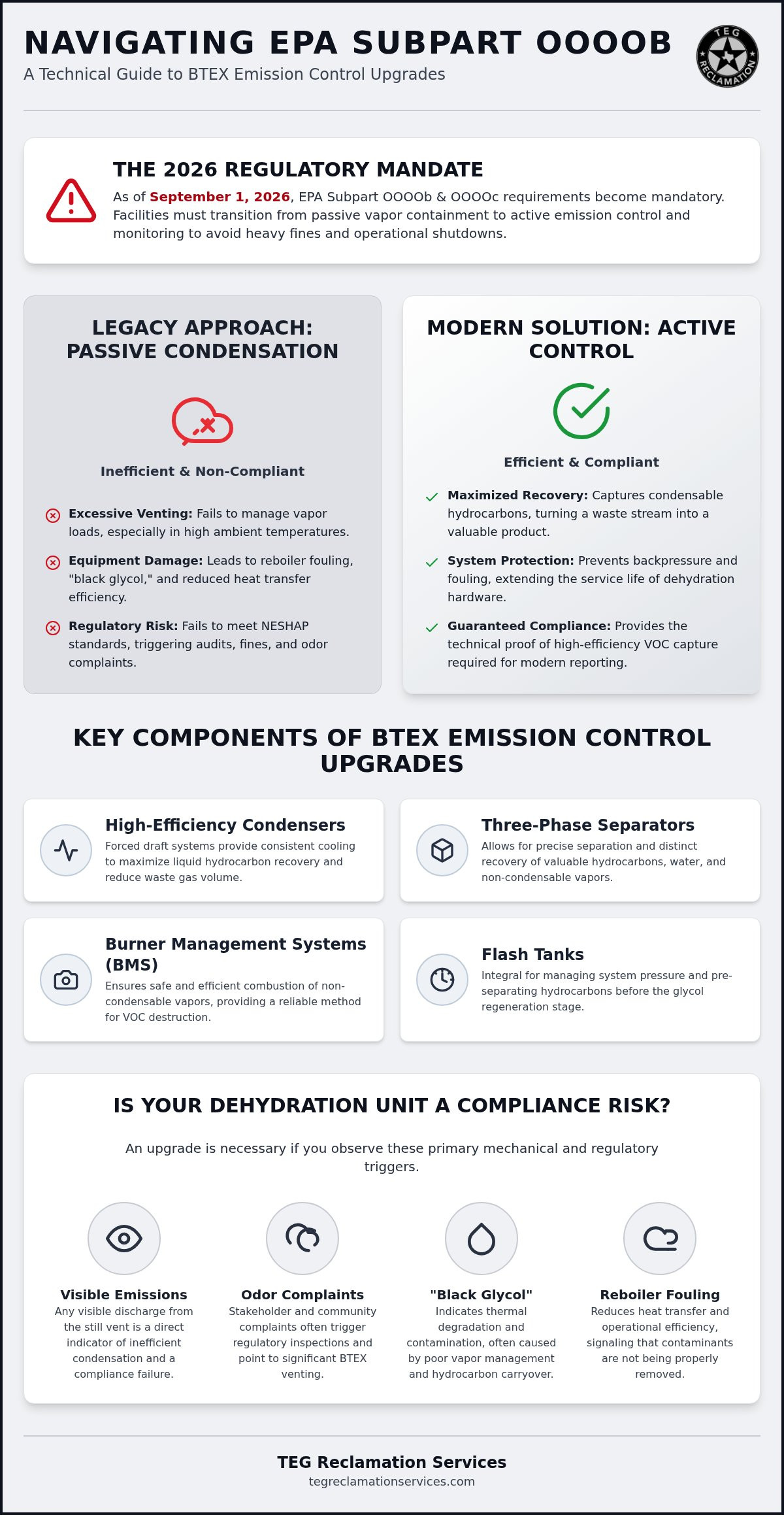
Regulatory standards for natural gas dehydration have shifted from simple vapor containment to rigorous performance verification. EPA Subpart OOOOb and OOOOc now dictate the operational requirements for both new and existing facilities. These rules require operators to move beyond passive condensation methods. Instead, they must implement active emission monitoring and control strategies that ensure volatile organic compounds (VOCs) are captured or destroyed with high efficiency. Grandfathered units, once exempt from the strictest standards, are increasingly subject to modernization mandates as equipment undergoes routine maintenance or capacity changes. The EPA focus on major sources under NESHAP means that even older systems must now demonstrate equivalent control efficiencies to their newer counterparts. This shift makes BTEX emission control upgrades a technical necessity rather than an optional improvement.
Understanding BTEX Compounds and Environmental Impact
BTEX stands for Benzene, Toluene, Ethylbenzene, and Xylene. These compounds are hazardous air pollutants (HAPs) frequently found in the wet gas stream. Glycol dehydration units are primary sources of these emissions because glycol has a high affinity for absorbing BTEX during the dehydration process. When the glycol is heated in the reboiler, these compounds are released. Unmitigated venting poses significant health risks and creates local odor issues that often trigger stakeholder complaints. The absorption of BTEX into the glycol stream isn't just an emission problem; it's a maintenance challenge. When these compounds aren't managed correctly at the stack, they can lead to equipment fouling and reduced heat transfer efficiency. Modern upgrades focus on optimizing the separation process to recover these hydrocarbons before they become an environmental or mechanical liability.
Compliance Deadlines and Regulatory Pressure
The 2026 calendar year marks a pivotal milestone for emission reporting and enforcement. By September 1, 2026, stationary sources must be classified as existing, new, or modified to determine their specific compliance requirements under newly adopted air toxic regulations. These mandates prioritize reducing emissions from sources near communities that are disproportionately impacted by air pollution. Proactive modernization is the only reliable way to avoid the rising costs of non-compliance, which include heavy fines and the potential loss of operational permits. Waiting for an inspection to trigger action usually results in emergency retrofitting, which is both expensive and disruptive. By integrating BTEX emission control upgrades now, operators ensure their facilities remain compliant while extending the service life of their dehydration hardware. To help offset the costs of these critical capital improvements, many companies consult with Engineered Tax Services to leverage tax incentive studies and accounting method changes. Active control involves more than just hardware; it requires a systematic approach to vapor management that provides the technical proof required for modern reporting.
Modernizing a dehydration unit requires a shift from basic containment to active process management. BTEX emission control upgrades focus on four critical hardware integrations: high-efficiency condensers, three-phase separators, Burner Management Systems (BMS), and flash tanks. Each component serves a specific role in reducing the volume of hazardous air pollutants (HAPs) before they reach the atmosphere. High-performance systems don't just capture waste; they process it to ensure operational continuity and safety.Condensation Technology and Vapor Recovery
Transitioning from ambient to forced draft condensers is a primary upgrade path for many operators. Ambient systems often fail to manage vapor loads during high ambient temperatures, leading to excessive venting. Forced draft systems use mechanical airflow to ensure consistent cooling across the shell-and-tube heat exchanger. This improves the efficiency of the thermal transfer, allowing for maximum liquid hydrocarbon recovery. By managing vapor pressure effectively, operators can reduce the volume of waste gas directed to the reboiler burner. This process is essential for navigating the Evolving Regulatory Landscape for BTEX Emissions. Efficient recovery also prevents the build-up of backpressure, which can otherwise impede the glycol regeneration process.
Optimizing hydrocarbon recovery requires precise separation. Three-phase separators allow for the distinct recovery of water, liquid hydrocarbons, and non-condensable gases. Integrating a flash tank before the BTEX unit further reduces the load by removing light-end gases early in the process. This pre-treatment prevents the BTEX unit from being overwhelmed during surges in gas flow. It's a pragmatic way to ensure the system remains within its design capacity even as production volumes fluctuate.
Burner Management and Safety Upgrades
A robust BMS is the final safeguard in the emission control chain. It ensures that any non-condensable vapors are destroyed through reliable combustion rather than vented. Modern BMS units feature flame ionization and automated relight systems, which are mandatory for maintaining environmental compliance. These systems also integrate with reboiler temperature management to ensure that the destruction of waste gas doesn't compromise the heating cycle of the glycol. Proper burner management prevents unburned fuel and HAPs from escaping the stack, which is a common cause of regulatory fines. These components must function as a single, integrated loop to achieve maximum efficiency. Facilities looking to verify their current system performance can benefit from professional DEHY equipment upgrades to ensure all components work in synergy.
The Operational Benefits of Integrated BTEX Modernization
Many operators view emission control as a regulatory burden. This is a narrow perspective. Efficient BTEX system upgrades serve as a protective layer for the entire dehydration unit. When the system captures condensable hydrocarbons effectively, it prevents these contaminants from recirculating or causing fouling within the reboiler. This proactive management stops the formation of "black glycol," a condition often caused by the thermal cracking of hydrocarbons that haven't been properly separated. By maintaining a cleaner process stream, facilities reduce the frequency and cost of chemical replacements. Proper vapor management ensures that the reboiler operates at peak efficiency, utilizing fuel gas more effectively while protecting the fire tube from carbon buildup.
Protecting Glycol Purity Through Emission Control
There's a direct correlation between VOC capture efficiency and the long-term health of triethylene glycol (TEG). Modern BTEX emission control upgrades minimize the thermal degradation of the glycol stream by ensuring that the reboiler isn't forced to process excessive waste gas. High hydrocarbon loading in the glycol reduces its water-absorbing capacity, which forces the system to run hotter and harder. This cycle accelerates the breakdown of the glycol's molecular structure. For a deeper look at maintaining process fluid integrity, consult our glycol contamination removal guide. Restoring glycol purity to 98% is only achievable when the emission control hardware functions correctly. Clean glycol is more than a chemical preference; it's a requirement for achieving the desired dew point depression without overworking the hardware.
Maximizing Facility Uptime and Reliability
Mechanical reliability is the byproduct of a balanced system. Poorly managed vapors often lead to high-pressure excursions or burner failures, both of which trigger unplanned shutdowns. Upgrading the emission control hardware allows for better vapor management, which stabilizes reboiler pressure. This stability extends the service life of critical components like Kimray pumps. These pumps are sensitive to the particulates and acidity that develop in degraded glycol. By keeping the process stream pure, you reduce the mechanical wear on pump seals and diaphragms. Technical troubleshooting often reveals that system bottlenecks aren't located in the dehydrator itself, but in the restricted flow of an outdated BTEX unit. Restoring this balance improves overall facility uptime and ensures that the equipment operates within its original design specifications. This integrated approach doesn't just satisfy an inspector; it safeguards your capital investment by ensuring every mechanical part functions as part of a synchronized, efficient loop.
Identifying When Your Dehydration Unit Requires an Upgrade
Identifying the exact moment for BTEX emission control upgrades requires more than a glance at a calendar. It demands a technical evaluation of operational data and physical hardware condition. Persistent odors at the stack or visible emissions are the most obvious indicators of system failure. These signs suggest that the condenser is no longer achieving the necessary thermal transfer to liquefy hydrocarbons. Beyond odors, operators should analyze glycol loss rates. Excessive loss often points to VOCs stripping glycol out through the vent. High reboiler fuel consumption is another red flag; it suggests the burner is working harder to process a poorly managed waste gas stream. Strategic BTEX emission control upgrades address these technical indicators by restoring the system's ability to manage vapor loads effectively.
Technical Indicators of Poor BTEX Performance
Technical performance often degrades silently before a total failure occurs. One primary indicator is a high concentration of hydrocarbons in the glycol flash gas. This suggests the glycol is oversaturated, which places an unsustainable load on the emission control unit. You might also observe frequent pilot light failures or general burner instability. These issues typically stem from inconsistent waste gas quality or pressure fluctuations within the BTEX unit. Liquid carryover into the vent system is a critical warning sign. It indicates that the condenser is overwhelmed or that the three-phase separator is failing to isolate liquids. Premature failure of Kimray pump seals often signals that the glycol purity has been compromised by poor emission management.
The Audit Process for Emission Control Systems
A structured audit is the only way to move from guesswork to a strategic plan. Start with our dehydration facility upgrades checklist to establish a baseline for your equipment's current state. The process should follow these three technical steps:
Step 1: Conduct baseline emission testing and a regulatory gap analysis to identify how far your current performance deviates from 2026 standards.
Step 2: Assess the mechanical integrity of condensers and separators, specifically checking for ASME-code status and signs of internal corrosion.
Step 3: Evaluate the integration of the burner management system to ensure it's providing automated relight capabilities and flame ionization.
Assess the age of your hardware during this process. Many units installed over a decade ago lack the surface area required for modern forced-draft cooling. If your audit reveals these deficiencies, it's time to consider professional DEHY equipment upgrades to restore technical integrity and ensure compliance.
Strategic Field Support for BTEX and DEHY Optimization
Strategic field support is the final link in the compliance chain. While hardware provides the capability for emission reduction, specialized field technicians ensure that these systems deliver consistent results under variable field conditions. Engaging in BTEX system maintenance involves more than just visual inspections. It requires a deep understanding of the chemical and mechanical interactions within the dehydration loop. Professional support during BTEX emission control upgrades ensures that new components don't create backpressure or thermal imbalances that could compromise the reboiler fire tube. On-site commissioning services allow for the verification of destruction efficiencies without the need for production shutdowns. This approach prioritizes operational continuity, ensuring that modernization efforts don't come at the cost of uptime. System flushing and chemical cleaning are often necessary during new installations to remove existing contaminants that could foul high-efficiency condensers.
Professional DEHY Commissioning and Troubleshooting
Commissioning is a technical validation process that ensures upgrades meet design specifications in a live environment. Field experts identify hidden inefficiencies, such as restricted vapor lines or improper pump sizing, that passive monitoring might miss. Maintaining system balance often requires expert Kimray pump repair. If the circulation rate isn't perfectly calibrated to the gas flow and reboiler temperature, the BTEX unit will struggle to process the resulting vapor load. Troubleshooting focuses on the synchronization of these parts, ensuring that the glycol loop and the emission control hardware function as a single, optimized unit.
Long-Term Maintenance Strategies
Regulatory reporting accuracy in 2026 depends on the verifiable performance of your equipment. A preventative maintenance schedule for BTEX components should include regular inspections of the burner management system and the three-phase separator. These technical reviews provide the data necessary for NESHAP compliance and help avoid the emergency retrofitting mentioned in previous sections. Achieving and maintaining 98% glycol purity is a critical benchmark for the longevity of BTEX emission control upgrades. Pure glycol prevents the buildup of carbon and corrosive salts that can destroy shell-and-tube heat exchangers. By treating emission control as a core part of facility maintenance, operators can extend the service life of their equipment while ensuring they remain within the strict legal boundaries of modern air quality regulations.
Securing Operational Continuity through Technical Modernization
Compliance in the 2026 landscape demands a transition from passive containment to active, verifiable vapor management. Strategic BTEX emission control upgrades are no longer just about environmental stewardship; they're a fundamental investment in the mechanical integrity of your facility. By prioritizing high-efficiency condensers and robust burner management, you protect glycol purity and extend the service life of critical components like Kimray pumps.
Achieving 98% glycol purity and ensuring zero production shutdowns during modernization requires a partner with deep field experience. TEG Reclamation Services brings 45+ years of technical expertise to every project, offering on-site technical field services nationwide. Our proven success in DEHY optimization and commissioning provides the technical proof required for modern reporting and long-term reliability.
Consult with TEG Reclamation Services for your BTEX emission control upgrades to verify your system's performance and secure your operational future. We're ready to assist you in maintaining a compliant and highly efficient facility.
Frequently Asked Questions
What are the main components involved in a BTEX emission control upgrade?
Components include high-efficiency forced draft condensers, three-phase separators, and Burner Management Systems (BMS). A flash tank is also integrated to remove light-end gases before they reach the main control unit. These BTEX emission control upgrades ensure that each stage of the vapor stream is processed to maximize hydrocarbon recovery. This hardware loop is essential for maintaining safety standards while reducing the volume of waste gas directed to the reboiler burner.
How does EPA Subpart OOOOb affect existing dehydration units in 2026?
Under the 2026 standards, existing units are no longer exempt from high-efficiency control requirements. Reclassification depends on whether the equipment has been modified or if it's located near disproportionately impacted communities. Operators must demonstrate that their systems achieve specific destruction or removal efficiencies. Failure to modernize these units can result in significant fines or the loss of operational permits as enforcement timelines for Subpart OOOOb and OOOOc become active.
Can a BTEX upgrade be performed without a full production shutdown?
Yes, specialized on-site technical field services allow for the installation and commissioning of new hardware without halting gas flow. Technicians focus on integrating components like forced draft condensers and BMS units while the dehydration unit remains in service. This approach avoids the high costs associated with production shutdowns. It requires a meticulous, step-by-step workflow to ensure that every mechanical connection is secure and that system pressure remains stable throughout the upgrade process.
What is the difference between an ambient and a forced draft BTEX condenser?
Ambient condensers rely on natural air convection for cooling, which often fails during high temperature periods. This leads to excessive venting and regulatory non-compliance. Forced draft condensers utilize mechanical fans to provide consistent airflow across the heat exchanger. This ensures that the system maintains a stable thermal transfer rate regardless of external weather conditions. Upgrading to a forced draft system is a primary strategy for maximizing the recovery of liquid hydrocarbons.
How do BTEX system upgrades improve the lifespan of triethylene glycol?
These BTEX emission control upgrades reduce the hydrocarbon load that returns to the reboiler. When glycol is saturated with VOCs, it requires higher temperatures for regeneration, which accelerates thermal cracking. By efficiently removing these compounds, the glycol remains pure for longer periods. Restoring glycol purity to 98% protects the molecular structure of the TEG, preventing the formation of corrosive salts and "black glycol" that can foul the fire tubes and pumps.
Why is a burner management system critical for BTEX emission compliance?
A BMS is the final safeguard against the venting of hazardous air pollutants. It provides automated relight capabilities and flame ionization to ensure that non-condensable vapors are destroyed through consistent combustion. Without a robust BMS, a pilot failure could lead to the immediate release of benzene and other toxins into the atmosphere. This hardware is critical for meeting the performance verification requirements mandated by the latest EPA and state-level air quality regulations.
What are the signs that my current BTEX system is failing to meet standards?
Technical indicators of failure include persistent stakeholder odor complaints and visible emissions from the stack. You might also notice frequent reboiler burner instability or high glycol loss rates. These signs suggest that the condenser is overwhelmed or that the separation process is no longer isolating liquid hydrocarbons effectively. If your system requires frequent manual relights or shows signs of liquid carryover into the vent line, it's likely failing to meet current standards.
How often should a dehydration unit emission control system be audited?
Operators should conduct a technical audit at least once per year or whenever production volumes fluctuate significantly. An audit includes a baseline emission test and a mechanical integrity assessment of the condensers and separators. Regular reviews ensure that the system stays within its original design capacity and remains compliant with 2026 reporting milestones. This proactive approach identifies "hidden" inefficiencies in the glycol loop before they lead to equipment failure or regulatory enforcement actions.


Comments