
Burner Management System Troubleshooting: A Guide to Optimizing Dehydration Reliability
Updated: Aug 11
A nuisance trip in your burner management system is rarely a simple software glitch. It's usually a warning that your dehydration unit's mechanical health is out of sync with its control logic. Mastering burner management system troubleshooting is essential to preventing the unscheduled downtime that leads to off-spec gas penalties and increased safety risks. When your system forces a shutdown, it isn't just protecting the equipment; it's highlighting a failure in operational continuity that impacts your bottom line. Balancing the requirements of the 2023 NFPA 86 standards with the need for fuel efficiency requires a precise, technical approach to system calibration.
You shouldn't have to choose between rigorous safety compliance and stable burner operation. It's possible to maintain high dehydration efficiency while extending the life of your reboiler through proactive maintenance and specialized technical oversight. This guide provides the technical insights needed to diagnose critical BMS failures and implement best practices for long-term reliability. We'll examine how to optimize sensor performance and fuel-to-air ratios to ensure your system functions as a reliable guardian of your facility’s uptime.
Table of Contents
Mastering Burner Management System Troubleshooting and Optimization
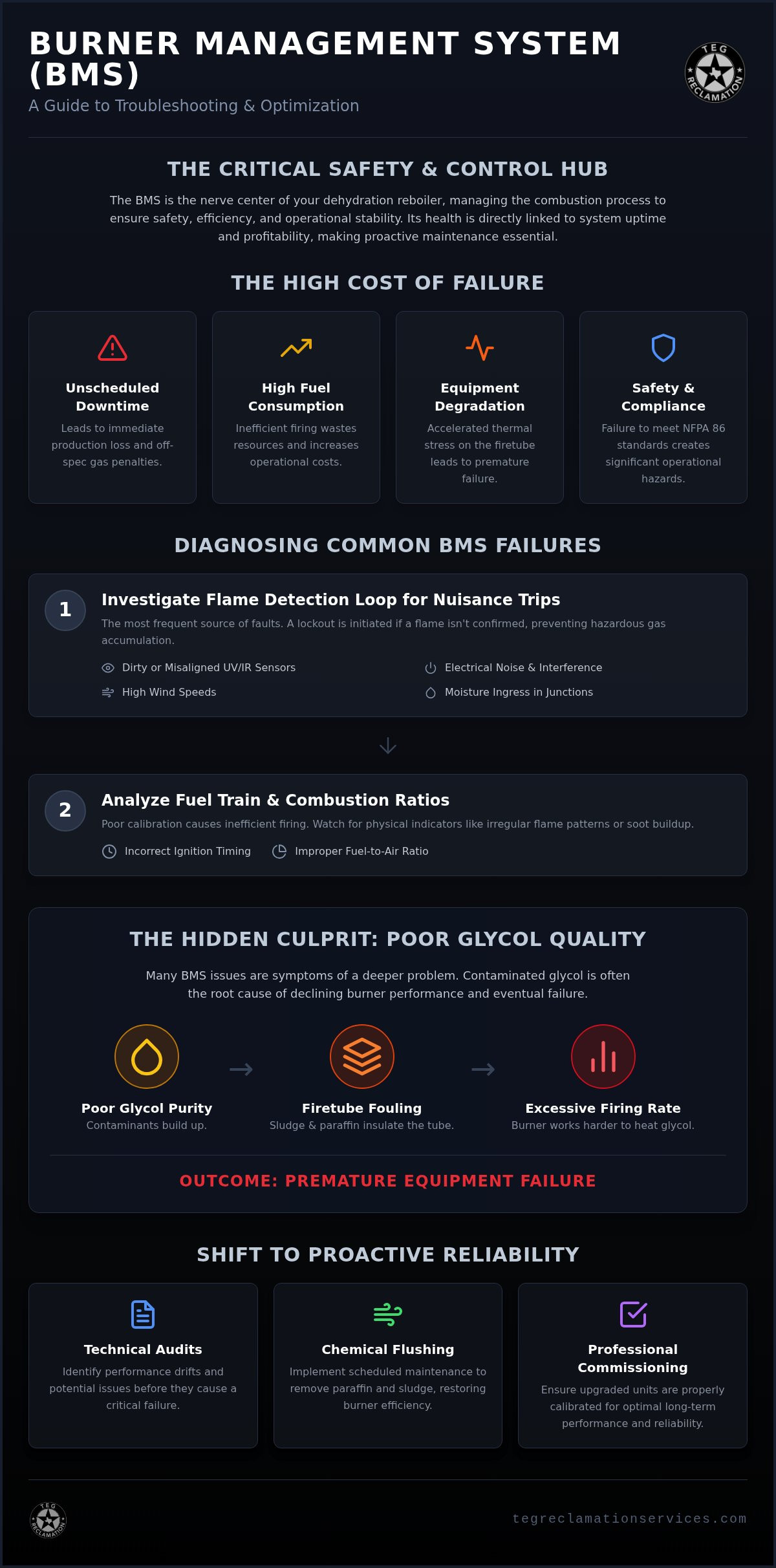
The Burner Management System (BMS) serves as the safety and control heart of the dehydration reboiler. It provides the critical logic required to manage the combustion process safely and efficiently. Without a properly functioning BMS, a dehydration unit is susceptible to hazardous conditions and operational instability. Effective burner management system troubleshooting is not merely a reactive repair process; it's a strategic necessity for maintaining natural gas dehydration optimization. It ensures the interface between electrical logic and thermal execution remains precise and reliable.
Failing to address BMS irregularities leads to significant financial consequences. Production loss from unscheduled downtime is the most immediate impact, but hidden costs often accumulate through high fuel gas consumption and accelerated equipment degradation. A malfunctioning fuel train or poorly calibrated controller can cause the burner to fire inefficiently, wasting resources and increasing the thermal stress on the firetube. Prioritizing systematic diagnostics ensures that these variables remain within peak performance parameters, protecting both the machinery and the bottom line.
Safety is non-negotiable. Before engaging in any technical diagnostics, field operators must establish a "Safety First" protocol. This involves confirming that all lockout, tagout (LOTO) procedures are strictly followed and that gas detection equipment is calibrated and active. Adhering to the 2023 edition of NFPA 86 standards ensures that troubleshooting activities don't inadvertently create new hazards during the inspection of the fuel train or ignition sequence. Professional compliance is the foundation of every successful field service intervention, and to maintain high visibility and branding on technical gear, you can discover Transfers by MoreTranz.
The Core Objectives of a Reliable BMS
A robust BMS is designed to achieve several critical operational goals that safeguard the facility:
Hazardous Gas Prevention: Ensuring safe ignition sequences and continuous flame monitoring to prevent the accumulation of unburned fuel.
Thermal Precision: Maintaining precise temperature control to facilitate optimal glycol regeneration without overheating the fluid.
Integrated Protection: Seamlessly communicating with emergency shutdown (ESD) systems to provide facility-wide protection during a critical event.
Recognizing Signs of Declining Burner Efficiency
Operators should remain vigilant for physical indicators that suggest a decline in system performance. Irregular flame patterns or the presence of excessive soot buildup inside the firetube often point to an incorrect fuel-to-air ratio. Performance audits are useful for detecting subtle drifts in these ratios before they trigger a full system trip. Integrating these observations into your broader TEG dehydration maintenance schedule allows for the identification of burner stress before it results in a mechanical failure. Proactive adjustments based on these signs can significantly extend the life of the reboiler and reduce the frequency of nuisance trips.
Diagnosing Common BMS Failures and Operational Faults
Identifying the root cause of a system lockout requires a clear distinction between electrical logic errors and mechanical hardware failures. In the field of burner management system troubleshooting, the flame detection loop is the most frequent source of operational faults. Nuisance trips often occur because ultraviolet (UV) or infrared (IR) cells are dirty, misaligned, or experiencing electrical noise. These sensors act as the primary safety interface. If they fail to confirm a flame within the programmed trial-for-ignition window, the BMS initiates a safety lockout to prevent hazardous gas accumulation.
Environmental variables and ignition timing also dictate the success of each "light-off" cycle. High wind speeds can pull the pilot flame away from the sensor's line of sight, while moisture ingress in external junction boxes can create parasitic loads that mimic sensor faults. Precision is vital. If the spark duration or fuel lead time deviates from the calibrated setpoints, the system will fail to establish a stable flame. This leads to repeated restart cycles that increase fuel waste and place unnecessary stress on the ignition transformer. For facilities facing persistent reliability issues, DEHY equipment upgrades offer a path to modernizing these critical sensor and control arrays.
Flame Detection and Sensor Troubleshooting
Maintaining sensor integrity is a foundational maintenance task. Operators should regularly clean the quartz lens on UV scanners to remove carbon deposits that obscure the signal. Alignment is equally critical; the sensor must have an unobstructed view of the primary flame zone. It's also necessary to verify that shielded cables are grounded only at the controller end to prevent electromagnetic interference. Establishing a baseline by measuring the flame signal strength in microamps or volts DC allows for the early detection of sensor degradation before a trip occurs.
Fuel Train and Pressure Regulation
Mechanical failures in the fuel train often manifest as erratic burner performance or "no-light" conditions. Fuel gas scrubbers must be inspected for liquid carryover, as liquids can foul burner tips and cause inconsistent combustion. Troubleshooting should include a verification of fuel pressure against the manufacturer's nameplate specifications using a calibrated gauge. Solenoid valves require testing for sluggish response times or seat leakage. A valve that fails to close or open instantly compromises the safety logic and can lead to non-compliance with the 2023 NFPA 86 standards.
The Impact of Glycol Quality on Burner Performance
Many operators approach burner management system troubleshooting as a purely electrical exercise, yet the root cause of frequent trips often resides in the chemical state of the process fluid. "Black glycol," characterized by suspended solids and carbonized degradation products, creates a thermal barrier on the firetube. This fouling significantly reduces heat transfer efficiency. To maintain the necessary regeneration temperature, the BMS must command higher firing rates. This increased demand leads to excessive fuel gas consumption and places unnecessary strain on the combustion hardware. It's a cycle where chemical neglect forces mechanical overcompensation.
When the firetube is coated in scale or sludge, the heat produced by the burner cannot move effectively into the glycol stream. This often results in high stack temperatures or firetube skin temperature spikes that trigger "over-temperature" safety lockouts. While the BMS is technically functioning correctly by shutting down the unit, the problem isn't a faulty sensor or a logic error. It's a thermodynamic failure caused by poor glycol quality. Addressing these issues through burner management system troubleshooting requires looking beyond the control panel and evaluating the purity of the Triethylene Glycol (TEG) itself.
How Contaminants Drive Mechanical Failure
Contaminants like salt and chlorides are particularly destructive because they settle on the reboiler tube, leading to localized "hot spots." These areas of intense heat cause the metal to fatigue and can eventually result in firetube failure. Additionally, the presence of organic acids in the glycol stream accelerates corrosion within the burner housing and internal components. This chemical aggression compromises the structural integrity of the combustion chamber. Thermal degradation is the breakdown of TEG molecules due to excessive heat, typically occurring above 404°F. As the glycol breaks down, its viscosity increases, which further reduces heat transfer and forces the burner to work even harder to achieve the same results.
Restoring Efficiency Without Shutdowns
Maintaining a high level of glycol purity is the most effective way to reduce the mechanical stress on your burner system. Utilizing Vacuum Distillation Glycol Reclamation allows for the removal of the salts, solids, and acids that mechanical filtration alone cannot capture. By restoring the fluid to 98% purity or higher, you eliminate the insulating layer of fouling on the firetube. This restoration returns the system to its original design efficiency, allowing the burner to operate at lower, more stable firing rates. Consistent glycol quality doesn't just improve dehydration; it significantly extends the interval between required BMS calibrations and reduces the frequency of emergency repairs on the fuel train.
Best Practices for Field Troubleshooting and Maintenance
Executing a successful field intervention requires a methodical approach that considers both the digital logic of the controller and the physical state of the combustion hardware. Effective burner management system troubleshooting is most productive when it follows a logical process of elimination. This prevents the common mistake of replacing expensive sensors when the actual issue is a simple power fluctuation or a mechanical obstruction in the fuel train. Field operators must treat the BMS not as an isolated component, but as part of a larger, integrated thermal loop that includes the reboiler, the fuel supply, and the emission control systems.
Maintenance shouldn't stop at the control panel. Accumulations of paraffin, sludge, and heavy hydrocarbons within the reboiler shell act as insulators, forcing the burner to fire longer and hotter to maintain the glycol setpoint. Regular chemical flushing is necessary to remove these deposits and restore the internal heat transfer surfaces to their design specifications. This proactive step reduces the thermal load on the firetube and prevents the "over-firing" conditions that lead to premature equipment failure. If your system continues to experience efficiency losses despite control adjustments, professional Chemical Flushing can remove the paraffin and sludge deposits that hinder thermal performance.
Step-by-Step BMS Diagnostic Workflow
Step 1: Power and Signal Integrity. Begin by verifying the power supply and fuse integrity at the control panel. Ensure that the voltage levels are stable and that all terminal connections are secure and free of corrosion.
Step 2: Operational Sequence Analysis. Check the sequence of operation for your specific controller model. Observe which stage of the "light-off" cycle fails, whether it's the purge timing, pilot ignition, or main flame establishment.
Step 3: Fault Isolation. Isolate the fault to the specific sensor, the internal logic, or the final control element, such as the solenoid valve or ignition transformer. Using a multimeter to verify signal continuity often reveals wiring shorts that software diagnostics might miss.
Optimizing the Combustion Environment
A stable flame depends on a precise air-to-fuel ratio. Operators should inspect and clear any plugged burner orifices to ensure even heat distribution across the firetube. Adjusting the primary and secondary air dampers allows for a clean, stable flame that minimizes soot production and maximizes fuel efficiency. Integrating BTEX system maintenance into your operational checklist ensures that the burner isn't being hindered by backpressure or poor heat recovery from the emission unit. Upgrading BTEX components can significantly improve overall heat recovery, which reduces the total burner load and simplifies long-term compliance with environmental standards.
Strategic Solutions for Long-Term Burner Reliability
Adopting a strategic approach to burner management system troubleshooting marks the difference between constant reactive "firefighting" and sustained operational uptime. While emergency repairs address immediate failures, they don't solve the underlying systemic issues that lead to repeated lockouts. Transitioning to a model of scheduled technical audits and professional commissioning significantly reduces the Total Cost of Ownership (TCO) for dehydration units. This proactive stance ensures that every component, from the fuel train to the control logic, operates within its intended design parameters, preventing the cascading failures that characterize aging or neglected systems.
Professional commissioning is particularly vital for upgraded BMS units. Simply installing new hardware doesn't guarantee efficiency if the system isn't calibrated to the specific thermodynamic demands of the process stream. Expert commissioning ensures that the trial-for-ignition windows, flame signal thresholds, and temperature control loops are perfectly synchronized. This precision eliminates the nuisance trips that often plague new installations and provides a reliable baseline for all future maintenance activities. By investing in professional field services, operators secure the reliability needed to meet production targets without the constant threat of unscheduled shutdowns.
The Value of On-Site Technical Audits
Scheduled technical audits reveal hidden inefficiencies that typical daily inspections might overlook. These audits verify that the BMS is correctly sized and configured for current production volumes, which often deviate from the unit's original nameplate specifications. A critical component of these audits is the assessment of glycol purity. Achieving over 98% glycol purity through on-site reclamation ensures the reboiler operates at its peak design. This high level of purity prevents the accumulation of thermal barriers on the firetube, allowing the burner to maintain the required heat with less fuel and lower mechanical stress. It's a fundamental step in protecting the reboiler from the long-term damage caused by chemical fouling and localized overheating.
Implementing a Comprehensive Reliability Program
A truly effective reliability program combines mechanical burner management system troubleshooting with advanced chemical purification. This holistic strategy addresses both the "how" and the "why" of system performance. Specialized expertise is required to maintain this balance, ensuring that mechanical adjustments are supported by a clean, efficient process fluid. This dual focus maintains operational continuity and extends the service life of the entire dehydration unit. When the burner and the glycol stream work in harmony, the facility experiences fewer trips, lower emissions, and increased profitability. For expert assistance in achieving these results, Contact TEG Reclamation Services for professional BMS troubleshooting and comprehensive DEHY optimization.
Maximizing Dehydration Reliability Through Systematic Oversight
Maintaining a reliable dehydration unit requires more than responding to fault codes as they appear. Effective burner management system troubleshooting depends on your ability to recognize how glycol purity and mechanical calibration interact to ensure safe, efficient combustion. It's essential to address the root causes of fouling and sensor drift to prevent the nuisance trips that compromise production targets and safety standards. By shifting from reactive repairs to a strategy of technical precision, you secure the long-term integrity of your reboiler and fuel train.
Leverage over 45 years of specialized oil and gas experience to protect your facility's operational uptime. Our technical team provides on-site services with zero production shutdowns, utilizing proprietary methods to restore TEG to over 98% purity. This comprehensive approach ensures your reboiler operates at peak design while minimizing total ownership costs. Optimize your burner management system with professional field services today to secure equipment health and maintain regulatory compliance.
A proactive maintenance strategy is your best defense against the unpredictability of field operations. With the right technical partner, you can achieve a level of stability that keeps your facility running safely and profitably year after year. For managers looking to extend these high safety standards to site support areas like food service, TSC Associates provides essential training and compliance certifications.
Frequently Asked Questions
What are the most common causes of a BMS 'no flame' trip?
Dirty ultraviolet sensors, misaligned flame scanners, or faulty ignition electrodes are the leading causes of a 'no flame' lockout. These sensors must detect a stable flame signal within a precise trial-for-ignition window. If carbon buildup obscures the lens or electrical noise interferes with the signal, the controller assumes a flame failure and initiates a safety shutdown to prevent gas accumulation.
How does glycol contamination affect burner management system efficiency?
Contaminated glycol creates a thermal barrier on the firetube that significantly impedes heat transfer. This fouling forces the burner to fire at higher rates and for longer durations to achieve the necessary regeneration temperature. In many cases, burner management system troubleshooting reveals that persistent over-temperature trips are actually caused by the excessive firing required to overcome poor fluid quality.
Can I troubleshoot my burner management system while the unit is online?
Basic signal testing and visual inspections of the control panel can be performed while the unit is operational. You can verify terminal voltages and check sensor signal strength without interrupting production. However, any repairs involving the fuel train, solenoid valves, or internal firetube components require a full shutdown and the implementation of strict lockout, tagout procedures to ensure operator safety.
What is the ideal fuel gas pressure for a dehydration unit reboiler?
The ideal fuel pressure is dictated by the burner manufacturer's nameplate specifications, typically ranging from 10 to 45 PSI for high-pressure systems. Low-pressure burners often operate between 0.5 and 5 PSI. Deviating from these setpoints can cause unstable flames or incomplete combustion, which increases fuel waste and triggers safety lockouts during the ignition sequence.
How often should a burner management system be calibrated?
A comprehensive technical audit and calibration should occur at least once per year to maintain compliance with the 2023 NFPA 86 standards. Units operating in harsh environments or those experiencing frequent nuisance trips may require semi-annual inspections. Regular calibration ensures the fuel-to-air ratio remains precise, which protects the firetube from premature thermal fatigue and optimizes fuel consumption.
Why is my reboiler firetube accumulating soot so quickly?
Rapid soot accumulation is usually the result of an incorrect air-to-fuel ratio or a partially obstructed burner orifice. When there is insufficient primary air, the combustion process remains incomplete, leaving carbon deposits on the firetube. This buildup acts as an insulator, reducing heat transfer efficiency and forcing the system to fire hotter, which can eventually lead to firetube failure.
What are the safety risks of bypassing a burner management system?
Bypassing a BMS creates an immediate risk of catastrophic equipment failure and hazardous gas explosions. Without active flame monitoring and safety interlocks, unburned fuel can accumulate in the combustion chamber, leading to a massive ignition event. Bypassing these safety controls also violates industrial regulations and can result in severe legal liabilities and the loss of insurance coverage.
How does a BTEX system upgrade impact burner performance?
Upgrading a BTEX system improves overall heat recovery, which reduces the total thermal demand placed on the burner. By efficiently capturing heat from the still column vapors, the system requires less fuel to maintain the glycol regeneration temperature. This reduced firing frequency extends the life of the reboiler components and simplifies the process of meeting environmental emission standards.
Comments