
Chemical Flushing for Production Equipment: A Guide
A production system that looks contaminated doesn’t automatically need a chemical flush. The right decision depends on whether the observed condition is one flushing can address and what the equipment must meet afterward. For operators considering chemical flushing production equipment, that distinction helps prevent a cleaning scope from being mistaken for a mechanical repair.
Before coordinating equipment access and operating requirements, start with the symptoms and equipment context rather than assuming a standard procedure will fit. Prepare the affected asset, the concern observed, relevant maintenance history, and the outcome you need. You can discuss these details without disclosing proprietary process information.
This guide explains when an assessment may be warranted, what information to prepare, and how to agree on scope and follow-up with a qualified provider. It also compares chemical flushing with mechanical cleaning, component repair, and glycol reclamation, so you can identify the appropriate service path while keeping internal methods and process information confidential.
Table of Contents
What Chemical Flushing Production Equipment Means, and What It Is Intended to Address
Chemical flushing is a specialized equipment-cleaning service that uses a planned cleaning scope to address deposits or other internal cleanliness concerns in selected production equipment. Suitability depends on the equipment’s condition, materials, service history, and the operator’s objectives. Chemical flushing production equipment describes a service category, not a single procedure or a guaranteed result.
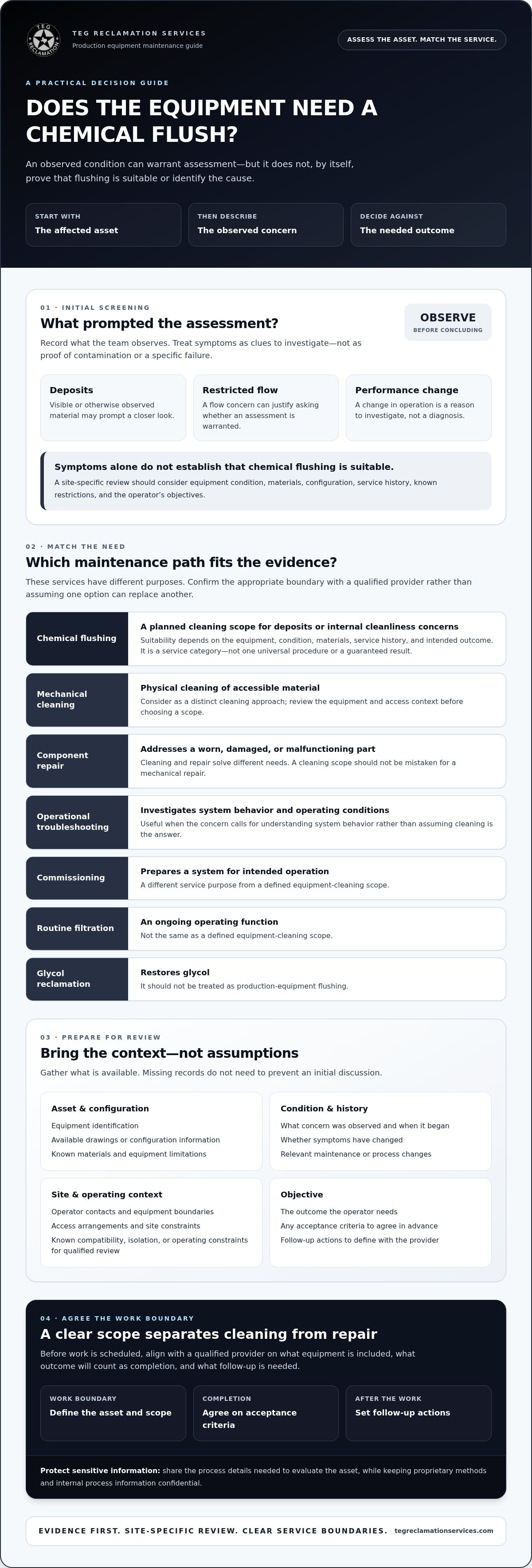
Cleaning and repair address different needs. Deposits, restricted flow, or a performance change may prompt an assessment, but those symptoms don’t establish the cause or prove that cleaning is appropriate. Worn, damaged, or malfunctioning components may need repair or further diagnosis. Assess the asset and available evidence before deciding whether flushing belongs in the maintenance plan.
The term can also refer to different cleaning approaches across industries. Clean-in-place (CIP), for example, describes cleaning internal surfaces without disassembly. This general reference explains one use of chemical cleaning, but it doesn’t determine which approach or equipment is suitable for an oil and gas operation. Confirm the service boundary and any relevant methods with a qualified provider.
What production-equipment conditions may prompt an assessment?
Observed deposits, restricted flow, or a change in equipment performance can justify asking whether an assessment is warranted. These are indicators to investigate, not proof of contamination or a specific failure. Before contacting a provider, document:
The affected equipment and the operating concern observed.
When the symptoms began and whether they have changed.
Recent maintenance or process changes that may help explain the timing.
The operator’s desired outcome and any known equipment limitations.
This record gives a provider useful context without requiring disclosure of proprietary process details. It also separates what the team has observed from assumptions about the root cause.
How is chemical flushing different from related maintenance services?
Each maintenance option has a distinct purpose. Mechanical cleaning addresses accessible material through physical means; component repair addresses a worn, damaged, or malfunctioning part. Commissioning prepares a system for intended operation, while operational troubleshooting investigates system behavior and conditions. The evidence and site-specific review needed will vary.
Routine filtration is an ongoing operating function, not the same as a defined equipment-cleaning scope. Glycol reclamation restores glycol, so it should not be treated as equipment flushing. For more context, see the guide to glycol chemical cleaning for dehydration units. Confirm the relevant service boundary with a provider rather than assuming one option can replace another.
How to Assess Whether Chemical Flushing Fits Your Production Equipment
Use an initial screening to organize the facts, not to replace a site-specific engineering review. Identify the affected asset, describe the symptoms, note when they occur, and state the outcome the operator needs. Keep observations separate from conclusions. A performance change may justify investigation, but it doesn’t show by itself that cleaning is the right response.
Observed symptoms alone don’t establish whether chemical flushing is suitable for an asset. A qualified review should consider equipment materials and configuration, service history, known restrictions, and the operator’s objectives. Share the information needed for assessment while protecting sensitive process details. Before scheduling, agree on work boundaries and what will count as completion.
Which equipment and operating records should teams review?
Gather what is available rather than delaying an initial discussion because a record is missing. Useful context can include:
Equipment identification and available drawings or configuration information.
Known material information and maintenance or service records.
A clear description of the concern, when it arose, and any recent maintenance or process changes.
Known compatibility, access, isolation, or operating constraints that need qualified review.
Share only the process information needed to evaluate the asset. The CDC’s reference on decontamination procedures for chemical process equipment offers broader context on planning and verification. It isn’t a substitute for reviewing the specific equipment and site conditions.
Which questions help confirm the service scope?
Before scheduling, ask the provider to separate confirmed scope from items that depend on further inspection or site assessment. Confirm which equipment is included and excluded, what operator coordination is needed, and who is responsible for access and site arrangements.
Agree on acceptance criteria and closeout documentation in advance. Ask how the proposed scope accounts for the identified materials and operator requirements, and what follow-up is expected if the agreed criteria aren’t met. Clear answers help prevent different expectations about what the service includes.
TEG Reclamation Services provides chemical flushing and process-equipment support for oil and gas operators. To discuss chemical flushing service scope, start with the affected equipment, known constraints, and intended outcome, without disclosing proprietary process details.
Chemical Flushing Versus Other Production-Equipment Maintenance Options
Choose a maintenance option based on the diagnosed concern, not a preferred service. Chemical flushing production equipment may be worth evaluating when evidence points to removable deposits or contamination, but it isn’t a universal fix. Equipment materials, condition, access, and operating requirements can make flushing unsuitable or indicate a different response. Review service fit and potential operational impact with a qualified provider before setting scope.
The comparison below is a screening aid, not a substitute for asset-specific evaluation. Evidence may support further investigation without confirming a root cause.
When might cleaning be evaluated instead of repair?
Cleaning may be considered when available evidence suggests removable contamination or deposits could be relevant to the concern. It shouldn’t be assumed to resolve the issue. Damage, wear, leakage, or persistent malfunction may call for inspection or repair instead, and more than one issue can be present. Establish the likely cause and equipment suitability before selecting a cleaning scope.
What should operators compare before selecting an approach?
Compare the diagnosed concern, material compatibility, equipment access, proposed work boundaries, and the verification needed to determine whether the objective was met. Ask the provider and site team how the work could affect operations, what coordination is required, and which conditions must be resolved before scheduling. Base the decision on the asset and agreed outcome, not on assumed procedures.
Glycol reclamation is a separate service for restoring glycol, not a substitute for equipment cleaning or repair. Operators seeking that distinct context can refer to glycol chemical cleaning for dehydration units and confirm which service applies to their specific need.
How to Plan Chemical Flushing for Production Equipment
Plan chemical flushing around an agreed scope and a site-specific review of the equipment, operating constraints, and intended outcome. Move from assessment to scope confirmation, site coordination, execution oversight, and closeout. For each stage, identify the contact, decision path, and record of what has been agreed.
Before scheduling, identify equipment boundaries, operator contacts, access arrangements, and site-specific constraints. Confirm who can make operational decisions and who coordinates access and communication. This preparation helps identify unresolved questions before work is planned, rather than relying on assumptions once activity is underway.
What information should be confirmed before service?
Review the equipment scope with the provider and share available records, material information, and relevant service history. Discuss access arrangements and operator constraints that could affect planning. Raise questions about material compatibility or site safety for qualified review instead of guessing or relying on generic guidance.
Agree on responsibilities before work begins. Name the operator contact for site coordination, clarify how operational decisions will be handled, and confirm who will provide or review service documentation. Keep proprietary process details confidential and provide only the information needed to assess the equipment.
Confirm work boundaries in writing. Identify the equipment included and excluded, assumptions the scope depends on, how changes will be discussed, and what communication the site team expects during the work. Chemical recipes, concentrations, temperatures, pressures, sequencing, and proprietary equipment setups belong in qualified, project-specific planning, not a general guide.
How should operators review completion and follow-up?
Before execution, define acceptance criteria that the operator and provider can evaluate, and agree on the records available at closeout. Afterward, compare the documentation with the agreed scope. Record outstanding observations and decide whether additional inspection or other maintenance is appropriate. Completion of a defined scope doesn’t establish that every separate operating concern has been resolved.
If follow-up concerns relate specifically to glycol condition, consult relevant glycol contamination removal guidance and keep that issue distinct from equipment-flushing closeout. Glycol reclamation restores glycol; it shouldn’t be treated as a substitute for a defined equipment-cleaning scope.
TEG Reclamation Services provides chemical flushing and process-equipment support for oil and gas operators. To discuss an assessment, share the equipment boundaries, known constraints, and desired outcome with TEG Reclamation Services about chemical flushing.
When to Engage a Chemical Flushing Service for Production Equipment
Consider a service assessment when an operating concern may relate to equipment cleanliness and the cause or appropriate response isn’t clear. A provider discussion can help determine whether chemical flushing is relevant to the asset, what information is needed for assessment, and where the proposed scope begins and ends. An inquiry is a starting point, not confirmation that flushing is suitable or will produce a particular result.
Its other services include DEHY system commissioning, equipment upgrades, field troubleshooting, and glycol reclamation. These are distinct offerings, and the right service depends on the equipment and concern. Glycol reclamation restores glycol; it shouldn’t be treated as equipment flushing.
What should an operator include in a service inquiry?
A concise, non-sensitive summary helps the provider understand the request without exposing proprietary process details. Include:
The equipment or system involved and the observed concern.
Relevant service history, recent maintenance, and changes related to the issue.
The operator’s objective and any available equipment or maintenance records.
Known access, site, compatibility, or operating constraints, plus timing considerations.
The decision-makers and site contacts who can review scope and coordinate next steps.
Separate confirmed observations from suspected causes. Ask what additional information is needed, which equipment can be assessed, what is included or excluded, and whether a site-specific review is required before the scope can be confirmed. This keeps the discussion useful while limiting disclosure to information relevant to the assessment.
How does TEG Reclamation Services support equipment maintenance?
TEG Reclamation Services offers chemical flushing alongside process-equipment support for oil and gas operations. Other services include DEHY commissioning, equipment upgrades, field troubleshooting, and glycol reclamation, but these aren’t interchangeable with flushing. Focus the initial provider discussion on the affected equipment, its condition, site constraints, and the operator’s desired outcome.
Founder Rocky McDonald brings more than 45 years of oil and gas process-equipment experience. That background informs the company’s equipment-support work, but it isn’t a guarantee of a particular flushing outcome. Confirm service fit, scope, responsibilities, and acceptance criteria for the asset in question.
For an initial discussion, discuss chemical flushing and equipment-support needs with TEG Reclamation Services.
Make the Next Maintenance Decision With a Clear Scope
Consider chemical flushing production equipment in light of the asset’s condition, materials, service history, and the operator’s objective. Observed symptoms can prompt an assessment, but they don’t prove flushing is suitable. Comparing cleaning with repair and troubleshooting helps align the response with the concern.
Before scheduling, prepare relevant equipment information, identify site constraints and decision-makers, and agree with the provider on work boundaries and acceptance criteria. These steps support a focused evaluation while helping protect proprietary process details.
TEG Reclamation Services provides chemical flushing and process-equipment support, including field troubleshooting and DEHY commissioning. Founder Rocky McDonald brings more than 45 years of oil and gas process-equipment experience. To discuss your requirements and determine appropriate next steps, contact TEG Reclamation Services about your production-equipment service requirements.
A clear assessment is a practical starting point for making a confident maintenance decision.
Frequently Asked Questions
What is chemical flushing for production equipment?
Chemical flushing for production equipment is a specialized cleaning service considered for a defined asset and operating concern. Its purpose and suitability depend on equipment materials, condition, service history, and site requirements. The term doesn’t mean every system needs flushing or that cleaning will repair a fault. Before planning work, operators and a qualified provider should agree on equipment boundaries, the intended objective, and acceptance criteria.
When should production equipment be evaluated for chemical flushing?
Consider requesting an assessment when a persistent operating concern or suspected contamination warrants investigation. A change in flow or performance may be a reason to review the equipment, but symptoms alone don’t identify the cause or establish that flushing is appropriate. Share available equipment information, relevant maintenance history, recent changes, and known operating constraints. A provider can then review whether further assessment or a defined service scope is warranted.
Can chemical flushing fix mechanical damage in production equipment?
No. Chemical flushing shouldn’t be assumed to repair worn, damaged, leaking, or malfunctioning components. It’s a cleaning service, and its suitability depends on the equipment’s actual condition and the intended objective. If inspection or operating history points to mechanical damage or a persistent fault, arrange an appropriate repair assessment. Discuss the findings with a qualified provider to determine whether cleaning has a role alongside, or instead of, other maintenance.
How do operators decide between chemical flushing and mechanical cleaning?
Start by comparing the suspected condition, equipment materials, access, and desired outcome. Chemical flushing and mechanical cleaning have different scope considerations, and neither is automatically suitable for every asset. Ask a qualified provider to review the equipment-specific evidence, explain the limitations of each option, and identify how completion would be evaluated. Base the decision on that assessment, not on a generic rule or assumed procedure.
What happens if chemical flushing is not suitable for the equipment?
If flushing doesn’t appear suitable, ask the provider to explain the concern and identify any additional information or inspection needed to assess the asset. Depending on the findings, the operator may need to consider mechanical cleaning, component repair, or operational troubleshooting. Those options also require appropriate evaluation. Don’t proceed based on assumed compatibility; resolve material, access, or operating uncertainties through qualified, site-specific review before choosing a maintenance path.
What information should I provide when requesting chemical flushing?
Provide the equipment identification, a concise description of the concern, available materials or drawings information, relevant maintenance history, and known site constraints. State the objective and any documentation requirements, too. Share only process details needed and approved for assessment, especially if they’re proprietary. The provider can clarify what additional information is necessary, which equipment may be within scope, and whether a site-specific review is needed before work can be planned.
Is chemical flushing the same as glycol reclamation?
No. Chemical flushing is an equipment-cleaning service, while glycol reclamation is a separate service for restoring contaminated triethylene glycol. They address different scopes and aren’t interchangeable. If the concern relates to equipment cleanliness, describe the asset and observed condition. If it concerns glycol condition, explain that separately so the provider can identify the relevant service for review. Don’t assume that reclamation cleans equipment or that flushing restores glycol.


Comments