
Cost of Glycol Replacement vs Reclamation: Industrial DEHY Financial Guide
Dumping degraded triethylene glycol and hauling in fresh chemistry might seem like the cleanest fix for an underperforming dehydration unit, but it frequently masks severe operational losses. When plant managers analyze the true cost of glycol replacement vs reclamation, the purchase invoice for virgin fluid represents only a fraction of the real balance sheet impact. You already understand how quickly fouled fluid drives up reboiler fuel consumption, induces foaming, and damages circulation pumps. Still, treating fluid renewal as a routine chemical purchase ignores the crippling expense of deferred gas production and hazardous waste liabilities.
This financial guide breaks down the complete lifecycle economics, operational downtime risks, and mechanical consequences of virgin chemical changeouts versus on-site mobile purification. You'll discover how purifying contaminated TEG back to over 98% purity during live gas production protects facility revenue, cuts fluid expenditures, and extends the operating life of your critical reboilers and pumps.
Table of Contents
The True Economics of Natural Gas Dehydration Glycol Management
Natural gas treating plants cannot compromise on dew-point depression. When triethylene glycol (TEG) inventories degrade, operators face a recurring operational crossroads that directly impacts the bottom line. Calculating the true cost of glycol replacement vs reclamation demands looking far past the purchase order line items for virgin fluid. Operating budgets encompass production throughput, mechanical reliability, and the heavy regulatory framework governing industrial operations.
Every barrel of circulating chemical endures continuous thermal stress, oxygen contact, and feed-gas contaminants. As water vapor is stripped in the contactor column, trace constituents enter the closed loop. Over continuous operational cycles, this thermal and chemical stress systematically degrades raw chemical stock, requiring an authoritative evaluation of long-term lifecycle expenditures.
Direct Chemical Acquisition Costs vs Total Lifecycle Burden
Procuring fresh chemical creates a complex administrative and logistical chain. Facility managers must manage bulk freight transportation, offloading permits, and chemical storage footprint. Beyond raw volume charges, recharging an entire system generates substantial site labor expenses. Operations crews must manage drain-down sequences, purge circulation loops, and coordinate recharge pumping.
Crucially, spent fluid does not simply vanish. Circulating fluid absorbs benzene, toluene, ethylbenzene, and xylene (BTEX) compounds from live hydrocarbon streams. This volatile organic contamination alters the waste profile, triggering strict cradle-to-grave manifest tracking under RCRA frameworks. The resulting hauling fees, disposal surcharges, and hazardous handling compliance rapidly eclipse initial procurement projections.
The Physical Degradation Mechanisms of Triethylene Glycol
Within a standard glycol dehydration process, reboiler skin temperatures break down TEG into corrosive organic acids such as glycolic, formic, and acetic acid. These acidic byproducts lower fluid pH, accelerating metallurgy loss throughout fire tubes and piping spools.
Thermal cracking: Prolonged heat stress generates heavy, viscous polymers that coat heat-exchange surfaces and lower thermal efficiency.
Inorganic salt accumulation: Produced water carryover introduces dissolved chlorides that drop out of solution, forming hard, insulating scale on fire tubes and stripping columns.
Surface tension destabilization: Degraded chemical stock readily binds with condensed liquid hydrocarbons and upstream corrosion inhibitors, driving chronic foaming events.
Left unchecked, degraded TEG causes massive hydrocarbon vapor carryover, trips safety relief valves, and forces operators to dial back plant throughput. Analyzing the cost of glycol replacement vs reclamation reveals that chemical contamination compromises the entire mechanical integrity of the production train.
Full Fluid Replacement: Financial Realities, Risks, and Downtime
Total fluid dumping is rarely as simple as ordering replacement chemical. When gas processing facilities opt for full fluid changeouts, the direct purchase invoice represents only the initial financial exposure. A true assessment of the cost of glycol replacement vs reclamation reveals that physical downtime, transit logistics, and hazardous waste liabilities consistently eclipse raw chemical expenses.
Introducing fresh chemistry into an uncleaned system creates rapid financial depreciation. Residual tar, polymerized glycols, and corrosive iron sulfide scale remain inside the packing, contactor trays, and heat exchangers. The incoming virgin fluid acts as a solvent, mobilizing these settled contaminants. Within weeks, the pristine charge discolors, drops in pH, and exhibits thermal degradation characteristics nearly identical to the discarded batch.
Logistical Burdens, Trucking Overhead, and Environmental Liabilities
Coordinating fluid replacement triggers extensive off-site logistics. Because operational TEG readily absorbs aromatic hydrocarbons from wet gas streams, spent inventories carry strict regulatory classifications. Transporting this volume off-site requires certified hazardous liquid haulers, specialized vacuum trucks, and legally binding cradle-to-grave waste manifests.
Every transit mile elevates corporate liability. Hauling thousands of gallons of contaminated fluid across public roadways introduces severe spill exposures, road-use permitting overhead, and third-party disposal surcharges. Federal regulators continuously scrutinize emissions and handling practices; guidance from the EPA on Glycol Optimization reinforces that minimizing overall chemical throughput and emissions is essential for long-term plant compliance.
Facility Turnarounds and the Cost of Deferred Gas Production
Offline changeouts carry enormous production penalties. Draining a contactor loop, depressurizing vessels, flushing lines, and reloading chemical requires taking dehydration trains entirely offline. In midstream operations, halting gas transmission runs up steep deferred revenue figures every single hour the plant sits idle.
Extended turnaround windows: Manual draining, confined-space entry, and physical vessel rinses regularly stretch planned outages past schedule.
Residual contamination risks: Skimping on vessel decontamination guarantees premature degradation of the incoming charge.
Production deferrals: Revenue lost from halted gas deliveries rapidly dwarfs the initial purchase cost of fresh chemistry.
When system internals contain heavy carbonaceous fouling and hard salt deposits, simple fluid dumping fails to restore thermal transfer. If an offline turnaround is mandatory, pairing mechanical work with targeted glycol chemical cleaning strips stubborn degradation products from fire tubes before refilling. However, avoiding these costly outages entirely through specialized on-site treatment delivers superior financial stability for gas dehydration facilities.
On-Site Glycol Reclamation: Engineering Efficiency and Zero Downtime
Modern dehydration operations cannot afford the revenue losses tied to facility turnarounds. Mobile vacuum distillation reclamation resolves this dilemma by restoring fouled inventory directly at the plant battery. Rather than draining the system and discarding usable chemical, specialized mobile rigs tap into operating loops to purify chemistry without disturbing active processing. This approach fundamentally resets the cost of glycol replacement vs reclamation, allowing operators to preserve capital while sustaining sales gas deliveries.
Operating under deep vacuum lowers fluid boiling points, isolating triethylene glycol without exposing the chemistry to thermal cracking thresholds. High-recovery separation returns the purified base chemical to over 98% purity. Because the bulk volume stays on location, purchasing fresh batches becomes unnecessary.
Continuous Sidestream Vacuum Distillation Without Shutdowns
Mobile reclamation equipment integrates directly into active processing trains via dedicated slipstream tie-ins. The system siphons a steady flow of degraded chemical from the circulation loop, processes the volume through low-temperature vacuum separation, and injects restored, high-purity fluid back into the surge tank.
Dehydration trains stay fully operational throughout the campaign. Contactors maintain gas contact, stripping moisture to exact contract limits while fluid quality improves in real time. Rigorous process modeling, such as NETL Glycol Dehydration Data, highlights how tightly dehydration efficiency aligns with reboiler energy demands. Purifying inventory online stabilizes these thermodynamic duties without choking pipeline throughput.
Targeted Removal of Non-Volatile Impurities, Salts, and Solids
Standard surface filters trap basic particulates, but they cannot address dissolved contamination. Vacuum distillation physically strips the non-volatile compounds that degrade fluid chemistry:
Inorganic chlorides: Extracts dissolved salts that standard mechanical filtration misses, preventing severe hot-spot scaling across firetubes.
Corrosive degradation acids: Strips out low-molecular-weight organic acids to restore stable operating pH.
Polymerized sludges: Separates suspended heavy hydrocarbons and thermal degradation polymers.
For systems handling aggressively soured gas or high salt carryover, executing structured glycol contamination removal preserves baseline fluid integrity before severe foaming occurs.
Protecting Critical Assets and Extending Component Longevity
Clean chemical delivers immediate mechanical dividends. Eliminating abrasive suspended solids and corrosive salts stops erosive wear on pump seals, check valves, and piston rods. Maintaining neutral pH levels prevents rapid metallurgic degradation across contactor internals and reboiler shell walls.
Clean inventory directly preserves pumping hardware. Abrasive particulates quickly destroy internal check valves and dynamic elastomer packings, leading to frequent loss of circulation. Maintaining high-purity fluid safeguards mechanical components, preventing the need for emergency Kimray pump repair and extending the mean time between overhauls across the facility.
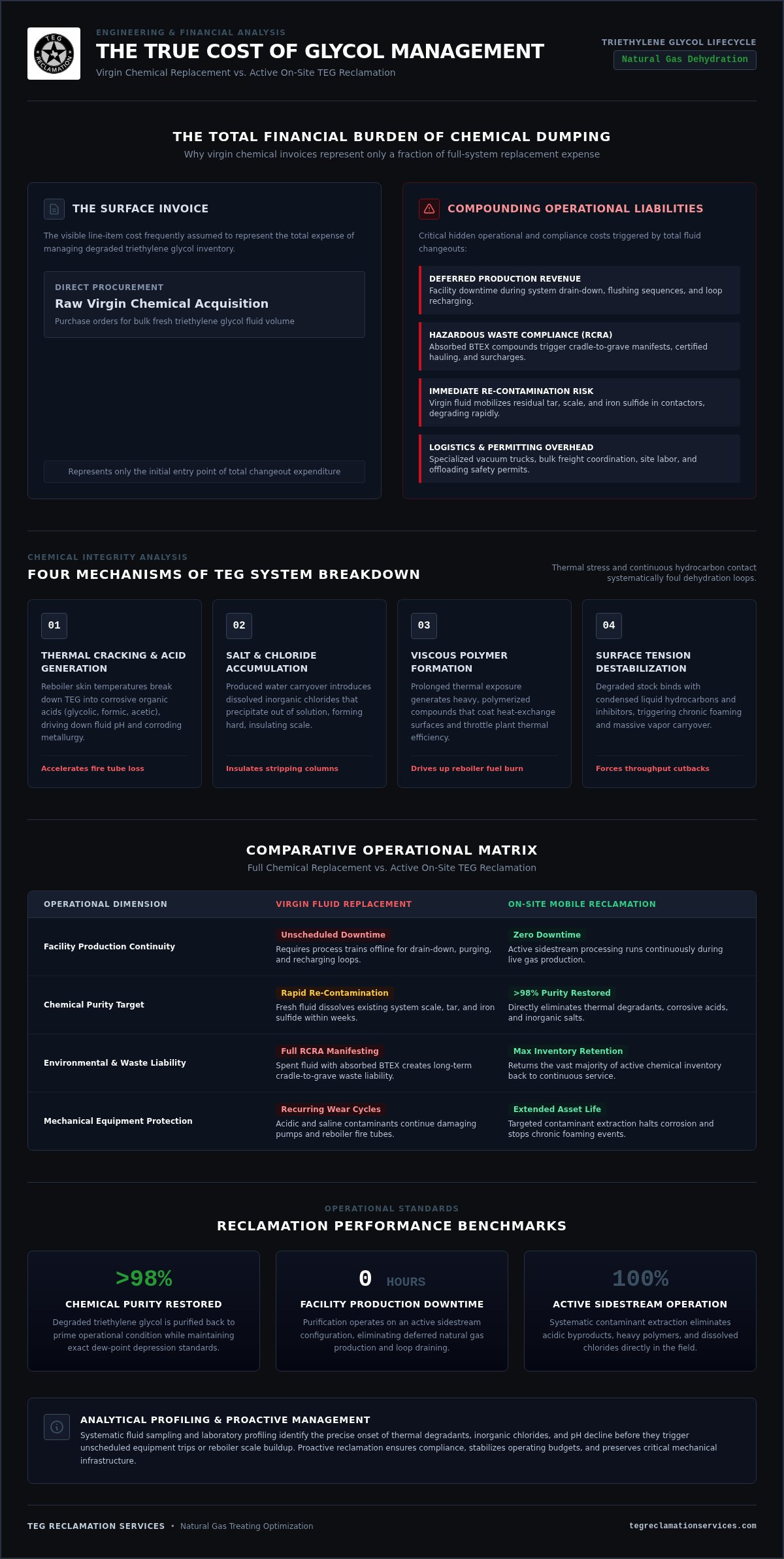
Replacement vs. Reclamation: Comparative Financial and Operational Matrix
Direct comparisons between fluid disposal and purification highlight stark differences in operational efficiency. Calculating the total cost of glycol replacement vs reclamation requires modeling the recovery yields of your existing volume alongside the hidden overhead of raw fluid replenishment. Mobile on-site vacuum distillation systematically recovers up to 90% to 95% of active inventory, drastically reducing the net volume of replacement chemistry required across a facility's lifecycle.
Zero-outage execution shifts the financial model entirely. By operating continuously on live dehydration systems, on-site purification bypasses the steep production curtailments and turnaround scheduling that traditionally define full changeouts. Facilities retain uninterrupted pipeline sales volume while upgrading chemical quality back to like-new operational parameters.
Capital Expenditure and Direct Chemical Volume Comparison
Amortizing on-site reclamation against repeated chemical purchases changes long-term operating budgets. Rather than allocating capital for full fresh inventory replacements every few years, plants preserve their working volume through targeted mobile purification campaigns.
Eliminated chemical staging: Operators avoid the freight coordination, demurrage charges, and yard storage risks of managing hundreds of barrels or dozens of chemical totes.
Drastic reduction in disposal fees: Extracting concentrated contaminants leaves only a tiny fraction of residual waste, eliminating bulk vacuum truck hauling and endless manifest filings.
Restored physical properties: Returning working fluid to over 98% purity re-establishes optimal boiling curves, restores neutral pH, and re-secures precise water-absorption rates.
Stabilizing these parameters ensures steady gas dew points, protects reboiler burner management systems from excessive firing duty, and shields plant margins from chemical market volatility.
Environmental Sustainability, Carbon Footprint, and ESG Impact
Corporate environmental mandates increasingly focus on circular resource management. Reclaiming industrial glycols in place delivers immediate Scope 3 emissions advantages by reducing the manufacturing demand for energy-intensive petrochemical synthesis. Producing virgin triethylene glycol relies on fossil fuel cracking and multi-stage chemical refining, carrying a substantial carbon baseline.
Site-based processing removes cross-country hazardous chemical transport from corporate supply chains. Decreasing heavy highway freight reduces transit diesel emissions and mitigates public environmental liability. Facilities that utilize mobile closed-loop processing align daily plant operations with measurable circular economy goals, converting a recurring hazardous waste stream into an indefinitely reusable asset.
To eliminate unnecessary chemical turnover and run comparative financial modeling on your live inventory, explore custom engineering support through TEG Reclamation Services.
Implementing an On-Site Glycol Reclamation Strategy
Transitioning from periodic fluid changeouts to active purification requires an organized operational workflow. Evaluating the true cost of glycol replacement vs reclamation begins well before service trailers arrive at the facility gate. It starts with baseline chemical verification, defining exact contamination levels to establish a clear intervention threshold before severe fouling damages system metallurgy.
Specialized mobile rigs deploy nationwide directly to upstream central delivery points, midstream compressor stations, and large gas processing facilities. Operating as self-contained processing platforms, these mobile units execute purification campaigns without interrupting primary dehydration throughput.
Fluid Sampling and Laboratory Analytical Audits
Precision lab analytics eliminate guesswork from chemical management. Routine testing tracks physical and chemical indicators across the circulation loop to profile fluid aging:
pH levels: Drops below neutral (pH 7.0) indicate organic acid formation from thermal degradation, signaling immediate corrosion risks.
Refractive index and water content: Karl Fischer titration and refractometry confirm baseline purity and detect dilution issues.
Dissolved chlorides: High salt levels confirm produced water carryover, providing an early warning before scale crusts reboiler tubes.
Suspended solids: Particulate quantification reveals the presence of abrasive iron sulfides and degraded polymers.
Identifying these diagnostic markers early lets operators schedule mobile purification before degraded properties trigger contactor foaming or sour gas trips.
Turnkey Field Execution and Tie-In Integration
Rig integration occurs seamlessly at designated low-pressure battery tie-ins. Field technicians establish supply connections at low-pressure process points, such as the glycol flash separator, surge tank, or reboiler overflow. Purified effluent then routes directly back into active circulation.
Dehydration trains run at normal process capacity throughout the entire campaign. On-site field testing continuously samples output chemistry, tracking salt separation, acid removal, and overall purity until the bulk loop surpasses the target >98% purity benchmark. Once restored, technicians disconnect the closed-loop tie-ins, demobilize the mobile rig, and leave the system running at baseline thermal efficiency.
Factoring analytical precision and turnkey execution into the total cost of glycol replacement vs reclamation demonstrates that mobile purification delivers predictable chemical control while entirely avoiding facility turnaround liabilities.
Optimize Your Dehydration Economics and Protect Plant Uptime
Managing dehydration operating expenditures requires looking beyond chemical purchase orders. When weighing the complete cost of glycol replacement vs reclamation, recurring fluid dump-and-replace cycles burden facilities with unneeded logistics, high disposal liabilities, and costly deferred production. Proprietary sidestream vacuum distillation bypasses these operational hurdles entirely, purifying degraded triethylene glycol to over 98% purity while your dehydration train stays fully online.
Backed by over 45 years of specialized operational engineering experience, on-site mobile purification halts corrosion, curbs foaming events, and directly extends the service life of critical reboilers and circulation pumps. You don't have to sacrifice gas throughput to maintain clean chemistry. Request an on-site glycol reclamation evaluation to stabilize your fluid budget and keep your operations running at peak efficiency.
Frequently Asked Questions
How does on-site glycol reclamation achieve >98% purity without shutting down production?
Purification occurs through a proprietary sidestream vacuum distillation process connected directly to low-pressure points on your operating system. A controlled volume of triethylene glycol diverts continuously into the self-contained mobile unit, separates volatile and non-volatile impurities under deep vacuum, and returns restored fluid straight into circulation. The natural gas contactor continues processing feed gas without interruption, eliminating the production deferrals that elevate the total cost of glycol replacement vs reclamation.
What specific contaminants are removed during vacuum distillation glycol reclamation?
Vacuum distillation isolates and removes dissolved inorganic chlorides, thermal degradation polymers, suspended iron sulfides, and corrosive organic acids like formic and acetic acid. It also boils off absorbed liquid hydrocarbons and water that routine mechanical filtration cannot trap. Stripping these non-volatile degradants restores the fluid's baseline chemical properties, normalizes operational pH, and re-establishes clean surface tension across the contactor tower.
Why does virgin glycol replacement often fail to resolve recurring DEHY operational problems?
Dumping and refilling fluid leaves residual salt crusts, polymerized sludges, and iron sulfide scale stuck inside reboiler firetubes, heat exchanger bundles, and tower internals. Fresh chemical acts as an aggressive solvent, scouring these settled contaminants right back into circulation. Within weeks, the virgin inventory degrades to the same fouled state as the discarded batch, re-triggering chronic foaming, high fuel consumption, and premature equipment trips.
Can reclamation remove dissolved chlorides and corrosive thermal degradation acids from TEG?
Yes. Thermal vacuum separation operates by vaporizing and condensing pure triethylene glycol away from non-volatile matter, leaving behind heavy salts and degradation products. Corrosive organic acids break out during the closed-loop distillation cycle, returning fluid to a stable, neutral pH. This phase change effectively strips dissolved chlorides, preventing the insulating scale build-up that causes localized reboiler hot spots and tube burnouts.
How does degraded triethylene glycol impact the operating lifespan of Kimray circulation pumps?
Fouled glycol acts as a grinding compound on dynamic pump internals. Suspended iron sulfides, hard salt particulates, and abrasive degradation sludges rapidly score reciprocating piston rods, wear out hydraulic D-slides, and compromise elastomer packings. Furthermore, corrosive organic acids degrade pump seals and internal check valves. Purifying fluid to high technical standards halts erosive wear, directly extending service intervals and reducing emergency pump rebuilds.
What volume of active glycol can typically be recovered during a mobile reclamation project?
A typical mobile reclamation campaign successfully recovers between 90% and 95% of your active system volume back to over 98% purity. Only the concentrated slurry of extracted salts, polymers, and insoluble solids is rejected from the process. This high recovery yield sharply limits the financial exposure of purchasing bulk chemical top-offs and slashes the overall cost of glycol replacement vs reclamation across midstream and processing assets.
How do the environmental liabilities of glycol replacement compare to on-site reclamation?
Total fluid replacements require hauling thousands of gallons of hazardous-classified liquid across public highways, generating legally binding cradle-to-grave waste manifests under strict RCRA compliance rules. On-site reclamation keeps chemical assets inside your battery limits. By restoring the working volume in place, facilities eliminate heavy trucking requirements, drastically reduce toxic disposal volumes, and support corporate environmental initiatives through circular resource reuse.


Comments