
Glycol Chemical Cleaning: Restoring Efficiency to Dehydration Units
A contaminated dehydration unit isn't just a maintenance headache; it's a direct threat to your facility's operational integrity. When triethylene glycol (TEG) becomes saturated with chlorides or degradation products, the resulting equipment damage often leads operators to consider glycol chemical cleaning as a necessary but disruptive intervention. Most facility managers feel trapped between the high cost of total glycol replacement and the production losses associated with maintenance shutdowns. You shouldn't have to sacrifice uptime to restore your system's health.
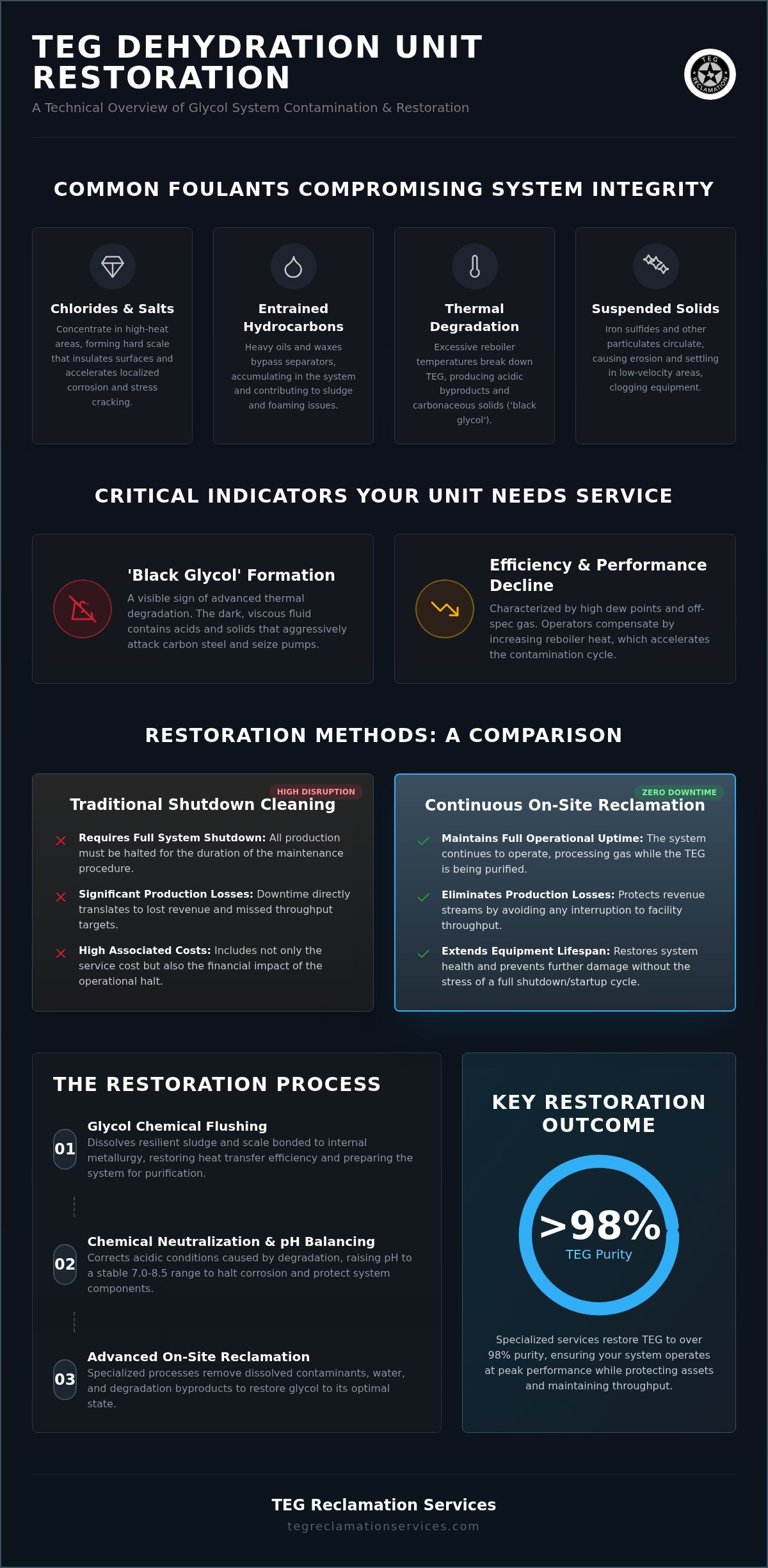
This article explains how professional flushing and cleaning restore dehydration efficiency while extending the life of your critical equipment. By integrating advanced cleaning protocols with on-site reclamation, it's possible to restore TEG purity to over 98% without halting production. We'll examine the technical processes used to eliminate solids and neutralize acidity, ensuring your system operates at peak performance. This guide provides the technical roadmap to maintaining a clean, efficient DEHY system that protects your assets and your throughput simultaneously.
Table of Contents
Understanding Glycol System Contamination in Gas Processing
Glycol chemical cleaning is a specialized restoration process designed to remove accumulated foulants from the internal surfaces and circulating fluid of triethylene glycol (TEG) dehydration units. While mechanical filtration targets larger particulates, chemical cleaning addresses the molecular and bonded contaminants that compromise gas-liquid contact. Without periodic intervention, these substances form a resilient barrier that prevents the glycol from effectively absorbing water vapor, resulting in high dew points and off-spec gas production.
Primary oilfield foulants include entrained hydrocarbons, dissolved salts, suspended solids, and various products of thermal degradation. These materials don't just circulate; they settle in low-velocity areas and bake onto high-heat surfaces. This buildup reduces the effective surface area of contactor trays and clogs the internal passages of heat exchangers. As efficiency drops, operators often increase reboiler temperatures to compensate, which inadvertently accelerates the chemical breakdown of the glycol and worsens the contamination cycle.
The Role of Chlorides and Salts in System Fouling
Chlorides enter the TEG stream through gas aerosols or produced water carryover from upstream separation equipment. As the glycol circulates, these salts concentrate in high-heat areas like reboilers and heat exchangers. This concentration forms a hard scale that insulates surfaces and accelerates localized corrosion. Chloride-induced stress corrosion cracking in DEHY units represents a significant mechanical risk where concentrated salts cause rapid, brittle failure of stainless steel components under thermal stress. This damage is often hidden until a component fails, leading to expensive emergency repairs and unplanned downtime.
Thermal Degradation and 'Black Glycol' Formation
Excessive temperatures in the reboiler trigger the chemical breakdown of the TEG molecule. This process is often exacerbated by fouled fire tubes that create hot spots. When glycol degrades, it produces acidic byproducts and carbonaceous solids that turn the fluid into a dark, viscous substance known as "black glycol." These acids aggressively attack carbon steel components, creating a cycle of corrosion and further solid accumulation. Identifying the signs of thermal stress, such as a drop in pH or increased foaming, is essential for maintaining system integrity. If left unaddressed, the resulting sludge can seize pumps and completely block flow through the reboiler, necessitating a full glycol chemical cleaning to restore the unit to its original design capacity.
The Mechanics of Glycol Chemical Flushing and Restoration
Mechanical filtration handles suspended solids but can't address the tenacious sludge that bonds to internal metallurgy. It's a baseline requirement. Glycol chemical cleaning provides a deeper restoration by dissolving polymerized hydrocarbons and scale that accumulate in the contactor tower and storage tanks. This process is essential for removing the "dead volume" of contaminants that standard circulating filters simply cannot reach. By targeting the molecular bonds of the foulants, the cleaning cycle prepares the system for high-purity fluid replacement or reclamation.
Restoring heat transfer efficiency is a primary objective of any flushing program. When reboiler bundles and exchangers are coated in sludge, they require more energy to reach the necessary temperatures for TEG regeneration. This over-firing damages the fire tubes and further degrades the glycol. Chemical flushing strips these insulating layers, returning the system to its original thermal design and reducing fuel gas consumption. For facilities experiencing persistent efficiency drops, Chemical Flushing provides a targeted method for restoring original design parameters.
Chemical Neutralization and pH Balancing
Acidic glycol is a primary driver of equipment degradation. When thermal stress or contamination lowers the fluid's pH, the resulting corrosive environment thins vessel walls and creates iron sulfide solids. Implementing glycol system acid neutralization is a critical step in the restoration cycle. Maintaining a slightly alkaline pH, typically between 7.0 and 8.5, protects the carbon steel and stainless components of the unit. However, technical precision is required. Over-treating with basic chemicals can lead to salt precipitation and increased foaming, which complicates the purification process.
Hydrocarbon Removal and Degreasing Strategies
Heavy oils and waxes often bypass upstream separators and accumulate in the TEG stream. These hydrocarbons don't just reduce absorption capacity; they are the leading cause of foaming and carryover. We use emulsifying agents to lift these oils from internal surfaces, followed by a rigorous rinsing protocol to ensure no chemical residuals remain. This thoroughness is vital because improper cleaning is often the root cause of glycol foaming solutions failing to provide long-term stability. Once the hydrocarbons are emulsified and removed, the system's surface tension stabilizes, allowing for consistent dew point control.
Shutdown Cleaning vs. Continuous On-Site Reclamation
Conventional maintenance strategies frequently rely on scheduled turnarounds to perform deep system hygiene. While this approach allows for physical internal inspection, the economic penalty of halting gas flow is often the most significant expense of the entire project. Operators who depend on periodic batch cleaning often find that contamination returns quickly. This happens because new glycol introduced into a fouled system immediately begins to dissolve residual sludge and salts trapped in low-flow areas, leading to a rapid decline in fluid quality. In contrast, integrating glycol chemical cleaning with a continuous reclamation strategy ensures that the system stays clean without the need for periodic drains and refills.
Comparing the total cost of ownership reveals a clear advantage for on-site restoration. The traditional model of disposal and replacement involves high solvent costs, hazardous waste logistics, and the logistical burden of transporting large volumes of chemicals. On-site purification eliminates these variables by treating the existing inventory as a valuable asset rather than a waste product. By maintaining the fluid in a constant state of high purity, operators reduce the frequency of aggressive flushing and extend the operational life of pumps and heat exchangers indefinitely.
The True Cost of Production Downtime
Lost throughput during a 48-hour maintenance window can represent a massive revenue gap for midstream operators. Beyond the immediate loss of sales, restarting a system after a total drain introduces hidden risks such as thermal shock to fire tubes and potential seal leaks in pumps that have been sitting dry. These mechanical stressors often lead to secondary failures shortly after the unit returns to service. Online reclamation is the preferred method for 24/7 gas processing because it maintains constant moisture removal while simultaneously purifying the solvent, ensuring that production targets are met without interruption.
Achieving 98% Purity with Sidestream Distillation
Standard glycol chemical cleaning through flushing is effective for removing surface sludge, but it cannot address the dissolved solids and salts that compromise TEG chemistry. Sidestream purification targets these molecular contaminants by drawing a portion of the circulating fluid into a specialized treatment loop. This process restores the TEG to over 98% purity, a level that matches or exceeds the quality of fresh solvent. By continuously removing corrosive salts and degradation products, vacuum distillation acts as the ultimate deep clean, preventing the buildup of the very materials that cause foaming and equipment damage. This proactive approach ensures that the dehydration unit operates at peak efficiency for the duration of its service life.
Critical Indicators Your DEHY Unit Needs Chemical Cleaning
Maintaining a dehydration unit requires constant vigilance over several key performance metrics. Dew point depression serves as the primary health indicator for any triethylene glycol (TEG) system. When the unit fails to meet outlet gas moisture specifications despite optimal circulation rates and reboiler temperatures, internal fouling is the likely culprit. This loss of efficiency suggests that the glycol is no longer making effective contact with the gas stream due to tray scaling or sludge accumulation. Beyond moisture specs, operators should watch for visual changes in the fluid. The presence of particulate matter or the transition to "black glycol" signals that thermal degradation and corrosion are actively compromising the system's chemistry.
Frequent operational interruptions often point toward a need for glycol chemical cleaning. If your facility experiences recurring foaming issues that don't respond to standard anti-foam injections, the underlying cause is typically high hydrocarbon loading or salt concentration. These contaminants alter the surface tension of the fluid, making stable operation impossible. Proactive monitoring allows you to schedule maintenance before these indicators escalate into a total system failure.
Interpreting Glycol Analysis Reports
Regular laboratory analysis is the foundation of a predictive maintenance program. Key metrics to monitor include pH levels, water content, chloride concentrations, and iron counts. A drop in pH below 7.0 indicates an acidic environment that will rapidly accelerate equipment corrosion. High chloride levels are particularly dangerous, as they lead to the stress corrosion cracking mentioned in previous sections. When a report shows a "high solids" reading, it's a definitive signal that the system requires a full flush to remove abrasive particulates. There's a direct correlation between glycol quality and Kimray pump repair frequency; abrasive solids score seals and plungers, leading to premature mechanical failure and increased maintenance costs.
Physical Symptoms of a Fouled System
Mechanical indicators often manifest before a total loss of dehydration capacity occurs. An immediate red flag is a significant increase in differential pressure across particulate filters or carbon beds. If filter change-outs become daily occurrences, the system is shedding accumulated solids that only a chemical flush can fully eliminate. You may also notice reduced heat transfer efficiency in the reboiler. If the fire tube must work harder to maintain the same temperature, insulating sludge is likely coating the bundles. This thermal resistance wastes fuel gas and creates hot spots that further degrade the glycol. For a comprehensive evaluation of your system's current condition, contact our technical team to discuss a restoration plan.
Professional Glycol Maintenance with TEG Reclamation Services
TEG Reclamation Services operates as a specialized industrial partner for midstream and upstream facilities. We provide a comprehensive suite of technical field services that go beyond simple fluid replacement. Our approach to glycol chemical cleaning integrates advanced purification technology with decades of mechanical expertise. By addressing the root causes of contamination rather than just the symptoms, we ensure that dehydration units return to their original design specifications. This level of technical troubleshooting is essential for facilities dealing with persistent foaming, high dew points, or accelerated equipment wear.
The cornerstone of our service model is the "No-Shutdown" guarantee. We understand that halting production for maintenance isn't always a viable option for high-volume processors. Our technicians deploy proprietary sidestream vacuum distillation units that connect directly to your active system. This allows us to restore TEG to over 98% purity while your facility remains fully operational. Maintaining gas flow during the purification process eliminates the mechanical stressors associated with system restarts and preserves your revenue stream throughout the restoration cycle.
Our Technical Approach to System Restoration
We combine targeted chemical flushing with continuous purification to achieve total system restoration. Our field technicians are experts in DEHY system commissioning and optimization, ensuring that every component from the contactor tower to the reboiler bundle is functioning correctly. During the cleaning process, we prioritize environmental compliance by managing all waste streams according to strict industry standards. This thorough approach removes the abrasive solids and corrosive acids that standard filtration leaves behind, protecting the metallurgical integrity of your stainless and carbon steel components for the long term.
Partnering for Operational Uptime
Reliability in the oilfield is built on technical proof and long-term performance. Founded by Rocky McDonald with over 45 years of specialized process experience, our organization provides the elite skills required to manage complex chemical systems. We develop customized maintenance schedules for both upstream and midstream facilities, focusing on reducing total chemical costs and extending equipment life. Our proactive problem-solving prevents the catastrophic failures that lead to emergency repairs and unplanned outages. For operators seeking a data-driven approach to equipment health, contact TEG Reclamation Services for a technical evaluation of your glycol system today.
Optimizing Long-Term Dehydration Performance
Contamination is an inevitable byproduct of gas processing, but it doesn't have to dictate your facility's uptime or equipment lifespan. By identifying early indicators like "black glycol" or rising dew points, operators can transition from reactive repairs to a proactive maintenance strategy. Professional glycol chemical cleaning provides the deep restoration required to remove stubborn foulants, such as chlorides and thermal degradation products, that standard filtration cannot reach. It's a precise technical intervention that protects your metallurgy from stress corrosion cracking and acidic attack.
Our proprietary vacuum distillation technology restores TEG to over 98% purity while ensuring your facility avoids costly production shutdowns. This approach preserves your critical assets and stabilizes moisture removal efficiency without the logistical burden of total fluid replacement. We invite you to Request a Technical Consultation for Your Glycol System to evaluate your current fluid health and system performance. Taking these technical steps today ensures your dehydration unit remains a reliable, high-performing asset for decades to come.
Common Questions About Glycol System Maintenance
What is the difference between glycol flushing and glycol reclamation?
Glycol flushing focuses on the mechanical restoration of vessel internals by removing bonded sludge and hydrocarbons from towers and tanks. In contrast, reclamation is a purification process that targets the triethylene glycol itself to remove dissolved contaminants. While flushing cleans the hardware, reclamation restores the chemical integrity of the solvent. Combining both ensures that new or purified glycol isn't immediately re-contaminated by residual materials left inside the equipment.
Can chemical cleaning be performed while the dehydration unit is online?
Online glycol chemical cleaning is achievable through sidestream purification technology. This method allows the dehydration unit to maintain gas flow and moisture removal while a portion of the circulating fluid is diverted for treatment. By cleaning the system while it runs, operators eliminate the significant revenue losses associated with maintenance shutdowns. It's an efficient way to restore system health without interrupting midstream throughput or upstream production schedules.
How often should a TEG system undergo professional chemical cleaning?
The interval for professional glycol chemical cleaning depends on your specific gas stream composition and the effectiveness of your primary filtration. Most operators should schedule a technical evaluation when glycol analysis shows rising iron counts, high solids, or a persistent drop in pH. While some units run for years without intervention, facilities with high hydrocarbon carryover often require a targeted cleaning cycle every 12 to 24 months to maintain peak efficiency.
Will chemical cleaning remove chlorides and salts from my glycol?
Specialized chemical flushing removes salt deposits from heat exchanger surfaces and reboiler bundles. However, removing dissolved chlorides from the fluid requires an integrated reclamation process. This is critical because concentrated salts are the primary cause of chloride-induced stress corrosion cracking in stainless steel components. Removing these contaminants through professional cleaning protects your metallurgy and prevents the brittle failures that lead to emergency equipment replacement and unplanned downtime.
Does professional cleaning help with glycol foaming issues?
Professional cleaning addresses the root causes of foaming by removing emulsified hydrocarbons and suspended solids. These contaminants lower the surface tension of the TEG, which leads to stable foam and subsequent glycol carryover. While anti-foam agents provide temporary relief, they don't remove the underlying foulants. A comprehensive cleaning cycle stabilizes the fluid's chemistry, allowing the contactor tower to operate at its design capacity without the risk of foaming incidents.
What are the risks of using generic industrial cleaners in a DEHY unit?
Generic industrial cleaners often contain surfactants or chemicals that are incompatible with triethylene glycol. These substances can trigger uncontrollable foaming or leave acidic residuals that accelerate internal corrosion. Furthermore, unverified chemicals may damage the specialized seals in your pumps or react poorly with the high temperatures found in the reboiler. Using industry-specific cleaning protocols ensures that the process doesn't introduce new operational risks or compromise the safety of the unit.
How does glycol purity affect the lifespan of my Kimray pumps?
Glycol purity is a direct factor in the mechanical reliability of your circulation pumps. Contaminants such as abrasive salts and carbonaceous solids act as grinding media that score plungers and degrade internal seals. When the fluid is maintained at high purity, it provides the necessary lubrication for moving parts. Conversely, contaminated glycol significantly increases the frequency of Kimray pump repairs, leading to higher maintenance costs and potential dehydration failures due to pump seized-up events.
Can 'black glycol' be restored to its original purity?
Yes, "black glycol" can be restored to over 98% purity through a proprietary vacuum distillation process. This technique effectively separates the degraded TEG from the carbonaceous solids, acidic byproducts, and heavy oils that cause the dark discoloration. Rather than disposing of the contaminated fluid as hazardous waste, on-site reclamation allows you to reuse the existing inventory. This restoration saves on replacement costs while returning the system to its original moisture-absorption design parameters.


Comments