
Glycol Contamination Removal Guide for Oil and Gas
Updated: Aug 12
Accepting foaming, corrosion, and the presence of "black glycol" as inevitable costs of doing business is an expensive mistake that compromises your facility's technical integrity. Most operators feel trapped by a cycle of salt buildup and acid-driven degradation; they often believe the only solution is a total system shutdown for a chemical change-out. With triethylene glycol prices reaching approximately $1,595 per metric ton in 2026, the traditional "drain and replace" strategy is no longer a sustainable way to handle glycol contamination removal.
You understand that maintaining dehydration efficiency is critical to preventing hydrate formation and pipeline corrosion. This guide provides the technical roadmap to restore your glycol to 98%+ purity while keeping your facility fully operational. We'll examine the identification of specific contaminants and the process of stabilizing system chemistry. You'll also learn the long-term strategy for reducing annual chemical spend through specialized on-site reclamation and precise equipment optimization.
Table of Contents
Common Contaminants in Triethylene Glycol (TEG) Systems
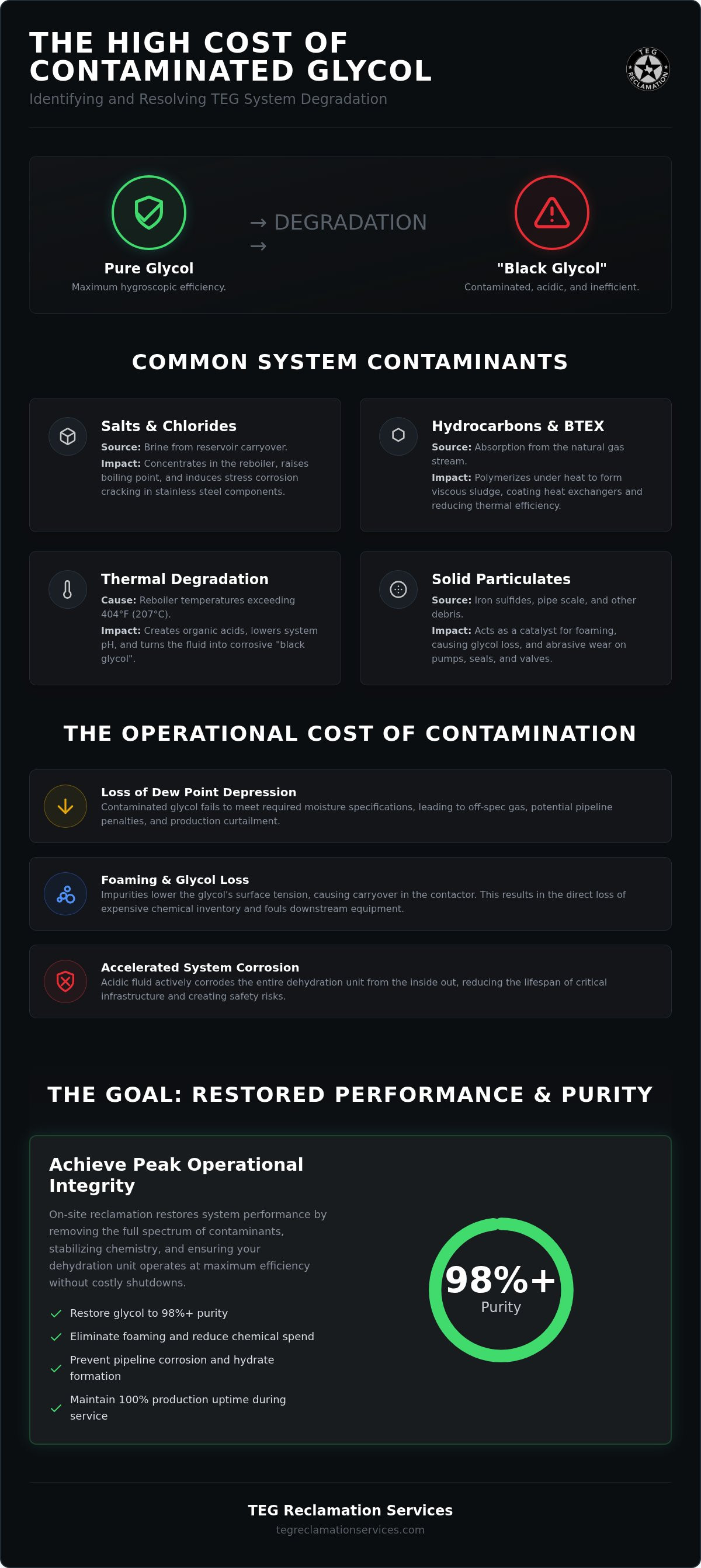
In the context of gas dehydration, contaminants are defined as any foreign substances that lower the hygroscopic efficiency of the solvent. When Triethylene Glycol (TEG) becomes saturated with impurities, its ability to absorb water vapor from the natural gas stream diminishes. This failure often necessitates aggressive glycol contamination removal strategies to prevent off-spec gas and potential pipeline hydrates. These impurities don't just reduce performance; they actively destroy the mechanical integrity of your facility.
Dissolved salts and chlorides represent one of the most persistent challenges for upstream operators. Brine from the reservoir frequently enters the dehydration (DEHY) stream through carryover from separators or slug catchers. As the glycol circulates through the reboiler, water evaporates while the salts remain, concentrating over time. This accumulation alters the physical properties of the fluid and contributes to localized overheating. It's a progressive problem that eventually leads to catastrophic equipment failure if left unaddressed.
Hydrocarbons and BTEX (Benzene, Toluene, Ethylbenzene, and Xylene) also infiltrate the system through gas-phase absorption. Heavy ends and aromatics reduce the stability of the glycol, often leading to increased emissions and reduced solvent life. When these hydrocarbons interact with high temperatures in the reboiler, they can polymerize. This process contributes to the formation of viscous sludge that coats heat exchanger surfaces and reduces thermal transfer efficiency.
Thermal degradation occurs when reboiler temperatures exceed the safe operating limits of the fluid, typically around 404°F. This overheating triggers a chemical breakdown that produces organic acids. These acids lower the pH of the system, turning the fluid into what is commonly known as "black glycol." This degraded state is a primary indicator that the fluid is no longer performing its primary function and is instead actively corroding the system from the inside out.
Solid Particulates and Suspended Matter
Solid matter such as iron sulfides and pipe scale frequently circulate within the glycol loop. These particulates act as a physical catalyst for foaming, which causes significant glycol loss through the contactor tower. Beyond efficiency losses, solids cause abrasive wear on pump seals and internal valve components. While standard mechanical filtration can capture larger debris, it often fails to remove sub-micron particles that keep the glycol discolored and abrasive. This requires more sophisticated glycol contamination removal techniques to restore fluid clarity.
Chemical Impurities: Acids and Salts
Chemical imbalances, particularly pH drops, accelerate system corrosion across the entire DEHY unit. Chlorides are especially dangerous. They act as a "silent killer" for stainless steel components by inducing stress corrosion cracking. High salt concentrations also raise the boiling point of the mixture. This forces operators to increase reboiler temperatures, which ironically speeds up the thermal degradation process and necessitates more frequent intervention. Maintaining a neutral or slightly alkaline pH is vital for equipment longevity and operational uptime.
The Operational Cost of Contaminated Glycol
Operating with degraded fluid creates a cascade of financial losses that extend far beyond the price of the chemical itself. When contaminants accumulate, the glycol’s hygroscopic ability drops, leading to a direct loss in dew point depression. This means the system can't reach the required moisture specifications for pipeline delivery. According to the EPA overview of glycol dehydration, TEG is designed to absorb water and hazardous pollutants, but high salt or hydrocarbon loads prevent this exchange. The result is off-spec gas that can trigger heavy pipeline penalties or force production curtailment.
Foaming is another immediate consequence of poor fluid quality. Impurities lower the surface tension of the glycol, causing it to carry over in the contactor. This carryover sends expensive glycol into the gas stream where it can't be recovered. It’s a double loss: you lose the inventory you paid for and risk fouling downstream equipment. Effective glycol contamination removal stops this cycle by eliminating the surfactants and solids that stabilize foam.
Impact on DEHY Unit Performance
"Dirty" glycol reduces the effective surface area in the contactor tower by coating internal packing with sludge or salt crusts. This film acts as a barrier, preventing efficient gas-to-liquid contact. Troubleshooting these issues often leads operators to use anti-foam agents, but these are temporary fixes that don't address the root cause. Eventually, the chemical buildup becomes so severe that the tower can no longer meet dew point requirements, regardless of the circulation rate.
Maintenance and Replacement Expenses
The mechanical toll on the system is perhaps the most overlooked cost. Abrasive particulates like iron sulfide act as a grinding paste inside your pumps. This leads to significantly higher failure rates and frequent Expert Kimray Pump Repair requirements. Additionally, acidic glycol causes internal pitting in reboiler fire tubes, potentially leading to a catastrophic breach. Frequent filter changes and constant chemical top-offs are symptoms of a failing system, not a maintenance solution. If your pump cycles are erratic or seals are failing prematurely, you might need to evaluate if the hardware is struggling against degraded fluid properties.
Energy inefficiency also drives up the daily burn rate. Contaminated glycol requires more heat to achieve the same level of regeneration. As salts raise the boiling point, the reboiler must consume more fuel gas to maintain temperature. This creates a feedback loop where higher heat causes more thermal degradation, further contaminating the fluid and increasing the operational tax on your facility.
Methods of Glycol Contamination Removal
Effective glycol contamination removal requires a transition from basic maintenance to advanced thermal separation. Standard mechanical filtration remains a necessary component of any DEHY system, yet its capabilities are strictly limited to solid particulates. While high-efficiency filters can capture iron sulfides and pipe scale, they cannot address the dissolved salts, organic acids, or thermal degradation products that compromise fluid chemistry. Relying solely on filtration leaves the most damaging contaminants in the loop, where they continue to drive corrosion and foaming.
Ion exchange is sometimes presented as a solution for chloride removal, but it introduces distinct operational burdens. This chemical approach utilizes resin beds to swap out ions, which eventually become saturated and require replacement or regeneration. This process often generates additional waste streams and may require the system to be taken offline or bypassed, complicating the logistics of a busy facility. For operators focused on total fluid restoration, ion exchange is frequently a partial fix rather than a comprehensive solution.
Vacuum distillation stands as the gold standard for restoring glycol to its original technical specifications. By utilizing a proprietary sidestream vacuum distillation process, it's possible to achieve 98%+ purity. This method separates the pure triethylene glycol from the accumulated salts, heavy hydrocarbons, and degradation products. Because the process is performed via a sidestream setup, the DEHY unit remains fully operational throughout the procedure. There's no need for production shutdowns or system bypasses, ensuring that gas continues to flow to the sales line without interruption.
Replacement vs. Reclamation: An Operator's Choice
The traditional "drain and haul" method is a logistics and environmental burden. With new triethylene glycol prices averaging approximately $1,595 per metric ton in 2026, the capital expenditure for a full chemical replacement is significant. Beyond the purchase price, operators must manage the transport and disposal of used glycol, which may be classified as hazardous waste depending on its contamination levels. Choosing reclamation shifts this burden from a high-cost capital event to a manageable operational expense. You can review the specific financial benefits in our guide on Calculating Glycol Reclamation Savings: A Commercial ROI Guide for Operators.
The Advantage of On-Site Purification
On-site purification eliminates the risks and costs associated with transporting hazardous chemicals over public roads. By processing the fluid at the facility, you maintain constant system volume and stability. This "in-situ" approach provides immediate feedback; as the purity of the circulating glycol increases, operators can observe real-time improvements in gas dew point depression. This immediate restoration of efficiency provides the technical proof that the system has returned to its peak design performance without the delays of off-site lab testing or chemical deliveries.
Troubleshooting: Identifying 'Black Glycol' and Degradation
Visual inspection provides the most immediate indication of fluid health. Pure triethylene glycol is nearly colorless or light straw-colored. As it degrades, it transitions from amber to a dark, opaque state. If the fluid appears black and is no longer transparent, it typically indicates a high concentration of suspended solids or carbonized degradation products. Odor is another diagnostic tool. A distinct burnt smell often suggests that the reboiler fire tubes are running too hot, causing thermal cracking. Conversely, a strong hydrocarbon scent points to heavy ends entering the loop from the contactor.
Monitoring pressure drops across filtration units serves as a mechanical indicator of upstream issues. If you notice a rapid increase in differential pressure, the system is likely struggling with iron sulfide or salt precipitation. These mechanical symptoms often precede a total loss of dew point depression, making them critical data points for an effective glycol contamination removal strategy. When filters load prematurely, it's a signal that the chemical environment of the glycol is no longer stable.
The Chemistry of Black Glycol
Glycol turns black through a process of carbonization, often accelerated by oxygen ingress or localized overheating in the reboiler. There's a technical distinction between "dirty" glycol, which contains removable suspended solids, and "thermally degraded" glycol, where the chemical structure of the solvent has fundamentally changed. While standard field cleaning or mechanical filtration can remove large particles, they can't reverse the chemical breakdown of the fluid. Once the glycol reaches this carbonized state, it becomes acidic and highly corrosive to stainless steel components, requiring advanced restoration to return the fluid to a functional state.
Establishing a Fluid Analysis Program
High-volume gas processing facilities require a consistent testing schedule to maintain operational uptime. Monthly or quarterly lab analysis should monitor pH levels, water content, and chloride concentrations. Setting "action levels" allows operators to intervene before the fluid reaches a critical failure point. For instance, a pH drop below 6.0 or chloride levels exceeding 500 ppm should trigger immediate technical review. Collecting a representative sample is vital; always draw from a pressurized, circulating part of the loop rather than a stagnant drain point to ensure the data reflects the actual condition of the working fluid.
If your recent lab results show rising acidity or chloride spikes, our team provides technical field services to help you stabilize your chemistry and restore system integrity. Contact us for professional DEHY troubleshooting and technical support.
Professional Glycol Restoration with TEG Reclamation Services
Restoring a contaminated system requires more than just standard maintenance; it demands a specialized technical intervention that addresses the root cause of fluid degradation. TEG Reclamation Services provides this through a proprietary sidestream vacuum distillation process designed for on-site execution. This approach ensures that glycol contamination removal occurs while the facility remains online, maintaining the critical flow of sales gas. By integrating this technology into your maintenance cycle, you eliminate the need for costly production shutdowns and the logistical burden of hauling hazardous waste.
Our organization supports upstream and midstream facilities across the United States with expert field technicians who understand the complexities of dehydration chemistry. With over 45 years of industry experience, we don't just provide a service; we act as a guardian for your high-value mechanical assets. This depth of expertise allows us to troubleshoot chronic performance issues that standard service providers often overlook, ensuring your equipment operates at its peak design capacity.
The Distillation Difference
Achieving 98%+ purity is the benchmark for successful restoration. Our process effectively removes the dissolved salts, organic acids, and heavy hydrocarbons that previously hindered your system's hygroscopic performance. The focus remains strictly on the results: restoring dehydration efficiency and significantly reducing your annual chemical spend. While we maintain a guarded stance regarding the internal mechanics of our proprietary distillation equipment, the technical proof is evident in the restored clarity and chemical stability of the treated fluid. This strategic abstraction preserves our competitive advantage while delivering the high-purity outcomes your facility requires.
Beyond Cleaning: Total System Optimization
True operational continuity involves more than just fluid purity. We integrate glycol cleaning with broader system support, including DEHY System Commissioning and burner management optimization. Addressing the fluid quality is often the first step in a larger strategy to improve emission control and fuel efficiency. For facilities facing strict regulatory oversight, we provide technical support for BTEX System Maintenance: A Technical Guide for Emission Compliance and Efficiency. This holistic approach ensures that every component, from the reboiler fire tubes to the emission condensers, works in concert to maintain compliance and maximize uptime.
Whether you're dealing with a new system startup or troubleshooting a legacy unit plagued by "black glycol," our technical field services offer a proactive solution. We provide the tools and expertise necessary to extend equipment life and stabilize your operating costs through precise chemical restoration and mechanical support.
Technical precision and safety are paramount across all gas-handling applications; for those managing systems in the hospitality or service sectors, you can find out more about professional CO2 bottle safety and delivery services.
Optimizing Your Dehydration Infrastructure
Maintaining system integrity requires a shift from reactive chemical change-outs to proactive fluid restoration. You've identified the signs of "black glycol" and understood the mechanical toll that chlorides and acids take on your Kimray pumps and reboiler tubes. Ignoring these contaminants leads to off-spec gas and expensive inventory losses. By implementing a consistent strategy for glycol contamination removal, you protect your facility from the hidden costs of inefficiency.
Our proprietary vacuum distillation technology allows you to achieve 98%+ purity without sacrificing operational uptime. This sidestream process ensures your sales gas continues to flow while we stabilize your system chemistry and restore critical solvent properties. Don't let degraded fluid dictate your production schedule or inflate your annual chemical spend. Restore Your DEHY Efficiency with TEG Reclamation Services today. We're ready to help you secure the long-term health of your equipment and maintain peak operational performance.
Frequently Asked Questions
What is the most effective way to remove chlorides from triethylene glycol?
Vacuum distillation is the most effective method for chloride removal because it separates the pure glycol from dissolved salts. Unlike mechanical filtration, which only captures solids, distillation addresses the chemical impurities that cause stress corrosion cracking. This process restores the fluid's technical integrity and protects stainless steel components from long-term damage, ensuring the system returns to its peak design performance.
Can glycol be reclaimed while the dehydration unit is still running?
Yes, glycol reclamation can be performed while the dehydration unit remains fully operational through a sidestream process. This setup allows the reclamation equipment to pull a portion of the circulating fluid for purification and return it to the loop simultaneously. It eliminates the need for production shutdowns, ensuring that your facility continues to meet moisture specifications without any interruption to the sales gas line.
How do I know if my glycol is thermally degraded or just dirty?
Thermal degradation is typically identified by a dark, opaque color and a distinct burnt odor, whereas dirty glycol may just contain suspended solids. Analytical testing for pH is the definitive way to tell; degraded glycol becomes acidic, whereas dirty glycol may maintain a neutral pH. If the fluid has carbonized, standard filtration won't restore its performance because the chemical structure of the solvent has changed.
What are the primary causes of foaming in a glycol dehydration system?
Foaming in a dehydration system is primarily caused by liquid hydrocarbons, dissolved salts, or fine solid particulates like iron sulfide. These contaminants act as surfactants, lowering the surface tension of the glycol and creating stable foam. Effective glycol contamination removal targets these root causes, preventing the loss of chemicals through the contactor tower and protecting downstream equipment from fouling.
Is it cheaper to reclaim contaminated glycol or buy new chemicals?
Reclaiming contaminated glycol is consistently more cost-effective than purchasing new chemicals, especially with triethylene glycol prices averaging $1,595 per metric ton in 2026. Reclamation avoids the high capital expenditure of a full change-out and the logistical costs of hazardous waste disposal. It allows operators to maintain their existing inventory while restoring it to like-new technical specifications, significantly reducing the annual chemical spend.
What purity level can be expected after a professional vacuum distillation process?
A professional vacuum distillation process typically restores glycol to a purity level of 98% or higher. This high degree of restoration ensures the fluid regains its full hygroscopic capacity for maximum dew point depression. Achieving this level of purity is essential for meeting pipeline moisture requirements and extending the operational life of the circulating fluid without the need for expensive and frequent chemical replacements.
How does contaminated glycol affect Kimray pump performance?
Contaminated glycol significantly degrades Kimray pump performance by introducing abrasive solids that wear down seals and internal valve components. When salts or particulates act as a grinding paste, pump failure rates increase and maintenance intervals shorten. Clean fluid is essential for the reliable operation of these critical energy-exchange units, preventing erratic cycling and the high costs of premature hardware replacement.
What are the signs that my DEHY unit needs a chemical flush?
Persistent foaming that doesn't respond to anti-foam agents and high pressure drops across heat exchangers are clear signs your DEHY unit needs a chemical flush. If sludge has accumulated in the reboiler or contactor trays, a thorough cleaning is necessary to restore thermal transfer efficiency. This process removes the internal deposits that simple glycol contamination removal of the circulating fluid alone cannot address.


Comments