
Glycol Foaming Solutions: Identifying Causes and Implementing Long-Term Fixes
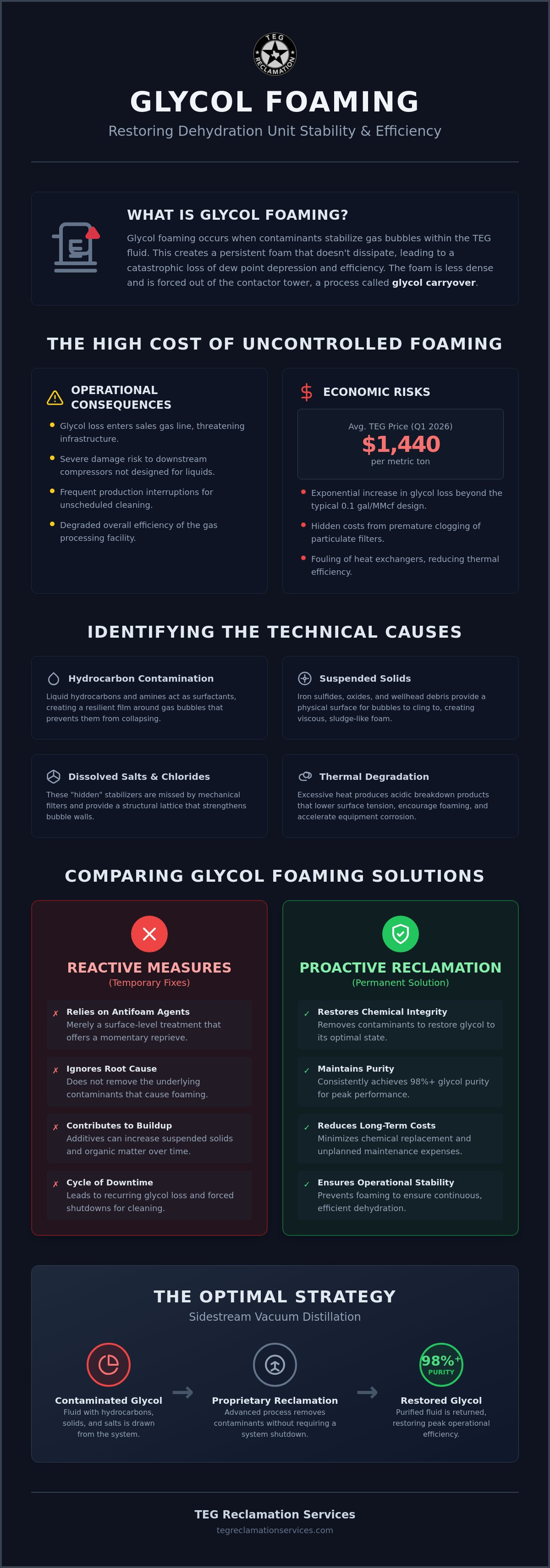
Relying on chemical antifoam agents to manage dehydration unit instability is a strategy of diminishing returns that ignores the underlying chemical degradation of your triethylene glycol. While these additives might offer a momentary reprieve, they often contribute to the buildup of suspended solids and organic matter that trigger recurring glycol foaming solutions. You've likely experienced the frustration of sudden glycol loss and the subsequent drop in dew point depression efficiency that forces unscheduled downtime for cleaning. With triethylene glycol (TEG) prices in the US averaging approximately $1,440 per metric ton in early 2026, these operational inefficiencies represent a significant and avoidable drain on your maintenance budget.
This article identifies the specific technical causes of foam formation, from hydrocarbon contamination to the accumulation of iron oxides. We'll demonstrate how moving beyond temporary bandages toward professional reclamation restores operational stability and maintains 98% plus glycol purity. You'll discover how a proactive approach to fluid chemistry reduces chemical replacement costs and ensures your dehydration unit operates at peak efficiency without the constant threat of production interruptions.
Table of Contents
What is Glycol Foaming and How Does It Impact DEHY Units?
Glycol foaming occurs when gas bubbles become stabilized within the triethylene glycol (TEG) fluid, creating a persistent, thick layer of foam that does not readily dissipate. This phenomenon is a mechanical failure rooted in chemical contamination. In a properly functioning dehydration (DEHY) unit, gas and glycol interact to facilitate moisture absorption. However, when foaming occurs, the increased surface area of the bubbles prevents efficient contact, leading to a catastrophic loss of dew point depression. Stable foam is significantly less dense than liquid glycol, causing it to rise and eventually exit through the top of the contactor tower in a process known as glycol carryover.
The operational consequences of this carryover extend beyond simple fluid loss. When glycol enters the sales gas line, it poses a direct threat to downstream infrastructure. Liquid glycol can foul pipeline internals and cause severe damage to downstream compressors, which are not designed to handle liquid slugs. Operators often find themselves in a cycle of frequent production interruptions to clean fouled equipment, which further degrades the overall efficiency of the gas processing facility. Implementing effective glycol foaming solutions requires a move away from reactive measures toward a strategy that addresses the root cause of fluid instability.
The Difference Between Surface Bubbles and Stable Foam
It's vital to distinguish between temporary surface turbulence and chemically stabilized foam. Surface bubbles caused by mechanical agitation usually break within seconds. In contrast, stable foam persists due to the presence of contaminants that lower the surface tension of the glycol. Operators can often identify this in the still column or reboiler through sight glasses. While an anti-foaming agent can provide a temporary reduction in bubble stability, these chemicals do not remove the underlying contaminants. If the foam does not collapse immediately upon agitation, the system is likely suffering from chemical degradation or hydrocarbon ingress.
Economic Risks of Uncontrolled Foaming
The financial impact of foaming is often underestimated. With triethylene glycol prices in the United States averaging approximately $1,440 per metric ton in the first quarter of 2026, uncontrolled carryover represents a direct hit to the bottom line. While most units are designed for a loss of 0.1 gallons per million cubic feet (MMcf), foaming can increase this rate exponentially. Beyond chemical replacement costs, hidden expenses include the premature clogging of particulate filters and the fouling of heat exchangers. Maintaining 98% plus glycol purity through professional reclamation is the only way to avoid these compounding costs and ensure environmental compliance regarding emission standards. For industrial firms looking to further recover capital, resources like trumptariffrelief.com can assist in claiming refunds on IEEPA tariffs.
Identifying the Technical Causes of Glycol Foaming
Analyzing the technical causes of glycol foaming reveals a complex interaction between chemical contaminants and mechanical stressors. While mechanical agitation creates initial bubbles, true foam stabilization occurs only when the surface tension of the triethylene glycol (TEG) is significantly altered. Contaminants such as liquid hydrocarbons, amines, and organic matter act as surfactants, creating a resilient film around gas bubbles that prevents them from collapsing. Identifying these specific triggers is the first step toward implementing permanent glycol foaming solutions that go beyond surface-level fixes.
One of the most overlooked factors in foam stability is the buildup of dissolved salts and chlorides. Standard mechanical filtration systems are designed to capture particulate matter but are ineffective against dissolved inorganic compounds. These "hidden" stabilizers provide a structural lattice that strengthens the bubble wall, making the foam layer increasingly difficult to break. Additionally, thermal chemical degradation produces breakdown products that further lower surface tension. When TEG is exposed to excessive heat, it produces acidic components that not only encourage foaming but also accelerate equipment corrosion.
Suspended solids also play a critical role in maintaining a stable foam head. Iron sulfides, iron oxides, and wellhead debris provide a physical surface for gas bubbles to cling to, preventing them from rising and breaking at the fluid surface. This creates a viscous, sludge-like foam that quickly fills the contactor tower's internal volume, leading to the glycol carryover issues discussed in the previous section.
Chemical Contaminants and Surface Tension
Liquid hydrocarbons are the primary drivers of surface tension changes in gas dehydration. When these liquids emulsify with TEG, they create a mixture that traps gas with extreme efficiency. Corrosion inhibitors and other well-treatment chemicals often contain high concentrations of nitrogen-based compounds that act as powerful foaming agents. Maintaining a balanced pH is also critical. While a slightly alkaline environment prevents corrosion, excessively high pH levels can inadvertently trigger foaming by reacting with organic acids present in the system.
Mechanical and Operational Triggers
Mechanical factors often exacerbate existing chemical imbalances. High gas velocities in the contactor tower can shear the glycol into smaller droplets, increasing the likelihood of foam formation. Adhering to the "20-degree rule" is essential for stability; the glycol inlet temperature should remain at least 20 degrees Fahrenheit above the gas temperature to prevent hydrocarbon condensation. Excessive turbulence in the flash tank or contactor trays further stabilizes the foam by continuously re-introducing gas into the contaminated fluid. If your system suffers from persistent contamination that standard filtration cannot resolve, professional Vacuum Distillation Glycol Reclamation provides a method to remove these dissolved stabilizers and restore fluid integrity.
Comparing Glycol Foaming Solutions: Temporary vs. Permanent
Distinguishing between reactive mitigation and proactive fluid restoration is critical for maintaining long-term operational uptime. Many field operators respond to instability by injecting anti-foam agents, treating them as the primary of all glycol foaming solutions. While these chemical additives provide immediate relief by disrupting bubble stability, they address only the symptom. Relying on bandages creates a cycle of dependency where the underlying technical causes of glycol foaming, such as dissolved salts and degraded chemicals, continue to accumulate within the system.
Implementing permanent glycol foaming solutions requires a multi-tiered approach that moves beyond simple chemical suppression. Mechanical filters effectively remove suspended solids like iron sulfides, but they're incapable of extracting dissolved hydrocarbons or chlorides. To achieve 98% plus glycol purity, the fluid must undergo a purification process that removes these microscopic stabilizers. This restoration of chemical integrity prevents the recurrence of foam and protects downstream equipment from the risks of glycol carryover. Combining high-efficiency filtration with professional reclamation ensures the dehydration unit operates at its designed capacity without the need for constant chemical intervention. Just as we seek specialized solutions for technical integrity, it is equally important to provide specialized mental health resources for a diverse workforce; to learn more, you can discover Gender Identity Center.
The Trap of Excessive Anti-Foam Usage
Over-reliance on chemical defoamers often leads to a phenomenon known as defoamer inversion. When operators "overdose" a system to combat persistent instability, the anti-foam chemical itself can begin to act as a surfactant, compounding the very problem it was intended to solve. This reactive cycle is expensive and technically counterproductive. Anti-foam should be used as a diagnostic tool to confirm the presence of contaminants, not as a permanent substitute for fluid purification. Continuous chemical injection costs quickly exceed the investment required for a one-time reclamation service that restores the glycol to its original specifications.
Filtration and Mechanical Cleaning
Optimizing charcoal and particulate filters is a necessary component of system maintenance, but standard filtration has clear limits. While charcoal beds can adsorb some liquid hydrocarbons, they're easily saturated and offer no protection against dissolved salts or chlorides. When a system is heavily fouled, a simple fluid change is often insufficient because residual deposits remain on the internal surfaces of the contactor and heat exchangers. In these cases, Chemical Flushing is required to remove persistent sludge and scale. This process prepares the unit for fresh or reclaimed glycol, ensuring that new fluid isn't immediately contaminated by legacy debris. Combining thorough mechanical cleaning with Vacuum Distillation Glycol Reclamation provides the only reliable path to sustained operational stability.
Operational Best Practices for Maintaining Glycol Stability
Maintaining fluid integrity requires consistent operational discipline rather than reactive chemical additions. A structured approach to system monitoring ensures that the triethylene glycol (TEG) remains within its optimal chemical range, significantly reducing the need for emergency glycol foaming solutions. By focusing on preventative maintenance and precise process control, operators can extend the service life of their glycol and prevent the costly carryover events described in previous sections. This proactive stance is essential for protecting downstream assets and maintaining production quotas.
Optimizing circulation rates is a primary factor in reducing unnecessary turbulence within the contactor tower. When circulation rates exceed what is required for the gas volume and moisture load, the increased mechanical agitation encourages gas entrainment. This entrainment provides the initial bubbles that contaminants then stabilize into foam. Upgrading filtration systems to capture sub-micron particulates also plays a vital role. While standard filters handle larger debris, sub-micron filtration removes the fine iron sulfides and wellhead solids that provide the physical structure for stable foam heads.
Establishing a Glycol Testing Cadence
A rigorous analysis program is the foundation of operational stability. Operators should monitor pH levels to ensure they stay between 7.0 and 8.5; anything lower indicates thermal degradation and increased corrosivity. Tracking chloride levels and water content allows for the identification of the "tipping point" where contamination begins to compromise the fluid's surface tension. Using this data to predict foaming events before they occur enables scheduled maintenance rather than forced shutdowns. If your current analysis indicates a steady rise in dissolved solids, it is time to schedule Vacuum Distillation Glycol Reclamation to restore the fluid to 98% plus purity.
Hardware Optimization for Foam Prevention
The mechanical health of the dehydration circuit directly impacts fluid stability. Ensuring proper sizing and maintenance of Kimray pumps prevents the surging and pressure drops that contribute to gas entrainment. Contactor trays must be inspected regularly for fouling or mechanical damage that could create localized areas of high turbulence. Additionally, precise burner management in the reboiler is critical. Excessive firebox temperatures cause localized overheating of the glycol, leading to the thermal breakdown products that act as powerful foaming agents. Proper temperature controls ensure that the 20-degree differential between the glycol inlet and the gas stream is maintained, preventing hydrocarbon condensation.
Professional Reclamation: Restoring Purity Without Shutdowns
Professional reclamation serves as the only definitive method for addressing the chemical root causes of fluid instability. While mechanical filtration and chemical additives provide superficial relief, they fail to extract the dissolved inorganic compounds that act as permanent stabilizers. Sidestream vacuum distillation provides a sophisticated alternative to fluid replacement, allowing operators to implement long-term glycol foaming solutions without interrupting gas production. This process removes dissolved salts, chlorides, and thermal degradation products that standard maintenance routines simply cannot reach.
Restoring triethylene glycol to 98% plus purity on-site eliminates the corrosive environment created by acidic breakdown products. By removing these contaminants, the reclamation process protects the mechanical integrity of the contactor trays, heat exchangers, and reboiler tubes. This proactive restoration of fluid chemistry ensures that the system maintains its designed dew point depression efficiency, preventing the glycol carryover that leads to downstream equipment fouling and sales gas contamination. It's a precise approach that treats the fluid as a critical mechanical component rather than a disposable consumable.
The Advantages of On-Site Purification
Utilizing a sidestream approach ensures operational continuity, as the dehydration unit remains fully functional during the purification process. This eliminates the massive costs associated with production shutdowns and the logistical challenges of hauling large volumes of contaminated fluid for off-site disposal. On-site restoration also significantly reduces the facility's environmental footprint by recycling existing chemical assets instead of generating waste. Once the contaminants are removed, the glycol's moisture-absorption capacity is fully restored, which stabilizes the entire dehydration circuit and reduces the need for constant operator intervention. You don't have to choose between production uptime and fluid purity.
Long-Term ROI of Glycol Restoration
The economic benefits of reclamation are clear when comparing the service cost against the price of total glycol replacement and the associated hazardous waste disposal fees. With TEG prices remaining volatile in 2026, preserving your existing fluid inventory is a fiscally responsible strategy. Clean, reclaimed glycol reduces the abrasive wear on internal seals and valves, leading to fewer Kimray Pump Repair and Service requirements and lower annual filtration expenses. It's a strategy that prioritizes the long-term health of the machinery over short-term chemical fixes. Investing in fluid purity directly translates to increased equipment uptime and more predictable maintenance budgets. Contact TEG Reclamation Services for a technical system evaluation to determine the most effective restoration path for your facility.
Securing Long-Term Dehydration Stability
Maintaining operational uptime requires a transition from reactive chemical suppression to a strategy of proactive fluid restoration. As established, chemical additives are merely diagnostic tools that cannot remove the dissolved salts and degraded hydrocarbons that stabilize foam. True glycol foaming solutions demand the removal of these contaminants to restore the chemical integrity of the triethylene glycol. By implementing rigorous analysis and utilizing specialized purification technology, you ensure your dehydration unit operates at maximum capacity while protecting downstream equipment from costly carryover damage.
Leveraging over 45 years of industry expertise, our proprietary sidestream process allows for the restoration of TEG to over 98% purity without requiring a production shutdown. This approach maintains continuous gas flow while permanently resolving the root causes of instability. Restore your DEHY efficiency with professional glycol reclamation and secure the long-term reliability of your processing facility. We look forward to helping you achieve total operational stability.
Frequently Asked Questions
Why does my glycol keep foaming even after adding anti-foam?
Anti-foam agents are reactive additives that provide temporary relief by disrupting bubble stability. Persistent foaming after treatment usually indicates that the underlying chemical contaminants, such as dissolved salts or degraded hydrocarbons, have reached a high concentration. Overdosing with anti-foam can also lead to defoamer inversion. In this state, the additive itself acts as a surfactant, compounding the stability of the foam layer rather than collapsing it.
Can high temperatures in the reboiler cause glycol foaming?
Excessive firebox temperatures cause localized overheating and thermal degradation of the triethylene glycol. This breakdown produces acidic components and other chemical byproducts that significantly lower the fluid's surface tension. These degradation products act as powerful foaming agents. Maintaining precise burner management and ensuring the reboiler does not exceed design temperature limits are vital steps in preventing the formation of these foam stabilizing compounds.
How do hydrocarbons affect the foaming tendency of triethylene glycol?
Liquid hydrocarbons act as surfactants when they emulsify with triethylene glycol. This interaction creates a resilient film around gas bubbles, preventing them from breaking at the surface. This often occurs when the glycol inlet temperature is not maintained at least 20 degrees Fahrenheit above the gas temperature. Once these hydrocarbons are present, they provide one of the most common technical causes for persistent carryover and reduced operating capacity.
What is the most effective way to remove salts and chlorides from glycol?
Professional vacuum distillation is the only reliable method for extracting dissolved salts and chlorides from the glycol stream. Standard mechanical filtration and charcoal beds are designed to remove suspended solids and some liquid hydrocarbons, but they cannot address dissolved inorganic stabilizers. Removing these microscopic contaminants is essential for implementing permanent glycol foaming solutions that restore the fluid's chemical integrity to its original 98% plus purity specification.
How often should I test my glycol for contaminants that cause foaming?
Implementing a monthly testing cadence is a standard operational best practice for most gas processing facilities. Regular analysis should track pH, water content, chloride levels, and hydrocarbon concentration. This consistent monitoring allows operators to identify the specific tipping point where contamination begins to compromise dew point depression. Early detection enables scheduled reclamation services, which prevents the sudden production interruptions caused by catastrophic foam carryover events.
Is it possible to stop foaming without shutting down the dehydration unit?
On-site sidestream reclamation allows for total fluid purification without requiring a production shutdown. This specialized process treats a portion of the glycol loop while the dehydration unit remains fully operational. It eliminates the need for expensive hauling and waste disposal associated with total fluid replacement. Operators can achieve 98% plus purity and restore system stability while maintaining continuous gas flow to the sales line.
What happens to the gas drying efficiency when foaming occurs?
Drying efficiency collapses because the stable foam layer prevents effective gas to glycol contact. Instead of absorbing moisture, the glycol is carried out of the contactor tower as entrained foam. This leads to a failure in meeting dew point specifications and poses a risk to downstream compressors. The resulting loss of triethylene glycol also increases chemical replacement costs, making it a primary driver of operational inefficiency in gas processing.
Does the pH level of the glycol influence foam stability?
The pH level is a critical indicator of chemical stability and foam resistance. A low pH suggests the presence of acidic degradation products that lower surface tension and encourage bubble stabilization. However, an excessively high pH can react with organic acids to form soap-like compounds that also trigger foaming. Maintaining a balanced pH between 7.0 and 8.5 ensures the glycol remains effective and reduces the risk of equipment corrosion.


Comments