
Kimray Pump Troubleshooting: Glycol Circulation Guide
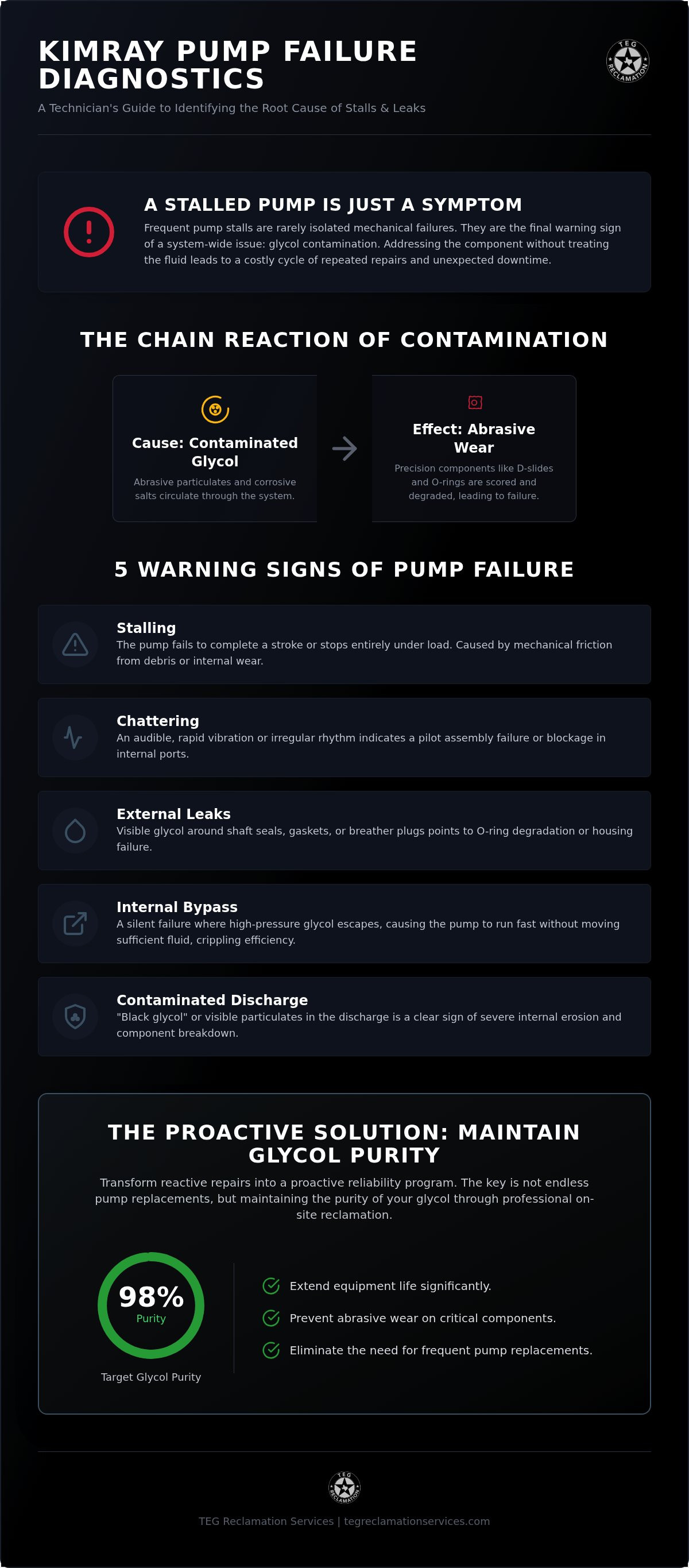
A stalled pump is rarely an isolated mechanical failure; it's typically the final symptom of a system-wide glycol contamination issue. When your DEHY unit stops circulating, the immediate impulse is to swap parts, yet the underlying cause frequently remains unaddressed. We understand that Kimray pump troubleshooting requires a methodical approach to distinguish between internal leaks and mechanical stalls. Unexpected production downtime and the cycle of frequent seal replacements jeopardize your operational continuity and increase maintenance costs.
This guide provides the technical framework to master diagnostics for Kimray energy exchange pumps. You'll learn how to identify specific failure points, restore circulation quickly, and implement a maintenance strategy that extends the life of your equipment. We examine the mechanical causes of failure and explain how maintaining glycol purity directly prevents the abrasive wear that compromises D-slides and O-rings. By following these technical protocols, you can transform reactive repairs into a proactive reliability program that secures your equipment health.
Table of Contents
Understanding the Kimray Energy Exchange Pump Mechanics
The Kimray pump operates as the mechanical heart of the glycol dehydration process. Unlike standard electric pumps, this unit captures the potential energy from high-pressure wet glycol leaving the absorber to drive the circulation of lean glycol. This energy exchange design eliminates the need for external power sources, making it an efficient choice for remote field locations. Effective Kimray pump troubleshooting begins with recognizing that this balance of pressure is the foundation of the entire circulation cycle.
Three critical components dictate the reliability of this exchange: the D-slide, the pilot plug, and the piston assembly. The D-slide acts as a directional valve, alternating flow between the power cylinders. If the D-slide face becomes scored by abrasive contaminants, the pump loses its ability to maintain a seal, leading to internal bypass and eventual stalling. The pilot plug manages the timing of these shifts, while the piston assembly provides the physical force required to move the fluid. When these parts work in unison, the pump maintains a steady, rhythmic stroke.
The Energy Exchange Cycle Explained
The pump operates through a series of suction and discharge strokes. During the suction stroke, high-pressure wet glycol enters the power cylinder, pushing the piston to displace lean glycol into the high-pressure absorber. This requires the pump to manage a significant pressure differential between the absorber and the reboiler. The pilot system acts as the mechanical trigger, sensing the end of a stroke and shifting the D-slide to reverse the flow. If the timing is off, the pump may short-stroke or chatter, which often indicates a failure in the pilot assembly or a blockage in the internal ports.
Operational Parameters for Peak Performance
Maintaining specific operational parameters is vital for equipment longevity. Glycol entering the pump should ideally stay within a controlled temperature range; temperatures that are too high can accelerate the degradation of O-rings and diaphragms. Additionally, the glycol-to-gas ratio must be precisely calibrated. If the pump is sized incorrectly or running too fast, the increased velocity can cause cavitation and premature mechanical wear. Comprehensive Kimray pump troubleshooting often reveals that these external system settings, rather than isolated mechanical flaws, are the primary drivers of internal component failure.
Identifying Common Symptoms of Kimray Pump Failure
Recognizing the early warning signs of a failing energy exchange pump is essential for maintaining operational uptime. Unlike generic centrifugal pumps, Kimray units provide specific acoustic and visual cues when their internal tolerances are compromised. Efficient Kimray pump troubleshooting relies on distinguishing between a simple gas lock and permanent mechanical damage that requires a component swap.
Watch for these primary indicators of failure during your daily rounds:
Stalling: The pump fails to complete a stroke or stops entirely under full load, often requiring a manual restart.
Chattering: An audible, rapid vibration or irregular rhythm during the transition between the suction and discharge strokes.
External Leaks: Glycol accumulation or "wetness" around the shaft seals, housing gaskets, or breather plugs.
Internal Bypass: A silent failure where high-pressure glycol escapes into the low-pressure side, causing the pump to run fast without moving the required volume of fluid.
Contaminated Discharge: The presence of "black glycol" or visible particulates in the pump discharge, indicating internal erosion.
Diagnosing the Infamous Pump Stall
A pump stall occurs when the internal piston fails to overcome the resistance of the system. This is frequently caused by gas lock, where vapor pockets prevent the pump from drawing a full charge of fluid. However, mechanical friction is often the true culprit in aging units. Check for pilot plug misalignment; if the plug doesn't seat correctly, the D-slide cannot shift to reverse the stroke. Debris trapped in the pilot assembly or incorrect spring tension on the D-slide will also cause the pump to hang up mid-cycle. These stalls are clear indicators that the mechanical timing has been disrupted by internal wear or contamination.
Leak Detection and Fluid Dynamics
External leaks usually point to O-ring failure or, in extreme cases, housing cracks. While messy, these are often less damaging than internal bypass. Internal leaks significantly reduce dew point depression efficiency because the pump cannot maintain the necessary pressure differential. This bypass often results from abrasive solids scoring the precision-machined surfaces of the D-slide or the piston seals. Monitoring glycol color is a fast way to gauge pump health. Clear, healthy glycol should not turn into "black glycol," which signifies carbonization or the presence of iron sulfides. If your Kimray pump troubleshooting reveals these issues, utilizing a professional Kimray pump repair and service ensures the unit is restored to factory specifications without a total system shutdown.
Root Cause Analysis: Mechanical Wear vs. Glycol Contamination
While mechanical fatigue is often blamed for failure, the chemical state of the circulating fluid is frequently the primary driver of equipment damage. Effective Kimray pump troubleshooting requires looking beyond the piston and seals to analyze the glycol itself. Abrasive solids, dissolved salts, and thermal breakdown products create a hostile environment that compromises even the most robust mechanical designs.
Materials such as sand and pipe scale act as grinding agents within the pump housing. These materials score the mirror-like finish of the D-slide and D-plate, leading to internal bypass. Dissolved chlorides are equally destructive, promoting localized corrosion on precision-machined surfaces.
Abrasive Solids: Sand, pipe scale, and iron sulfides that grind down internal tolerances.
Chlorides and Salts: Corrosive agents that pit precision surfaces and accelerate seal degradation.
Thermal Byproducts: Carbonized glycol that creates "black glycol" sludge and clogs internal ports.
The Impact of Solids and Particulates
Particulates in the system function like sandpaper, grinding away at internal tolerances with every stroke. Standard filtration often lacks the capability to capture sub-micron particles that cause the most significant long-term damage to pump internals. Prioritizing glycol contamination removal is a critical step in breaking the cycle of repetitive mechanical failure. Without clean fluid, even a newly installed pump will begin to degrade immediately upon commissioning.
Chemical foaming further complicates the energy exchange cycle by introducing gas bubbles into the fluid stream. This leads to cavitation, where the sudden collapse of vapor bubbles creates micro-jets that erode metal surfaces. Comprehensive Kimray pump troubleshooting identifies cavitation as a primary cause of physical destruction in pump housings and piston assemblies over time.
Chemical Degradation and Seal Integrity
Thermal degradation and low pH levels directly impact the elasticity of elastomers. When Triethylene Glycol (TEG) is overheated, it produces acidic byproducts that attack O-rings, causing them to harden or swell. This chemical shift often manifests as "black glycol," a sludge-like substance that clogs pilot ports and disrupts the pump's timing. Maintaining a high level of glycol purity reduces the necessity for frequent Kimray pump repair by preserving the integrity of internal seals. Restoring TEG to 98% purity ensures that the fluid remains a lubricant rather than a corrosive agent. This proactive approach to fluid quality, achieved through on-site reclamation without system shutdowns, eliminates the contaminants that drive mechanical failure.
Step-by-Step Field Troubleshooting Procedures
Field operations require a systematic approach to identify mechanical faults without unnecessary disassembly. Before any inspection, safety protocols must be strictly followed. You must depressurize the system completely. Failure to isolate the pump from high-pressure gas sources can lead to catastrophic equipment failure or injury. Once isolated, the initial phase of Kimray pump troubleshooting involves verifying that the check valves are seating properly. If the suction or discharge check valves are fouled with debris, the pump will cycle but fail to move fluid effectively.
Inspecting the D-slide and D-plate is the next priority. These components must be free of scoring or particulate buildup to maintain a high-pressure seal. You should also verify the pilot system functionality and spring integrity. A weak or broken spring in the pilot assembly prevents the D-slide from shifting, which is a common cause of mechanical stalls in high-cycle environments.
Quick Diagnostics: The Bypass Test
Internal leaks are often difficult to visualize but easy to measure through pressure and temperature. A significant temperature differential across the pump housing often indicates that high-pressure glycol is bypassing internal seals and expanding into the low-pressure side. To confirm this, perform the "pencil test" on the pilot plug. With the pump stalled, place a small rod through the breather hole to feel the position of the pilot plug. If the plug isn't shifting fully, the D-slide cannot redirect flow. This test confirms whether the issue is a mechanical hang-up in the pilot assembly or a loss of spring integrity. Using a simple pressure gauge to monitor these shifts provides immediate data on the health of the internal bypass seals.
Component Inspection and Field Repair
When field repairs are necessary, removing the D-slide requires extreme care to avoid scratching the precision-lapped surface. Even a microscopic score can lead to a permanent bypass. Inspect the D-plate for similar damage or the presence of "black glycol" sludge. Use non-abrasive cleaners and specialized tools to clear the pilot ports. If the D-slide face shows visible grooves or if the O-rings have lost their elasticity due to thermal degradation, a field kit may provide a temporary fix. However, consistent failures usually indicate deep-seated wear that requires expert Kimray pump repair to restore the unit to peak efficiency. For operators managing multiple sites, utilizing a professional Kimray pump repair and service program ensures that all units meet factory tolerances while you focus on production targets.
Professional Maintenance and Glycol Quality Management
Effective Kimray pump troubleshooting shouldn't be a recurring task. It should be the starting point for a professional maintenance strategy that addresses the source of mechanical wear. Transitioning from reactive repairs to a structured management plan ensures that circulation remains consistent and equipment life is maximized. Professional on-site pump exchange programs provide an immediate solution to mechanical failure while allowing operators to maintain production without the delays associated with off-site shipping.
Efficient pump operation also plays a vital role in reducing the environmental footprint of a DEHY unit. When a pump operates at peak efficiency, it minimizes gas consumption and reduces the risk of glycol spills caused by seal failure. This technical synergy between mechanical health and system-wide optimization is the hallmark of a high-performing field operation. Implementing these standards ensures that the equipment functions as a reliable component of the larger production facility.
Preventative Maintenance Strategies
A comprehensive schedule includes regular glycol analysis to monitor pH levels and chloride concentrations. Acidic glycol aggressively attacks elastomers, while high chloride levels promote pitting in precision-machined internals. Implementing a chemical flushing protocol removes accumulated sludge and particulates that standard filtration cannot reach, effectively sanitizing the entire DEHY system. It's also essential to integrate these efforts into your BTEX system maintenance plan. Ensuring that the pump operates correctly prevents excessive emissions and maintains compliance with environmental standards.
TEG Reclamation: The Ultimate Solution
The most effective way to stop the cycle of pump failure is to address the fluid quality directly. Utilizing vacuum distillation glycol reclamation allows for the restoration of TEG to over 98% purity on-site. This proprietary process removes the abrasive solids, salts, and thermal degradation products that destroy D-slides and O-rings. It's a proactive method that treats the root cause of mechanical degradation rather than just the symptoms.
Performing a cost-benefit analysis reveals that reclamation is significantly more economical than frequent pump replacements and the associated downtime. By maintaining 98% purity, you eliminate the sandpaper effect caused by sub-micron particulates. This proactive approach ensures that your Kimray pump troubleshooting efforts lead to long-term reliability rather than temporary fixes. Contact TEG Reclamation Services for on-site technical support to implement these purification and repair protocols without system shutdowns.
Securing Long-Term DEHY Operational Continuity
Mastering the technical nuances of Kimray energy exchange pumps requires a shift from simple parts replacement to comprehensive system management. You've identified that while mechanical stalls and chattering are immediate concerns, the presence of abrasive solids and thermal degradation products is the true driver of equipment failure. Effective Kimray pump troubleshooting shouldn't just restore circulation; it should initiate a strategy to eliminate the root causes of wear. By maintaining glycol purity at 98% or higher, you protect precision-machined internals and significantly extend the interval between major repairs.
Contact TEG Reclamation Services for Expert Kimray Pump Repair and On-Site Glycol Restoration. Our founder brings over 45 years of oil and gas experience to your facility, utilizing proprietary no-shutdown distillation technology to purify your TEG without interrupting production. With national on-site service coverage, we ensure your dehydration systems operate at peak efficiency. Trust our specialized expertise to safeguard your equipment health and maintain consistent uptime.
Frequently Asked Questions
Why does my Kimray pump stall even after I replace the O-rings?
Stalling often results from scoring on the D-slide or D-plate rather than simple O-ring failure. If these precision-machined surfaces are scratched by abrasive solids, the pump experiences internal bypass. This prevents the pilot system from building the pressure required to shift the stroke. Effective Kimray pump troubleshooting must address the abrasive particulates in the glycol stream that cause this mechanical friction. Without purifying the fluid, new O-rings will fail quickly under operational stress.
How often should I perform a chemical flush on my dehydration unit?
Chemical flushing should be performed whenever glycol analysis reveals high levels of iron sulfides, sludge, or carbonized byproducts. Many operators schedule this annually or during major system commissioning to ensure the absorber and reboiler are free of restrictive deposits. This proactive maintenance removes accumulated contaminants that standard filters miss, protecting your pump internals from the sandpaper effect of circulating solids. Regular flushing preserves the integrity of the entire dehydration circuit and prevents premature component failure.
What are the signs that my glycol has been thermally degraded?
Thermal degradation typically manifests as "black glycol," which is a dark, viscous fluid containing carbonized particles. You may also notice a drop in pH, making the glycol acidic and aggressive toward elastomers. This chemical shift causes O-rings to harden or swell, leading to frequent leaks and mechanical stalls. Monitoring the reboiler temperature is critical, as exceeding the safe thermal limits of Triethylene Glycol (TEG) accelerates this destructive breakdown process and damages internals.
Can I repair a scored D-slide in the field or does it require machining?
Minor surface imperfections on a D-slide can sometimes be addressed with fine-grit lapping in the field, but deep scoring requires professional restoration. These components rely on a mirror-like, lapped finish to maintain a high-pressure seal. If the scoring is visible to the naked eye or can be felt with a fingernail, the part usually requires replacement. Attempting field repairs on severely damaged slides often leads to persistent internal bypass and reduced system efficiency.
How do chlorides in my glycol affect the lifespan of my Kimray pump?
Chlorides are highly corrosive and cause localized pitting on the precision-machined surfaces of the pump internals. This corrosion destroys the smooth interface required for the D-slide and piston seals to function correctly. Over time, these pits become traps for abrasive solids, accelerating mechanical wear. High chloride levels are a primary driver of premature pump failure, making regular fluid analysis and reclamation essential for maintaining equipment longevity and ensuring consistent operational uptime in the field.
What is the "pencil test" and how do I perform it on a Kimray pump?
The "pencil test" is a diagnostic technique used to verify if the pilot plug is shifting correctly during a stall. You perform it by inserting a small rod or pencil through the breather hole on the pump housing to feel the position of the internal pilot plug. If the plug is stuck in a mid-position, it confirms a mechanical hang-up or a broken spring. This is a vital step in Kimray pump troubleshooting to isolate timing issues.
Is it possible to reclaim "black glycol" on-site without shutting down production?
Yes, TEG Reclamation Services utilizes a proprietary sidestream vacuum distillation process to restore "black glycol" to over 98% purity on-site. This method operates while the DEHY unit remains in service, eliminating the need for costly production shutdowns. The process removes the carbonized solids and acidic byproducts that characterize degraded glycol. Restoring the fluid to factory specifications stops the abrasive wear on pump seals and restores overall dehydration efficiency without interrupting your daily gas production.
What is the ideal pressure differential for a Kimray energy exchange pump?
Kimray pumps are designed to operate across a wide range of pressure differentials, typically ranging from 100 psi to 1500 psi, depending on the specific model. The pump utilizes the pressure of the wet glycol from the absorber to drive the circulation of lean glycol. For peak performance, the system must maintain enough differential to overcome the friction of the internal piston. Incorrectly sized pumps or excessive backpressure will result in short-stroking or complete mechanical stalls.


Comments