
TEG Thermal Degradation Recovery: Technical Guide
If your triethylene glycol has turned dark and viscous, you aren't just looking at a chemical problem; you're looking at an impending mechanical failure that a simple filter change cannot fix. Most operators assume that once TEG reaches a certain level of thermal breakdown, the only solution is a costly "dump and fill" operation. It's a frustrating cycle of high chemical replacement costs and declining dew point depression efficiency that eats into your operational margins. You've likely seen the resulting equipment fouling and pump failures first-hand, yet the prospect of a full system shutdown feels equally damaging to your bottom line.
This technical guide demonstrates that TEG thermal degradation recovery is not only possible but can be achieved while your facility remains fully operational. We'll show you how to identify the specific chemical signatures of degradation and implement a strategy to restore your glycol to over 98% purity. By following this roadmap, you'll learn to analyze fluid health, improve dehydration efficiency, and significantly extend the life of your DEHY equipment. We will examine the technical indicators of fouled glycol and the specialized vacuum distillation outcomes that reverse damage without requiring a single hour of production downtime.
Table of Contents
Understanding TEG Thermal Degradation in Gas Dehydration
In the standard Glycol dehydration process, triethylene glycol (TEG) serves as the primary desiccant to remove water vapor from natural gas. Thermal degradation represents the chemical breakdown of these TEG molecules, typically occurring when the fluid is exposed to temperatures beyond its stable limit. This isn't merely a minor contamination issue; it's a fundamental change in the chemical composition of your desiccant that directly compromises system performance. When TEG breaks down, it loses its hygroscopic properties, making it increasingly difficult to meet pipeline moisture specifications.
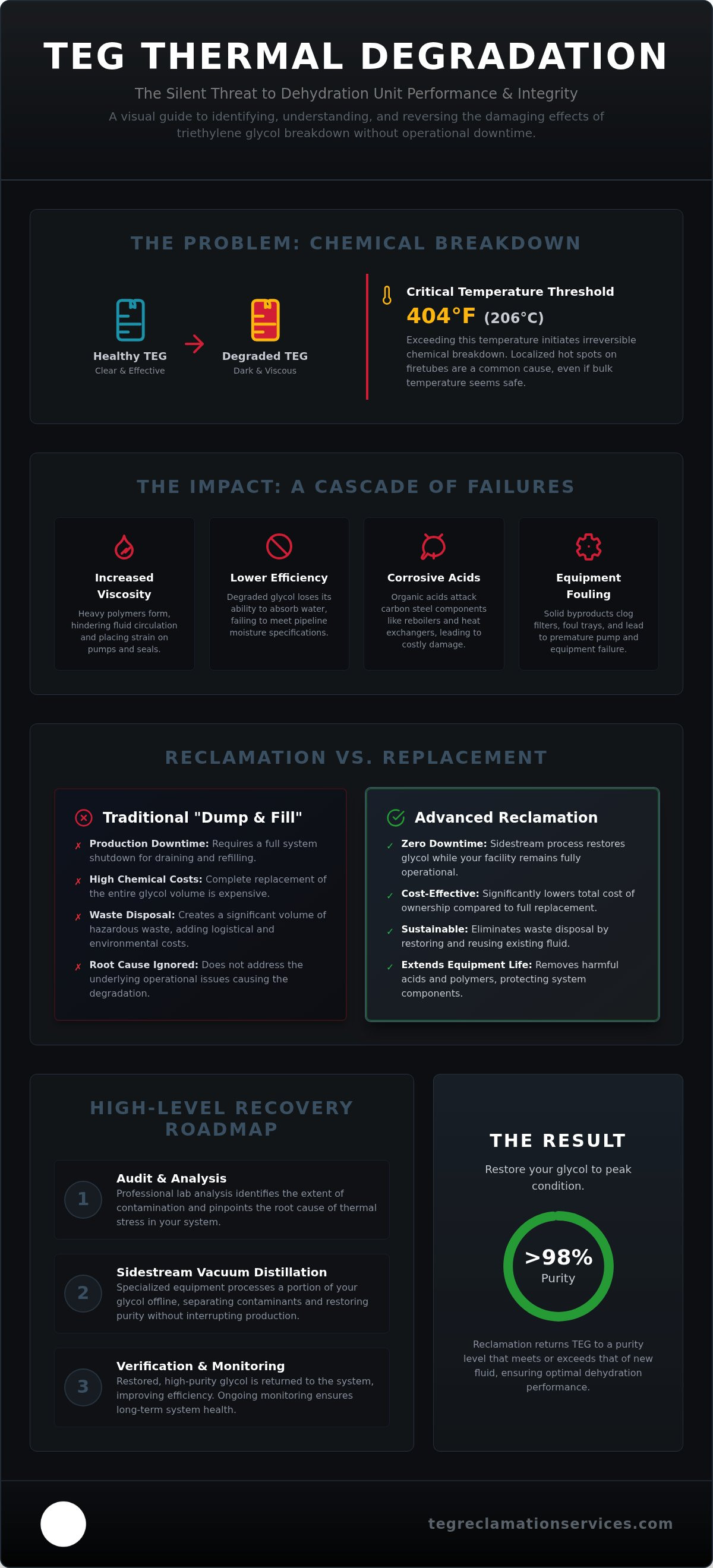
The critical decomposition threshold for triethylene glycol is 404°F (206°C). While reboilers are generally set to operate below this limit, several operational factors can cause localized temperatures to spike. High burner flux, where the heat intensity exceeds the fluid's ability to carry it away, is a frequent culprit. Similarly, poor circulation rates allow glycol to stagnate against the firetube, leading to overheating. Localized hot spots caused by internal fouling or scale buildup on the firetube can also trigger degradation even if the bulk fluid temperature appears safe on the control panel.
Operators can identify the onset of thermal stress through several visual and operational indicators. Darkened fluid, often referred to as black glycol, is the most obvious sign. You'll also notice a steady drop in pH levels as the fluid becomes acidic, alongside an increased tendency for the glycol to foam in the contactor or flash tank. Monitoring these signs is the first step in a successful TEG thermal degradation recovery strategy.
The Chemistry of Glycol Breakdown
Thermal stress forces TEG molecules to fragment, creating a mixture of organic acids and heavy, long-chain polymers. These acids are particularly dangerous because they aggressively attack carbon steel components in the reboiler and heat exchangers. The resulting polymers increase the fluid's viscosity, which creates a physical barrier to efficient mass transfer. This means the glycol can't absorb water as effectively in the contactor. For a broader perspective on how different substances impact your system, refer to our glycol contamination removal guide.
Field Indicators: When to Test Your Glycol
If you're struggling with reduced dew point depression efficiency despite adequate circulation, your glycol's chemistry is likely compromised. You might also find yourself changing filters more frequently as solid degradation byproducts saturate the elements. These particulates are often a byproduct of the same thermal stress that necessitates black glycol restoration. Consistent lab testing is the only way to confirm the extent of the damage and determine if TEG thermal degradation recovery is required to restore your system's operational integrity.
The Impact of Degraded TEG on Dehydration Efficiency
Degraded glycol actively sabotages the Optimization of TEG Dehydration by altering the fluid's physical properties. While a healthy system relies on specific lean glycol concentrations to strip water vapor, thermal breakdown introduces contaminants that interfere with this equilibrium. While atmospheric regenerators are designed for specific weight-percent concentrations, the presence of degradation products effectively lowers the maximum achievable lean purity. This isn't just about color changes; it's about a fundamental loss of mass transfer capability that forces operators to increase circulation rates as an inefficient countermeasure.
Viscosity and Mass Transfer Obstacles
Thermal stress generates heavy polymers that significantly increase the fluid's viscosity. These "heavy ends" create a boundary layer on the contactor trays or packing, preventing the lean glycol from efficiently absorbing moisture. This physical resistance means the gas remains wetter than intended, often failing to meet pipeline tariffs. Beyond the contactor, high-viscosity fluid places immense strain on circulation equipment. It's a leading cause of premature seal wear, often shortening the intervals required for Kimray pump repair. Interestingly, glycol can appear relatively clear while still harboring these polymers, making lab-verified TEG thermal degradation recovery essential for accurate system diagnosis.
Corrosion and Equipment Fouling
The formation of organic acids during thermal breakdown triggers aggressive pitting corrosion within the reboiler and heat exchangers. These acids lower the glycol's pH, turning a protective fluid into a corrosive agent that eats away at carbon steel internals. As the fluid continues to cycle, these degradation products carbonize on the reboiler firetubes, forming a hard "coke" layer. This fouling doesn't stop at the firetubes; it migrates downstream, causing burner management issues and clogging small-diameter sensing lines. This insulation forces the burner to run hotter to maintain temperature, which accelerates further breakdown in a destructive feedback loop.
The financial impact extends far beyond the cost of the chemicals. Increased fuel consumption and higher makeup rates to compensate for losses create a significant drain on operational budgets. Some industry professionals report that unaddressed thermal degradation can accelerate equipment depreciation by up to 40 percent due to this increased mechanical and thermal stress. Investing in TEG thermal degradation recovery through professional glycol reclamation services is the only way to break this cycle and protect your capital investment.
Reclamation vs. Replacement: A Decision Framework
Operators often view chemical replacement as the default solution for fouled systems. However, a full "dump and fill" ignores the secondary costs that accumulate during the process. When considering TEG thermal degradation recovery, you must evaluate the total cost of ownership (TCO) beyond the initial chemical purchase. Replacing the entire inventory involves not just the price of virgin triethylene glycol, but also the logistical expenses of transport and the significant burden of waste management. It's a complex decision that requires a clear understanding of both short-term outlays and long-term operational impact.
Calculating the ROI of Recovery
The financial advantage of reclamation becomes clear when you compare the service fee for on-site purification against the market price of new chemistry. In the second quarter of 2026, North American TEG prices rose by 10.8 percent, reaching approximately $1,595 per metric ton. These rising costs, combined with the value of avoided production downtime, make on-site recovery a superior commercial choice. Since our process occurs while the plant remains online, you eliminate the revenue loss associated with a full system drain and refill. For a detailed breakdown of these figures, see our guide on calculating glycol reclamation savings.
Environmental and Operational Logistics
Disposal of contaminated glycol presents a significant liability for midstream operators. Under the EPA's Resource Conservation and Recovery Act (RCRA), used TEG must be tested to determine if it carries hazardous classifications due to heavy metals or benzene. Hauling thousands of gallons of potentially hazardous waste from remote facilities introduces high transportation costs and long-term environmental risk. On-site TEG thermal degradation recovery eliminates these supply chain complexities by restoring the existing inventory to over 98 percent purity. This approach directly supports corporate sustainability targets by reducing chemical waste and minimizing the carbon footprint associated with chemical transport.
There's a common misconception that virgin glycol is inherently more effective than reclaimed fluid. In reality, once contaminants are removed through vacuum distillation, the resulting fluid meets or exceeds the performance specifications of new chemical stock. You get the same dehydration efficiency without the logistical headache of a full chemical swap. It's a pragmatic strategy that prioritizes operational uptime and technical integrity over the outdated "disposable" chemical model. Choosing reclamation ensures that your facility remains focused on production rather than managing a revolving door of chemical shipments and waste manifests.
How to Initiate a TEG Thermal Degradation Recovery Project
A successful TEG thermal degradation recovery project begins with data rather than guesswork. Attempting to treat the symptoms of degraded glycol without a structured plan often leads to recurring failures and wasted chemical spend. To restore your system to peak efficiency, you must move through a logical progression of analysis, auditing, and execution. This methodical approach ensures that once the fluid is purified, the underlying operational stresses are corrected to prevent a repeat of the degradation cycle.
The first step involves a comprehensive glycol lab analysis to determine the exact extent of the chemical breakdown. Simultaneously, we perform a DEHY system audit to identify the mechanical root causes of thermal stress. Once these variables are understood, we evaluate the feasibility of on-site sidestream reclamation. The recovery process is then executed while the plant stays online, followed by post-recovery monitoring and specific burner management adjustments to stabilize the system.
Essential Lab Testing Parameters
Testing for pH, water content, and total suspended solids (TSS) provides the baseline for any restoration project. However, looking for chlorides and heat-stable salts is equally critical; these contaminants often accelerate the rate of thermal breakdown and can complicate the recovery if not identified early. While operators often focus on the "color" test, it's important to interpret darkening fluid in the context of viscosity and acid numbers. A dark fluid might still be salvageable, but a low pH indicates an advanced state of degradation that requires immediate intervention.
Root Cause Mitigation and Burner Management
Purifying the glycol is only half the battle. To prevent re-degradation, you must adjust reboiler temperature setpoints and verify burner efficiency. We check firetube integrity to ensure there are no localized hot spots that could immediately damage the restored fluid. Furthermore, removing solids from TEG is a mandatory technical requirement before the distillation process begins. Eliminating these particulates protects the reclamation equipment and ensures the restored glycol meets our 98 percent purity standard.
Once the sidestream process is active, we monitor system parameters in real-time to ensure the restored fluid integrates seamlessly into the lean-rich cycle. This allows for a gradual improvement in dew point depression without shocking the system or requiring a shutdown. If your recent lab results indicate a critical drop in fluid quality, you can initiate the process by scheduling a technical DEHY system audit to determine the best path forward for your facility.
Advanced Sidestream Vacuum Distillation: The Gold Standard for Recovery
Sidestream vacuum distillation is the most effective technology for achieving total TEG thermal degradation recovery. While standard mechanical filters only remove large suspended solids, they cannot address the molecular-level breakdown products or dissolved salts that cause viscosity spikes and acid formation. Our proprietary on-site process targets these specific contaminants, restoring the glycol to over 98 percent purity. This high level of restoration returns the fluid to its original dehydration capacity, ensuring your facility meets pipeline moisture specifications without the need for virgin chemical purchases.
The "sidestream" configuration is a critical operational advantage for modern midstream facilities. By diverting a portion of the circulating glycol loop into the distillation unit, we purify the inventory while the DEHY unit remains fully active. This eliminates the revenue loss associated with production shutdowns and the logistical nightmare of a full system drain. It's a continuous, steady-state improvement of the fluid's chemistry that stabilizes the entire dehydration cycle and prevents the accumulation of heat-stable salts.
The Advantage of On-Site Purity Restoration
Sidestream processing allows the DEHY unit to maintain continuous dew point depression during the reclamation project. The focus is purely results-driven: we aim for "like-new" glycol performance that mirrors virgin chemical specifications. Using vacuum distillation is significantly safer for the fluid than atmospheric boiling because the reduced pressure allows for separation at much lower temperatures. This avoids the risk of further thermal stress during the recovery process itself, preserving the chemical integrity of the triethylene glycol and preventing the formation of new degradation byproducts.
Why Technical Expertise Matters
Managing the precise balance of vacuum pressures and temperatures requires a high degree of industrial authority and field experience. Our team leverages over 45 years of oil and gas equipment experience, founded on the technical expertise of Rocky McDonald. This background is essential when troubleshooting complex DEHY commissioning issues or identifying hidden mechanical failures that lead to fluid breakdown. We don't just provide a service; we act as proactive problem-solvers who understand the high-stakes nature of operational uptime. To secure your facility's technical integrity and fluid purity, contact TEG Reclamation Services for a glycol analysis and recovery plan.
Optimizing Gas Dehydration Through Technical Restoration
Thermal degradation is a persistent challenge in natural gas dehydration, but it doesn't have to dictate your operational budget. By shifting from a "dump and fill" mindset to a proactive restoration strategy, you can maintain peak dew point depression without the logistical burden of chemical waste. We've established that identifying early indicators and using a proprietary sidestream process allows for TEG thermal degradation recovery while your facility remains fully online.
Restoring your triethylene glycol to over 98% purity ensures that your DEHY unit operates with the efficiency of a newly commissioned system. This technical approach extends equipment life and eliminates the need for costly production shutdowns. If you're ready to stabilize your fluid chemistry and reduce chemical makeup costs, the next step is a professional evaluation of your current inventory. Request an On-Site Glycol Analysis and Recovery Quote today to protect your infrastructure. With the right technical partner, you can turn a chemical liability into a renewed asset.
Frequently Asked Questions
What is the primary cause of TEG thermal degradation?
Excessive heat exposure in the reboiler is the primary cause of chemical breakdown. When the fluid temperature exceeds the 404 degree Fahrenheit threshold, triethylene glycol molecules fragment into organic acids and heavy polymers. These localized spikes are often caused by high burner flux or poor circulation against the firetube. Proper TEG thermal degradation recovery identifies these root causes through system audits to prevent the immediate re-occurrence of fluid failure after restoration.
Can thermally degraded "black glycol" really be restored to 98% purity?
Yes, our proprietary vacuum distillation process effectively restores black glycol to over 98 percent purity. The dark color is a visual indicator of carbonized polymers and suspended solids resulting from thermal stress. By separating the pure TEG from these contaminants under controlled vacuum pressures, we return the fluid to its original performance specifications. This methodology ensures the desiccant regains its full moisture absorption capacity, mirroring the technical integrity of virgin chemical stock.
Do I need to shut down my dehydration unit for glycol reclamation?
No, production shutdowns are not required for our on-site reclamation services. We utilize a proprietary sidestream process that integrates directly into your active dehydration loop. This allows the DEHY unit to continue meeting pipeline moisture specifications while we extract and purify the contaminated fluid. Operators maintain full operational uptime, avoiding the revenue loss and logistical complexities associated with a complete system drain and refill during a turnaround.
How often should I test my TEG for thermal degradation?
Industry professionals recommend conducting a comprehensive lab analysis at least once per quarter to monitor fluid health. You should check for specific indicators like pH drops, increased viscosity, and total suspended solids. If you notice a sudden decrease in dew point depression efficiency or an increase in filter change frequency, more frequent testing is necessary. Consistent monitoring allows for TEG thermal degradation recovery to begin before the fluid causes permanent damage to reboiler firetubes.
What is the difference between glycol filtration and vacuum distillation?
Standard glycol filtration only removes suspended solid particulates, whereas vacuum distillation provides a complete chemical restoration. Filtration cannot touch dissolved organic acids, heat-stable salts, or heavy polymers that sabotage dehydration efficiency. Our distillation process uses low temperatures and vacuum pressure to separate the pure glycol from these molecular-level impurities. This results in a fluid that is chemically equivalent to new stock, providing a level of purity that mechanical filters simply cannot achieve.
How much can I save by reclaiming glycol instead of replacing it?
Savings are realized through several channels, starting with the avoidance of high chemical replacement costs. In 2026, North American TEG prices reached approximately $1,595 per metric ton, making reclamation a much more cost-effective alternative. Additionally, you eliminate the expense of hazardous waste disposal and the logistics of hauling contaminated fluid off-site. Because our process requires zero production downtime, you also avoid the significant revenue loss that occurs during a traditional system shutdown and chemical swap.
Will reclaimed glycol damage my Kimray pumps or other equipment?
Reclaimed glycol will not damage your equipment; it actually helps protect it by removing the contaminants that cause mechanical wear. Thermally degraded fluid contains organic acids and abrasive solids that lead to pitting corrosion and premature seal failures. By restoring the glycol to over 98 percent purity, you eliminate these destructive agents. This process supports equipment health and can significantly extend the intervals required for professional Kimray pump repair and other essential maintenance tasks.
Is there a limit to how many times TEG can be reclaimed?
There is no physical limit to how many times triethylene glycol can be distilled and restored. The TEG molecule itself does not "wear out" through use; it only becomes contaminated with byproducts and external impurities. As long as the reclamation process effectively removes these acids, salts, and polymers, the fluid can be recycled indefinitely. This makes sidestream distillation a highly sustainable solution for midstream operators looking to minimize waste and maintain long-term system stability.


Comments